
By: Lab Rat Finn
If you’ve ever opened a jar of live resin that instantly filled the room with that sweet, sweet terpy aroma, you’ve experienced terpene preservation done right. If you’ve ever opened a jar of 96% THC extract that smelled faint or flat, you’ve experienced quite the opposite. That difference isn’t accidental. It’s the result of process control, and it’s harder to get right than most people realize.
In the early days of extraction, the goal was simple: isolate as much sticky goop as possible without blowing anything up. As the industry has matured, it’s become clear that cannabinoids and not blowing anything up are only parts of the equation. The defining character of an extract lives in its volatile compounds.
Terpenes get most of the attention, and for good reason. They drive the citrus, pine, gas, and fruit notes that define a profile. But they aren’t the whole picture. What makes an extract feel “alive” is the broader mix of volatile compounds that rarely show up on standard lab panels. Esters, alcohols, aldehydes, ketones, sulfur compounds, and other trace volatiles all contribute to aroma and flavor in ways that terpene percentages alone can’t fully explain.
These compounds can exist at extremely low concentrations and still dominate the sensory experience. Human olfaction isn’t linear. A molecule can be minor by percentage and still major by impact. That’s why two extracts with nearly identical terpene panels can smell and taste completely different. A COA might show both as limonene, caryophyllene, and humulene dominant, but it won’t capture the full volatile fingerprint responsible for the actual experience.

In Oregon’s competitive cannabis market, terpene retention has become one of the clearest indicators of quality. Consumers are starting to look beyond THC percentage. Budtenders are comparing COAs. The “highest THC wins” era is slowly losing ground.
Our data backs that up. Across real production runs, terpene content regularly lands in the mid-single digits, with stronger expressions pushing higher when everything is done right and the starting material is decent quality.
Terpenes, however, are inherently unstable. They are among the first compounds to degrade or evaporate when exposed to heat, oxygen, or time. So what actually determines whether an extract keeps its flavor and aroma?
What Determines Terpene Retention
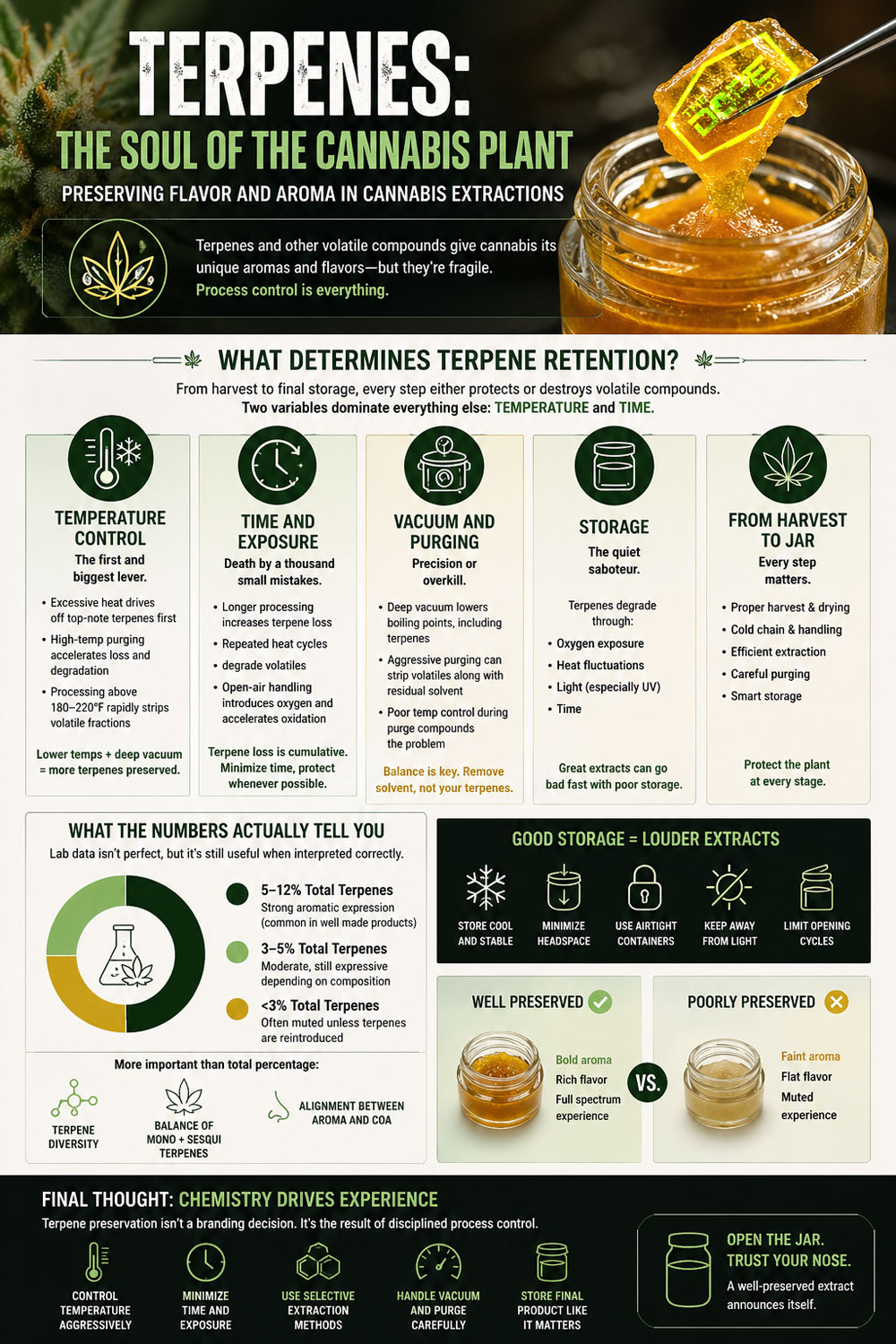
Terpene preservation isn’t luck. It’s process control. Every stage either protects volatile compounds or degrades them.
From harvest to final storage, two variables dominate everything else: temperature and time.
Other variables matter, but they all operate through those two levers.
Temperature Control: The First and Biggest Lever
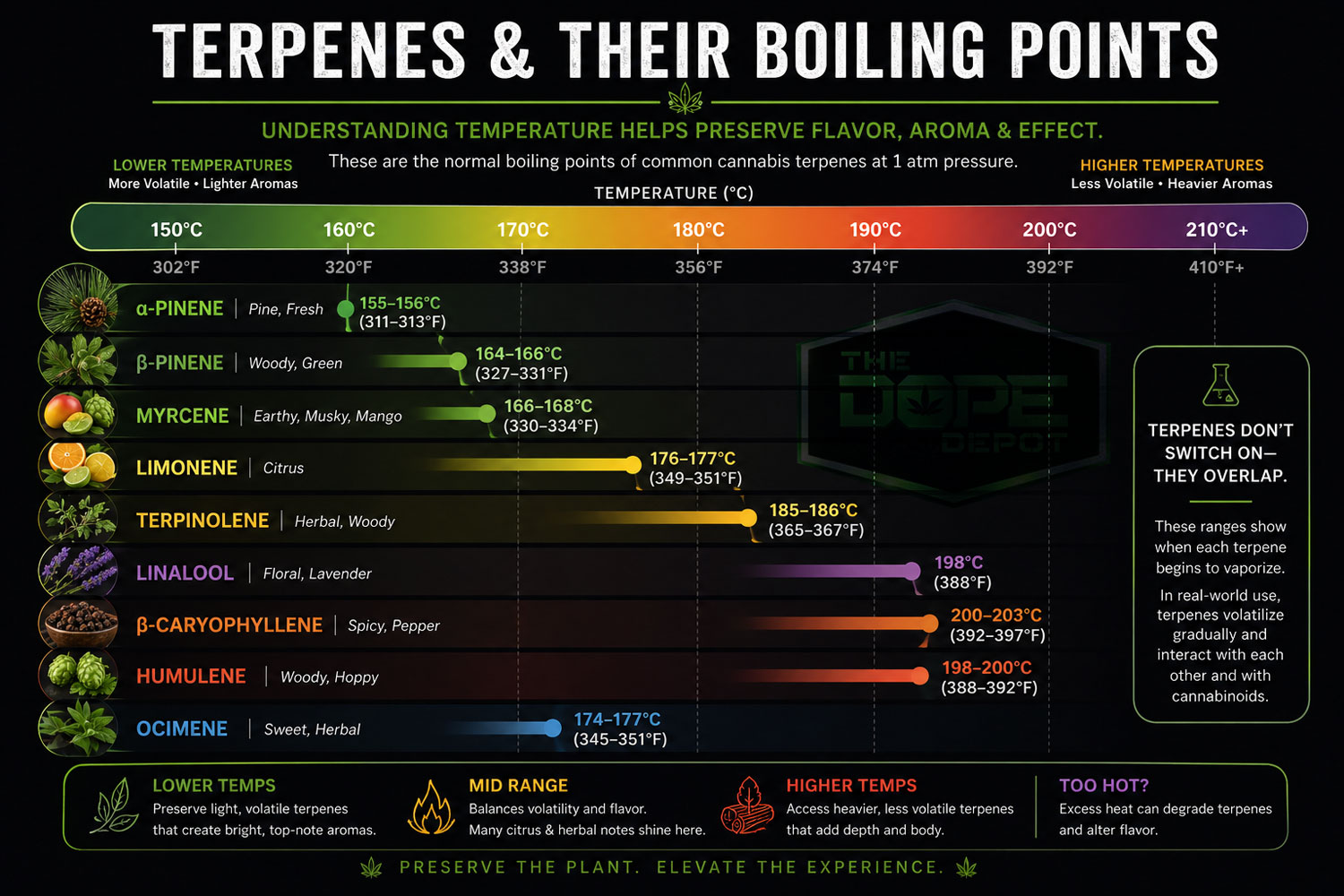
Terpenes are volatile by definition. Many monoterpenes begin evaporating at relatively low temperatures, well before cannabinoids are affected.
- Excessive heat during extraction drives off top-note terpenes first
- High-temperature purging accelerates loss and chemical degradation
- Processing above roughly 180 – 220°F rapidly strips volatile fractions
Vacuum systems allow operators to lower boiling points and purge at reduced temperatures, which is why they are critical in hydrocarbon extraction workflows.
Low-temperature processes consistently produce louder, more expressive extracts. Heat doesn’t just remove terpenes. It reshapes the profile into something flatter and less defined.
Time and Exposure: Death by Accumulation
Even with good temperature control, time works against you.
- Longer processing windows increase terpene loss
- Repeated heat cycles degrade volatile compounds
- Open-air handling introduces oxygen and accelerates oxidation
Terpene loss is cumulative. No single step ruins the extract. A series of small inefficiencies will.
Vacuum and Purging: Precision or Overkill
Vacuum is essential, but it’s easy to misuse.
- Deep vacuum lowers boiling points, including those of terpenes
- Aggressive purging can strip desirable volatiles along with residual solvent
- Poor temperature control during purge compounds the problem
Effective purging is about balance. Remove solvents without unnecessarily sacrificing volatile compounds.
Storage: The Quiet Saboteur
You can execute everything correctly and still degrade the final product through poor storage.
Terpenes degrade through:
- Oxygen exposure
- Heat fluctuations
- Light, especially UV
- Time
Best practices are simple and frequently ignored:
- Store cool and stable
- Minimize headspace
- Use airtight containers
- Avoid repeated opening cycles
A well-made extract can lose its edge quickly if storage is sloppy.
What the Numbers Actually Tell You
Lab data isn’t perfect, but it’s still useful when interpreted correctly. Since we’re operating in the Oregon market, that’s what data we’ll focus on.
- 5–12% total terpenes = strong aromatic expression
- 3–5% = moderate, still expressive depending on composition
- <3% = often muted unless terpenes are reintroduced
More important than total percentage:
- Terpene diversity
- Balance between monoterpenes and sesquiterpenes
- Alignment between aroma and COA
If a product tests high in terpenes but smells weak, something failed between production, packaging, and storage.
Final Thoughts: Chemistry Drives Experience
Terpene preservation is not a branding decision. It’s the result of disciplined process control.
If you want extracts that actually smell and taste like the plant they came from:
- Control temperature aggressively
- Minimize time and exposure
- Use selective extraction methods
- Handle vacuum and purge conditions carefully
- Store the final product like it matters
None of this is theoretical. It shows up immediately when you open the jar. A well-preserved extract announces itself before you even take a dab. A poorly preserved one needs excuses.