
The posts in this series are a pretty healthy read, so for those of you who lack the curiosity or the attention span, scroll to the end and find the TL;DR, or CLICK HERE!! Otherwise, put on your thinking caps and lets get moving!
If you don’t feel like reading, you can listen to Finn read the post to you. Download the mp3 here.
- Click here to skip to the top 5 Red Eye dab alpha-humulene heavy hitters.
- Click here to skip to the top 5 Gem Cart / Pocket Puffer alpha-humulene heavy hitters.
The Dry, Hoppy Counterweight in Cannabis
Alpha-humulene may be one of the easiest major cannabis terpenes to overlook. Limonene announces itself with citrus. Myrcene brings fruit, earth, and musk. Beta-caryophyllene arrives carrying a pepper grinder. Alpha-humulene usually works more quietly, adding dry herbs, wood, earth, hops, and bitterness behind louder compounds.
It rarely gets to be the star.
It’s more like the person in the studio who removes everything unnecessary from the mix. Alpha-humulene can make a terpene profile feel drier, more structured, more herbal, and less sugary. When paired with beta-caryophyllene, as it frequently is, the two create much of the peppery, woody backbone found in cannabis extracts.
It has also acquired several health and effect claims, including the persistent idea that humulene suppresses appetite. As usual, the chemistry is interesting.
What Is Alpha-Humulene?
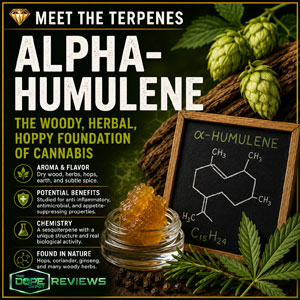
Alpha-humulene is a monocyclic sesquiterpene with the molecular formula C15H24. It’s found in cannabis, hops, basil, sage, coriander, black pepper, balsam fir, and numerous other aromatic plants.
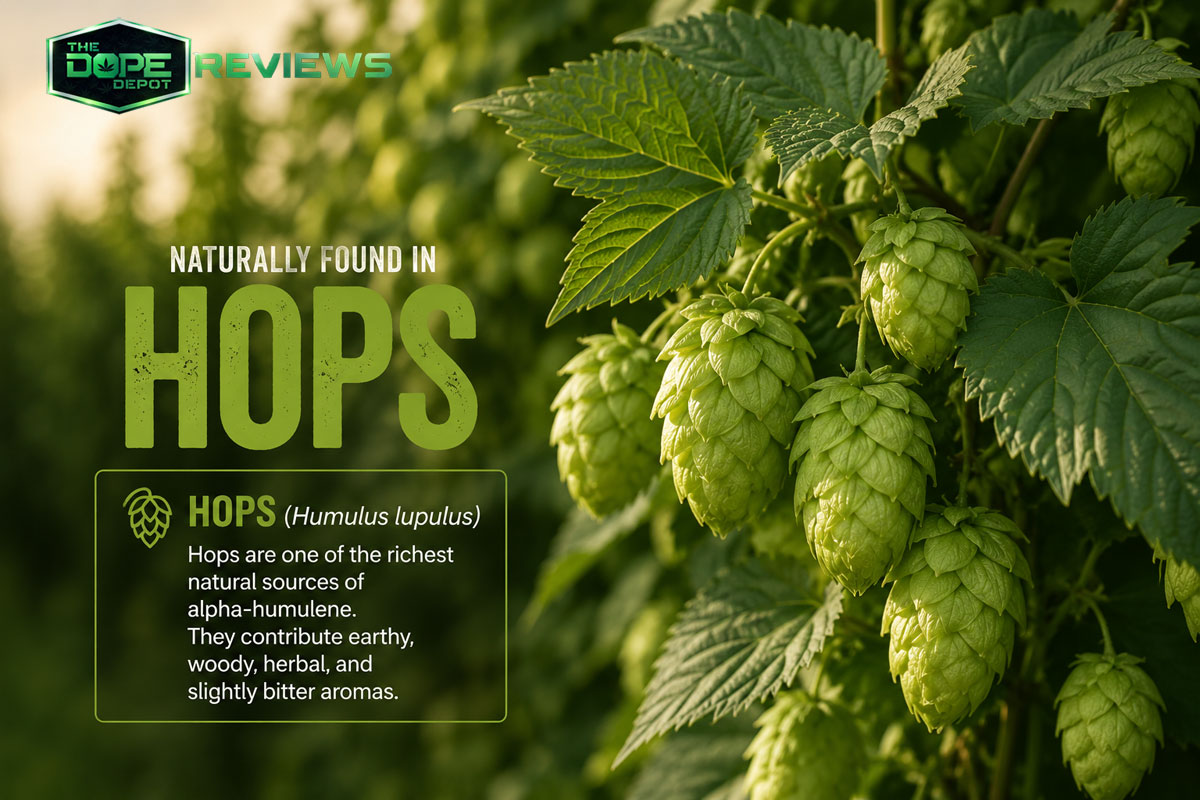
The name comes from Humulus lupulus, the hop plant used in brewing beer. Hops can contain substantial amounts of alpha-humulene, which is why the terpene is strongly associated with hoppy, woody, herbal aromas.
Alpha-humulene is also called alpha-caryophyllene. That alternate name creates understandable confusion because beta-caryophyllene is another major cannabis terpene. Alpha-humulene and beta-caryophyllene share the same molecular formula, but their atoms are arranged into different structures.
They are close chemical relatives, not two names for the same molecule. Beta-caryophyllene has a more complex bicyclic structure and is strongly associated with cracked pepper and spice. Alpha-humulene has a large single-ring structure and often leans drier, woodier, more herbal, and more bitter.
What Does Alpha-Humulene Smell and Taste Like?
Alpha-humulene is commonly associated with:
- Hops
- Dry herbs
- Wood
- Earth
- Balsam
- Black pepper
- Mild spice
- Green vegetation
- Bitter plant material
- Light tobacco
- Resin
It generally acts as a low or middle aromatic note rather than a bright top note. That means it may not jump out when a jar is first opened. Limonene, pinene, terpinolene, or ocimene may reach the nose first. Humulene becomes more noticeable underneath them, especially through the middle and finish of the flavor.
At higher concentrations, it can give an extract a distinctly dry or woody quality. It can also reduce the impression of sweetness created by fruity and floral compounds. This does not mean alpha-humulene literally removes sugar or sweet molecules.
It changes the sensory balance by contributing bitter, herbal, woody, and resinous notes. The palate interprets the complete mixture, not just a single spreadsheet column.
A Heavier Sesquiterpene
Like beta-caryophyllene, alpha-humulene is a sesquiterpene.
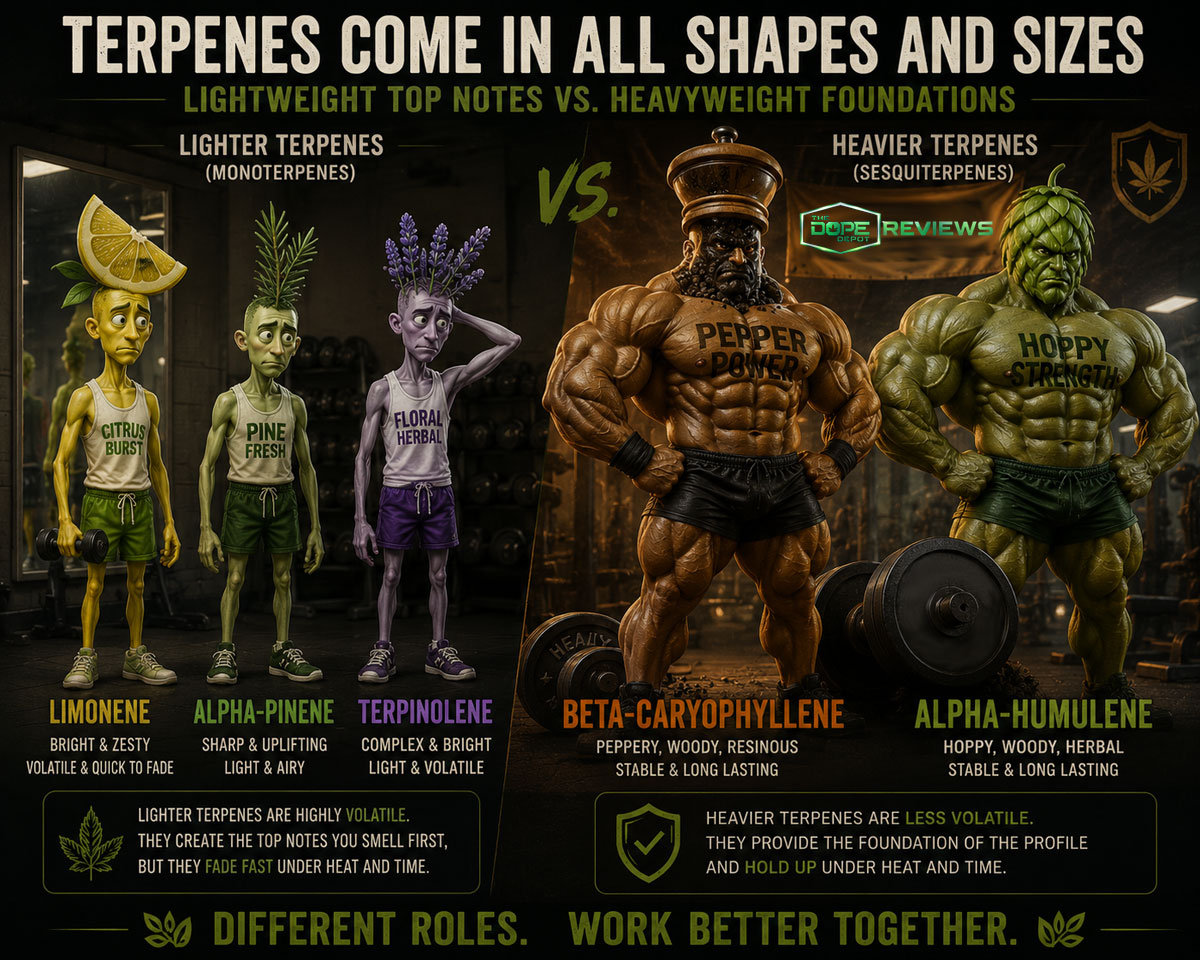
Sesquiterpenes contain fifteen carbon atoms, compared with the ten found in monoterpenes such as limonene, myrcene, pinene, and terpinolene.
Their larger molecular structures generally make sesquiterpenes less volatile than monoterpenes. This means alpha-humulene is less likely to evaporate as quickly as many of the bright, light compounds that define the top of a cannabis profile.
That relative stability helps it survive:
- Drying and curing
- Hydrocarbon extraction
- Vacuum purging
- Decarboxylation
- Cartridge production
- Ordinary storage
“Relatively stable” doesn’t mean immune to damage. Heat, oxygen, light, and time can still change alpha-humulene. Oxidation can produce oxygenated compounds, including humulene epoxides, altering both the chemistry and aroma. The heavier structure simply gives it a better chance of surviving processing than many smaller monoterpenes.
Less fragile is not the same as indestructible. Molecules, like humans and lab rats, eventually fall apart. The molecules are just quieter about it.
Why Alpha-Humulene and Beta-Caryophyllene Travel Together
One pattern becomes obvious after looking through enough PhytoFact sheets: alpha-humulene and beta-caryophyllene appear together constantly. Coincidence? Probably not.
Both are sesquiterpenes produced from the same basic plant precursor, farnesyl diphosphate. Some terpene-producing enzymes can generate both compounds, although usually in different proportions.
In cannabis, beta-caryophyllene is commonly produced at a much higher concentration than alpha-humulene. That relationship appears throughout our data sheets.
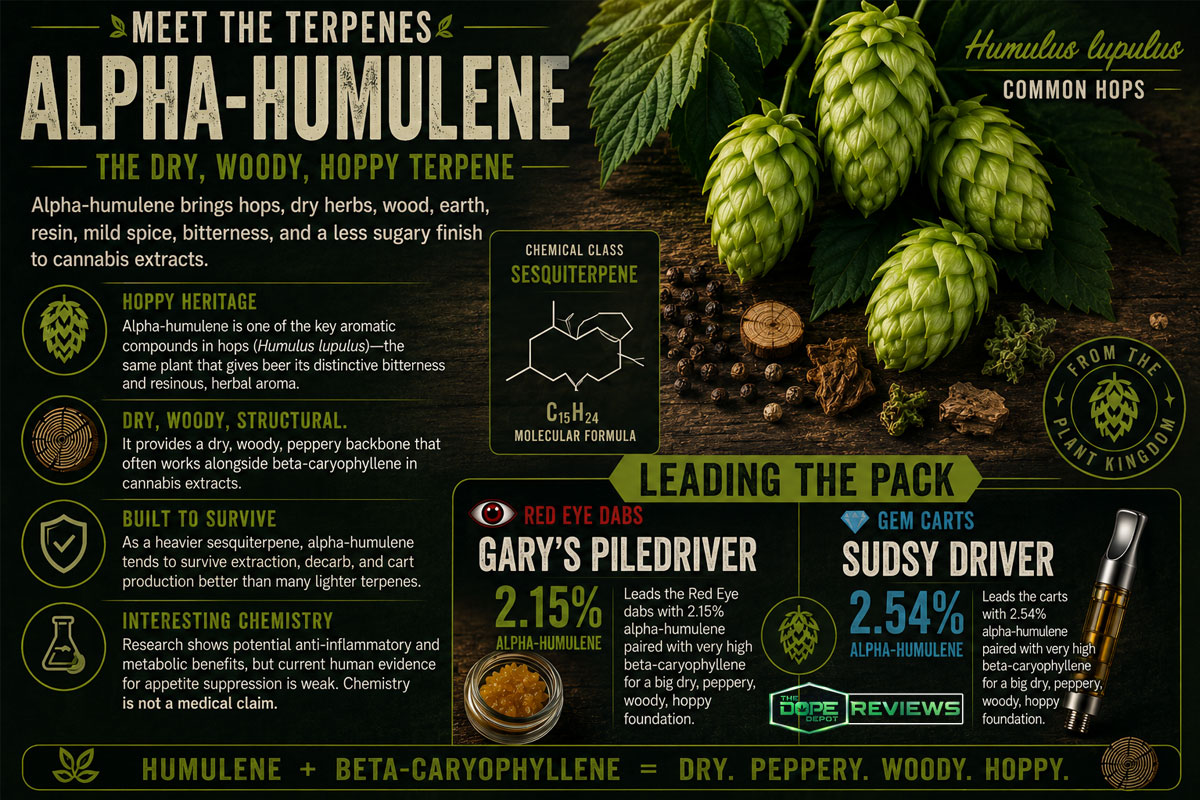
Gary’s Piledriver contains 2.15% alpha-humulene and 5.01% beta-caryophyllene. Sudsy Driver carries 2.54% alpha-humulene and 5.32% beta-caryophyllene. Tahoe Ghost contains 1.93% alpha-humulene alongside 4.85% beta-caryophyllene. They function like related parts of the same structural system.
Beta-caryophyllene brings pepper, spice, wood, and resin. Alpha-humulene reinforces the wood and herbs while adding dryness, bitterness, and a hoppy edge. They overlap, but they aren’t redundant.
Think of beta-caryophyllene as cracked black pepper and alpha-humulene as a dry bundle of hops and herbs sitting beside it. Together, they create a profile that feels sturdier and less sweet.
Does Alpha-Humulene Suppress Appetite?
Alpha-humulene is regularly described as an appetite suppressant.
The claim appears on dispensary menus, terpene charts, blogs, packaging, and social media posts. It is often presented as a defining effect that separates humulene from appetite-stimulating THC. The problem is that convincing human evidence for this claim is missing.
There are studies examining essential oils, aromatic compounds, inflammation, metabolism, and appetite-related biological pathways. That does not establish that inhaling a cannabis product containing 1% or 2% alpha-humulene will noticeably reduce hunger.
There are no strong controlled human trials showing that humulene-rich cannabis reliably suppresses appetite. Not yet at least. Even if isolated alpha-humulene eventually demonstrates a meaningful effect on appetite at a particular dose, that still wouldn’t prove that an ordinary dab or cartridge delivers enough of the compound to reproduce it.
Route of administration matters. Dose matters. Bioavailability matters. The remaining cannabinoids and terpenes matter. THC also has well-established appetite-stimulating effects in many users. Assuming a smaller concentration of humulene automatically cancels that effect is a considerable leap.
A product high in alpha-humulene may leave someone less interested in snacks. Another person may empty the pantry while insisting they’re only looking for something small.
What Does the Research Say?
Alpha-humulene has been studied for potential anti-inflammatory, antimicrobial, gastrointestinal, anticancer, analgesic, and metabolic activity. Most of the evidence is preclinical.
A frequently cited study tested alpha-humulene and beta-caryophyllene in several mouse and rat models of inflammation. Both compounds reduced some inflammatory responses, while alpha-humulene affected certain markers more broadly than caryophyllene under the study conditions.
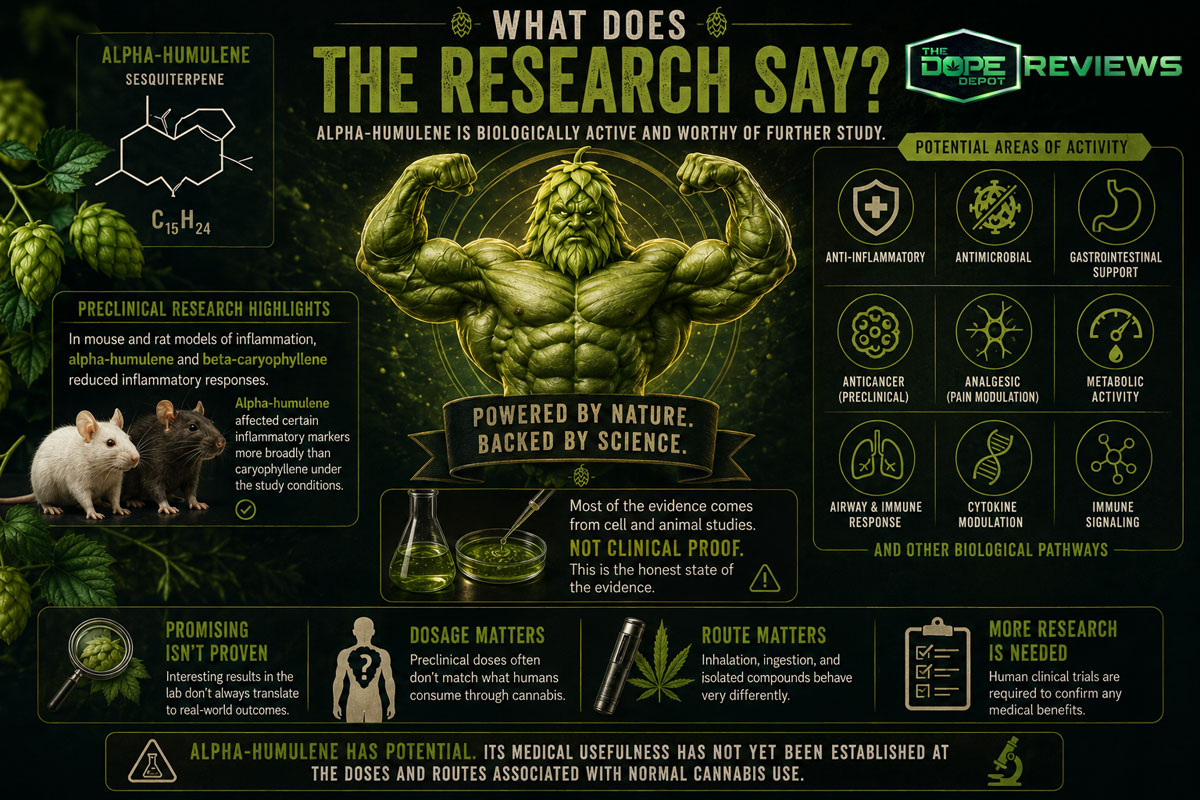
Other animal and cell studies have explored alpha-humulene’s possible effects on airway inflammation, cytokine release, immune signaling, and several other biological pathways. Those are meaningful findings. They are not clinical proof that humulene-rich cannabis treats inflammation in humans. That is the honest state of the evidence.
Alpha-humulene is biologically active and worthy of further study. Its potential medical usefulness has not yet been established at the doses and routes associated with normal cannabis use. “Promising research” and “this dab treats disease” are not the same.
Does Alpha-Humulene Determine the High?
Humulene-rich products are sometimes described as calming, clear-headed, grounding, focusing, or less appetite-stimulating. Those descriptions may match individual experiences, but they aren’t reliable predictions.
Alpha-humulene doesn’t act in isolation. Its effects, assuming it contributes perceptibly at a given dose, occur alongside:
- Major and Minor Cannabinoids
- Beta-caryophyllene
- Limonene
- Myrcene
- Linalool
- Other terpenes
- Unmeasured volatile compounds
- Individual metabolism and Endocannabinoid System
- Tolerance
- Whether or not Uranus is in retrograde
Our current humulene-heavy products include indicas, sativas, and hybrids. On our Red Eye dab menu you’ll find Gary’s Piledriver and Category 5 Jellykinz are hybrids. Tahoe Ghost, Papaya Cake, and Tiger Moves are indicas. In our one gram Gem Cart and two gram Pocket Puffer line, Sudsy Driver and Truffle Driver are sativas. Night Ryze and Gooey Oregon Diesel are indicas.
Reading Alpha-Humulene on a Lab Sheet
Alpha-humulene is usually not the dominant terpene in cannabis. It’s more commonly the second, third, or fourth most abundant compound, particularly in profiles led by beta-caryophyllene. That doesn’t make it unimportant.
A product containing 1.5% alpha-humulene may carry a strong dry, woody, herbal structure even when beta-caryophyllene is present at three, four, or five percent.
When reading the panel, look at:
- The alpha-humulene concentration
- Its percentage of the total terpene profile
- The beta-caryophyllene concentration
- The major monoterpenes surrounding the pair
Limonene can brighten a caryophyllene-humulene profile. Myrcene can make it heavier and earthier. Linalool can soften it. Pinene can sharpen the herbal and woody character. Terpinolene can introduce sweetness and fresh aromatic lift.
For this series, we went back a year or so and selected the five strongest alpha-humulene containing extracts from the Red Eye dab sheet and five from the Gem Cart and Pocket Puffer sheet. You can find these sheets on The Sheets page if you would like to check out the data for yourself.
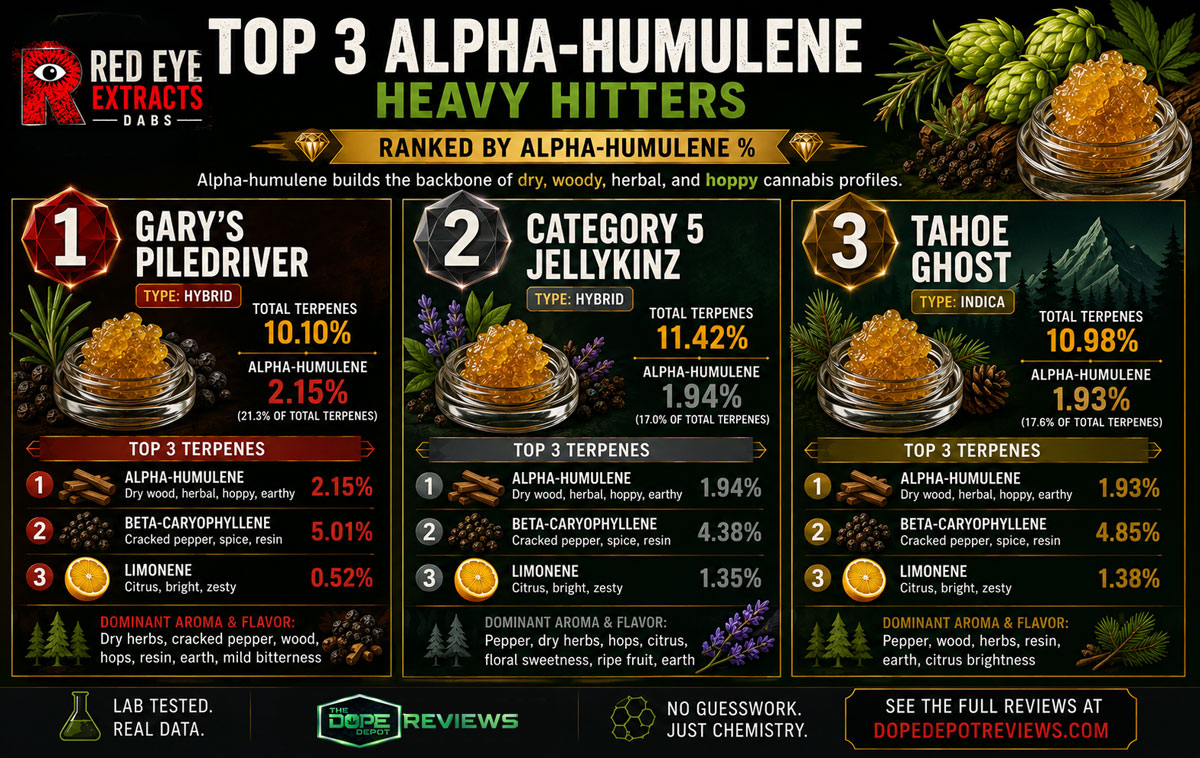
Five Red Eye Dab Alpha-Humulene Heavy Hitters
1. Gary’s Piledriver
Type: Hybrid
Total Terpenes: 10.10%
Alpha-Humulene: 2.15%
Gary’s Piledriver leads the current Red Eye Dab group with 2.15% alpha-humulene. That represents more than 21% of the complete measured terpene profile.
Beta-caryophyllene dominates at 5.01%, giving the extract an enormous peppery, woody, resinous foundation. Limonene sits at 0.52%, while myrcene and linalool appear in smaller amounts at 0.15% and 0.20%.
This is a highly focused sesquiterpene profile. Together, alpha-humulene and beta-caryophyllene account for more than 70% of the total measured terpene content.
Expect dry herbs, cracked pepper, wood, hops, resin, earth, and mild bitterness to do most of the heavy lifting. Gary’s Piledriver doesn’t use alpha-humulene as a seasoning. It uses it as structural lumber.
Check out the full review here.
2. Category 5 Jellykinz
Type: Hybrid
Total Terpenes: 11.42%
Alpha-Humulene: 1.94%
Category 5 Jellykinz comes in second with 1.94% alpha-humulene. That represents roughly 17% of its very large 11.42% total terpene profile.
Beta-caryophyllene leads at 4.38%, while limonene reaches 1.35%. Linalool is substantial at 0.75%, and myrcene follows at 0.71%. This is one of the broader Red Eye profiles in the alpha-humulene top five.
The humulene and caryophyllene provide dry herbs, wood, pepper, hops, and resin. Limonene brightens the profile with citrus, while linalool and myrcene add floral softness, ripe fruit, earth, and body.
Category 5 Jellykinz has enough alpha-humulene to keep the profile structured, but enough brighter and softer chemistry to keep it from becoming purely dry.
Check out the full review here.
3. Tahoe Ghost
Type: Indica
Total Terpenes: 10.98%
Alpha-Humulene: 1.93%
Tahoe Ghost lands just behind Category 5 Jellykinz with 1.93% alpha-humulene. That represents roughly 17.6% of the total measured terpene content.
Beta-caryophyllene reaches 4.85%, making the caryophyllene-humulene pairing responsible for more than 61% of the entire profile.
Limonene is also high at 1.38%, while linalool sits at 0.36% and myrcene at 0.30%. This should create a dense pepper, wood, herb, and resin foundation with enough citrus brightness to keep the profile from getting too dark.
Compared with Gary’s Piledriver, Tahoe Ghost carries more limonene and slightly less humulene, so the profile should feel brighter and more lifted around the edges. It’s still a big, dry, woody indica profile. It just remembered to open a window.
Check out the full review here.
4. Papaya Cake
Type: Indica
Total Terpenes: 11.63%
Alpha-Humulene: 1.69%
Papaya Cake contains 1.69% alpha-humulene inside the highest total terpene profile in the Red Eye top five. At 11.63% total terpenes, this extract is already chemically loud before we even get to the individual compounds.
Beta-caryophyllene dominates at 4.53%, creating a major peppery and woody foundation. Limonene follows at 1.34%, while myrcene reaches 0.66% and linalool contributes 0.52%.
Alpha-humulene should reinforce the dry, woody, herbal qualities of the beta-caryophyllene while counterbalancing some of the sweetness and brightness supplied by limonene, myrcene, and linalool.
Papaya Cake may carry a fruit-forward name, but its terpene structure contains a large amount of pepper, wood, herbs, and bitterness underneath. The cake apparently came from a bakery located beside a lumberyard and a hop farm.
Check out the full review here.
5. Tiger Moves
Type: Indica
Total Terpenes: 10.56%
Alpha-Humulene: 1.63%
Tiger Moves rounds out the current Red Eye top five with 1.63% alpha-humulene. Garlic Icing also lands at 1.63%, but Tiger Moves gets the feature here because it carries a higher total terpene content and a broader supporting profile.
Beta-caryophyllene leads at 4.26%, while limonene reaches 1.42%. Linalool is notable at 0.61%, and myrcene contributes 0.32%. This gives Tiger Moves a strong caryophyllene-humulene base with a brighter and softer upper layer than some of the more focused profiles above it.
Expect pepper, dry wood, hops, and herbs from the humulene and caryophyllene, with limonene adding citrus brightness and linalool smoothing the middle with floral sweetness. Tiger Moves is still built on dry, woody structure. It just moves with a little more citrus and flower around the edges.
Check out the full review here.
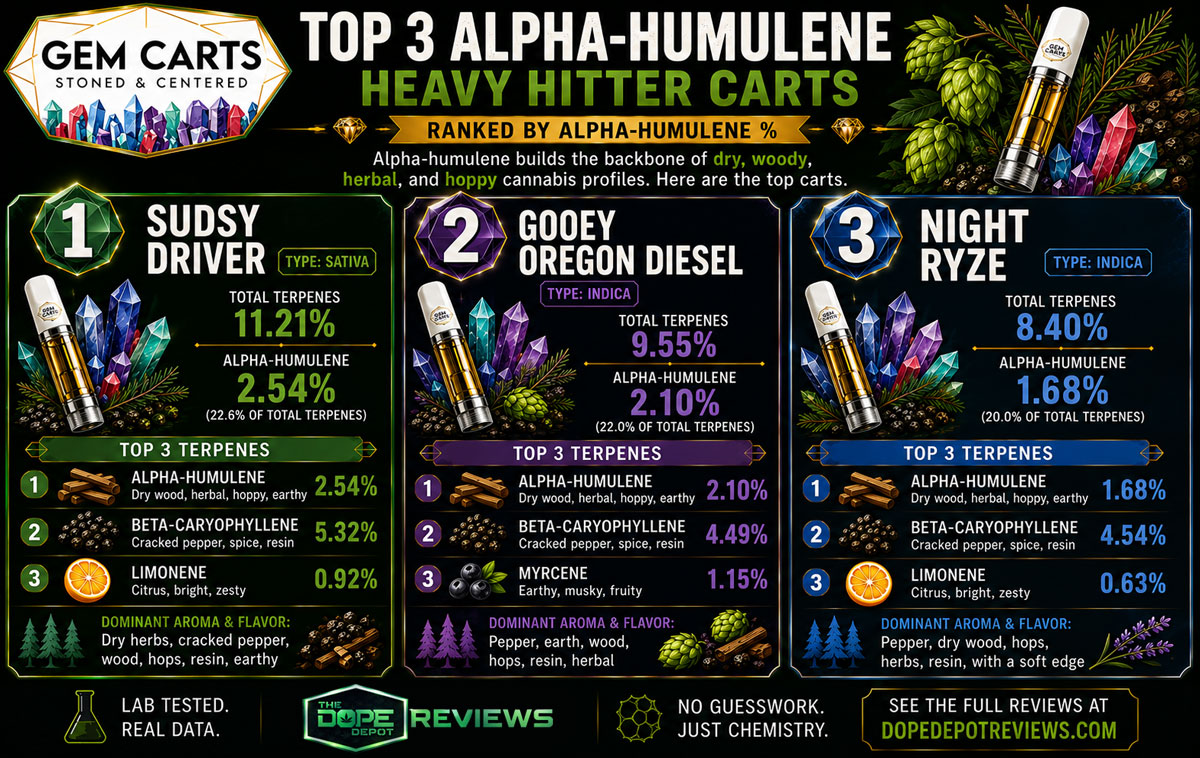
Five Alpha-Humulene Heavy Carts
1. Sudsy Driver
Type: Sativa
Total Terpenes: 11.21%
Alpha-Humulene: 2.54%
Sudsy Driver leads the current cart group with a massive 2.54% alpha-humulene. That is the strongest alpha-humulene result in either current category.
Beta-caryophyllene reaches 5.32%, which means the caryophyllene-humulene pairing accounts for more than 70% of the entire measured terpene profile. This is not a subtle structural contribution.
Limonene sits at 0.92%, myrcene at 0.52%, and linalool at 0.14%. The pinenes are present, but much smaller.
The profile should be intensely dry, woody, peppery, herbal, hoppy, and resinous. Sudsy Driver may be labeled sativa, but the terpene chemistry is dominated by heavy sesquiterpenes. The traditional category says daytime. The lab sheet says someone brought hops, pepper, and lumber.
Check out the full review here.
2. Gooey Oregon Diesel
Type: Indica
Total Terpenes: 9.55%
Alpha-Humulene: 2.10%
Gooey Oregon Diesel comes in second among carts with 2.10% alpha-humulene. Beta-caryophyllene leads at 4.49%, while myrcene reaches 1.15%. Limonene is much lower at 0.25%.
This is one of the heavier profiles in the cart top five. Alpha-humulene and beta-caryophyllene create a major base of dry herbs, wood, hops, pepper, resin, and bitterness. Myrcene adds earth, musk, fruit, and weight. With less limonene than most of the featured carts, this profile should lean less bright and more grounded.
The diesel character likely involves compounds beyond the standard terpene panel, but the measured chemistry gives us plenty to work with: pepper, earth, wood, resin, hops, and herbal density.
Check out the full review here.
3. Night Ryze
Type: Indica
Total Terpenes: 8.40%
Alpha-Humulene: 1.68%
Night Ryze carries 1.68% alpha-humulene within an 8.40% total terpene profile. That means alpha-humulene accounts for exactly 20% of the measured profile. Beta-caryophyllene dominates at 4.54%, making Night Ryze one of the most focused caryophyllene-humulene carts on the current sheet.
Limonene contributes 0.63%, linalool sits at 0.27%, and myrcene is relatively low at 0.10%. This is a very clear profile. Pepper, dry wood, hops, herbs, and resin should form the main structure. Limonene adds modest brightness, while linalool softens the edges slightly.
Night Ryze doesn’t need a huge total terpene number to make its point. When beta-caryophyllene and alpha-humulene together account for nearly three-quarters of the measured profile, the message isn’t exactly hidden in the footnotes.
Check out the full review here.
4. Truffle x Gooey Oregon Diesel
Type: Hybrid
Total Terpenes: 7.78%
Alpha-Humulene: 1.64%
Truffle x Gooey Oregon Diesel contains 1.64% alpha-humulene, representing about 21% of the total terpene profile. That makes it one of the most proportionally humulene-heavy products in this article.
Beta-caryophyllene leads at 3.55%, followed by myrcene at 0.50% and limonene at 0.33%. Alpha-terpineol is also notable at 0.21%, with smaller amounts of pinene, linalool, ocimene, and fenchol filling out the background.
This should be a dry, woody, peppery, earthy profile with a softer, slightly floral or woody layer from alpha-terpineol and linalool. Compared with Pineapple OG or Tahoe Ghost, this cart has less citrus brightness and more emphasis on the humulene-caryophyllene structure. The result should be dense, herbal, and resinous. Basically a terpene profile wearing work boots.
Check out the full review here.
5. Pineapple OG
Type: Hybrid
Total Terpenes: 11.77%
Alpha-Humulene: 1.60%
Pineapple OG rounds out the current cart top five with 1.60% alpha-humulene. That represents roughly 14% of its very large 11.77% total terpene profile. Beta-caryophyllene reaches 3.39%, limonene comes in at 2.19%, and myrcene contributes 1.78%. Beta-ocimene reaches 0.52%, with alpha-pinene at 0.46%. This is easily one of the broadest profiles in the group.
Alpha-humulene and beta-caryophyllene provide dry wood, herbs, pepper, and resin. Limonene adds strong citrus brightness. Myrcene brings ripe fruit, earth, and weight, while ocimene and pinene give the upper end additional freshness.
Because humulene represents a smaller proportion of this unusually dense profile, it’s less likely to dominate the flavor. Its job is structural. It keeps the fruit and citrus from turning the entire session into a tropical air freshener.
Check out the full review here.
What These Ten Dope Depot Products Show Us
The data sheet makes the humulene story sharper and more useful. First, alpha-humulene is almost always traveling with beta-caryophyllene. Every product featured here contains substantially more beta-caryophyllene than alpha-humulene. In most cases, beta-caryophyllene is more than twice as abundant.
This pairing creates a recurring sensory foundation:
- Pepper
- Dry herbs
- Wood
- Earth
- Resin
- Mild bitterness
- Hops
- Warm spice
Beta-caryophyllene brings pepper, spice, wood, and resin. Alpha-humulene reinforces the wood, herbs, hops, dryness, and bitter edge. They are not the same molecule, but they clearly enjoy showing up to the same party.
Second, the strongest alpha-humulene products in the current master list are not delicate.
Gary’s Piledriver, Sudsy Driver, Tahoe Ghost, Gooey Oregon Diesel, and Category 5 Jellykinz all combine high alpha-humulene with very high beta-caryophyllene. These are not profiles where humulene is merely sprinkling a little hop character over the top. It’s helping define the structure.
Third, the surrounding terpenes decide how dry or heavy that structure feels. Category 5 Jellykinz, Tahoe Ghost, Papaya Cake, Tiger Moves, and Pineapple OG contain more limonene, linalool, or myrcene, giving them more brightness, fruit, earth, and floral softness.
Gary’s Piledriver, Sudsy Driver, Night Ryze, and Truffle x Gooey Oregon Diesel are more focused around the caryophyllene-humulene core, so the dry, woody, hoppy structure should feel more dominant.
Fourth, high alpha-humulene does not belong to one traditional cannabis category. The current list includes indicas, hybrids, and sativas. Sudsy Driver is labeled sativa and contains the highest alpha-humulene result in the entire article. Gary’s Piledriver is a hybrid. Tahoe Ghost and Night Ryze are indicas.
Once again, the lab sheet provides more useful chemical information than the three-category retail system the industry seems so intent on making gospel. The molecules remain uninterested in our belief systems.
The Lab Rat Verdict
Alpha-humulene is one of the main sources of dryness and herbal structure in cannabis. It contributes hops, wood, earth, resin, mild spice, bitterness, and green plant character. As a heavier sesquiterpene, it generally survives processing more readily than lighter monoterpenes. It also has a close chemical and biosynthetic relationship with beta-caryophyllene, explaining why the two appear together so consistently in cannabis extracts.
The research surrounding alpha-humulene is promising but overwhelmingly preclinical. Animal and cell studies justify continued investigation into inflammation and several other biological pathways. What they don’t do is prove that humulene-rich cannabis treats disease or suppresses appetite in humans.
On a lab sheet, alpha-humulene rarely tells the entire story. It tells you how dry, woody, herbal, and bitter the foundation may be. The rest of the profile decides whether that foundation supports fruit, citrus, flowers, gas, earth, or something far stranger. In our experience, cannabis likes to choose something stranger.
TL;DR
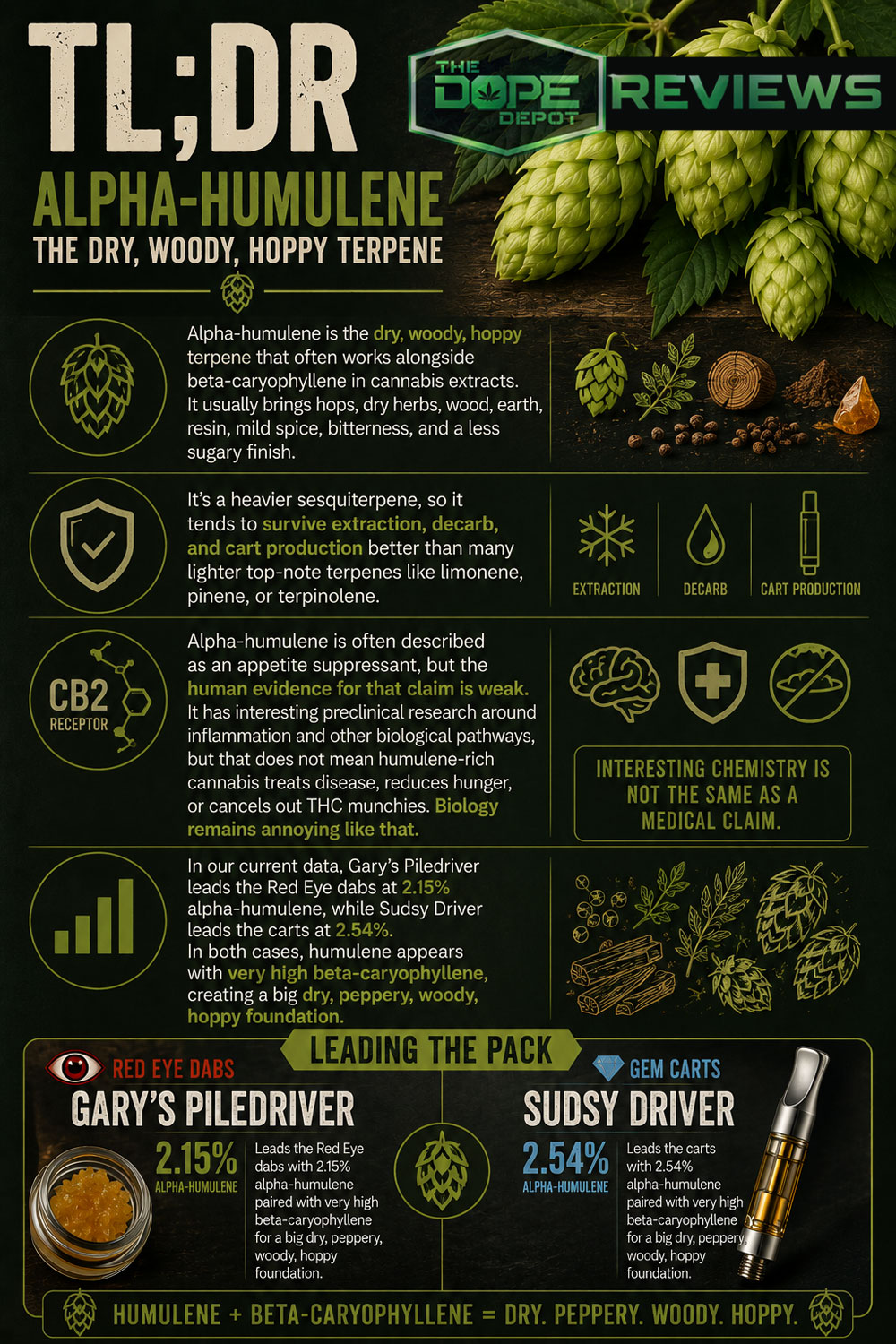
Alpha-humulene is the dry, woody, hoppy terpene that often works alongside beta-caryophyllene in cannabis extracts. It usually brings hops, dry herbs, wood, earth, resin, mild spice, bitterness, and a less sugary finish.
It’s a heavier sesquiterpene, so it tends to survive extraction, decarb, and cart production better than many lighter monoterpenes. That makes it one of the structural compounds we see holding up well across both Red Eye Dabs and carts.
Alpha-humulene is often described as an appetite suppressant, but the human evidence for that claim is weak. It has interesting preclinical research around inflammation and other biological pathways, but that does not mean humulene-rich cannabis treats disease, reduces hunger, or cancels out THC munchies. Biology remains annoying like that.
In our current data, Gary’s Piledriver leads the Red Eye dabs at 2.15% alpha-humulene, while Sudsy Driver leads the carts at 2.54%. In both cases, humulene appears with very high beta-caryophyllene, creating a big dry, peppery, woody, hoppy foundation.
The short squirrel version:
Alpha-humulene gives cannabis structure, dryness, and herbal depth. It usually doesn’t run the whole profile by itself, but when it’s high, it helps make the extract feel woodier, drier, less sweet, and more grounded.