
Podcast: Play in new window | Download (Duration: 22:30 — 16.0MB)
What Decarboxylation Actually Does to Cannabis Extract
This post is a fairly healthy read, so for those of you who lack the curiosity or the attention span, scroll to the end and find the TL;DR, or CLICK HERE!! Otherwise, put on your thinking caps and lets get going!
If you don’t feel like reading, you can listen to Finn read the post to you. Download the mp3 here or tap the play button above.

Here at The Dope Depot, a dab and a cart tend to start with the same extract, depending on the blends we’re making on any given week.
They cannot stay the exact same extract. That’s because the resin we put into a cart needs to go through one very important step first. Decarboxylation.
If you’ve spent enough time around cannabis, you’ve probably heard the word decarboxylation, or decarb for short, thrown around. Maybe you know it has something to do with heat. Maybe somebody told you it “activates the THC.” Maybe you nodded politely while quietly hoping nobody asked a follow-up question.
Fair enough.
Decarboxylation sounds significantly more intimidating than what is actually happening. At its simplest, we’re using controlled heat under vacuum to convert acidic cannabinoids like THCA into their neutral forms like THC.
But because we make both dabbable BHO for our Red Eye line, and decarbed resin for our Gem Carts and Pocket Puffers, we can do something a little more useful than simply explain the textbook chemistry.
We can look at the same extracts before and after decarboxylation.
For this little Lab Rat experiment, we’re comparing five matched batches tested by SC Labs:
- Grape Rozay
- Rumple Beans Fresh Frozen
- Mango Sapphire
- Blue Honey Cakes
- Big Tina
Same extract profiles, same lab, two different stages of the process. Let’s see what actually happened.
Why Does Cart Oil Need to Be Decarboxylated?
Most fresh cannabis resin contains a lot more THCA than THC.
THCA stands for tetrahydrocannabinolic acid. It’s the acidic precursor to THC that the plant naturally produces. Heat changes that. When THCA is decarboxylated, it loses a carboxyl group and releases carbon dioxide, or CO₂. What’s left is neutral THC.
In extremely simplified lab-rat notation:
THCA → THC + CO₂
That happens whenever you smoke weed, or take a dab, or decarb flower for use in making edibles. When we’re preparing cannabis extract for a cart, we do that conversion before the oil ever enters the filling machine or the cart hardware.
That’s why if you look at the PhytoFact sheets for our Gem Carts vs our Red Eye dabs, you’ll notice the dabs always have THCA showing up, and the carts always have THC.
Why?
Because leaving large amounts of THCA in extract that’s going into a cart creates several problems. Anyone who has accidentally sent non decarbed crude through a short path or a wiper will know that pain all too well.
Besides meeting the muffin man and making a mess in machines that aren’t made to deal with THCA, THCA can also readily form crystals, which is the last thing you want happening inside a cart designed for something a bit less viscous than rock candy. We also don’t want the bulk of the decarboxylation reaction happening inside the cart filler. Ask me how I know that makes a big mess…
The cart needs stable, usable oil, so the extract gets decarbed first.
Decarboxylation Also Changes the Weight
Here’s where things become important for understanding the lab tests we’re about to look at. When THCA becomes THC, some of the original molecular mass leaves as CO₂. That means the finished decarbed batch weighs less than the material we started with.
This is worth noting because laboratory results are generally reported as a percentage of the sample by weight. Let’s say we have some imaginary extract containing a certain amount of myrcene.
After decarb, maybe we still have roughly the same amount of myrcene. But the entire batch now weighs less because CO₂ and some volatile compounds have left during processing.
That surviving myrcene can therefore represent a larger percentage of the finished sample, even though nobody magically created additional myrcene inside the reactor.
This is an important distinction:
A higher terpene percentage after decarb does not necessarily mean more terpenes were created or even that absolutely none were lost. It means the terpene represents a different percentage of the final sample.
To calculate perfect absolute retention, we’d need the starting mass, ending mass, and representative analytical results for each batch. That’s useful if you’re writing a process-validation report. For what we’re doing here, it’s mostly an excellent way to make a cannabis blog substantially less enjoyable.
Instead, we’re interested in the bigger picture. How much does the chemistry change, and does the original terpene architecture survive the trip? Turns out, it often survives remarkably well.
Five Extracts, Before and After Decarb
Here are our five matched examples.
| Extract | Dab Terpenes | Decarb Terpenes | Main Acidic Cannabinoid Before | Main Neutral Cannabinoid After |
| Grape Rozay | 9.91% | 9.54% | THCA 73.3% | THC 73.7% |
| Rumple Beans FF | 9.15% | 10.54% | THCA 82.6% | THC 75.6% |
| Mango Sapphire | 9.08% | 8.36% | THCA 75.5% | THC 78.2% |
| Blue Honey Cakes | 7.82% | 8.44% | THCA 69.6% | THC 69.4% |
| Big Tina | 5.51% | 5.46% | THCA 79.0% | THC 82.0% |
Immediately, one thing should stand out. The terpene number doesn’t always go down.
Some decrease. Some barely move. Some actually increase as a percentage of the finished sample. Welcome back to chemistry, where simple rules are apparently considered poor manners.
Grape Rozay: Almost Ridiculously Stable
Let’s start with Grape Rozay because this pair might be the cleanest demonstration of what careful decarboxylation can look like. Check out the full Red Eye review here, and the Gem Cart review here.
The original dabbable Grape Rozay tested at:
79.89% cannabinoids
9.91% terpenes
The cannabinoid profile was dominated by:
THCA: 73.3%
THC: 3.7%
After decarboxylation:
76.86% cannabinoids
9.54% terpenes
And now the cannabinoid profile is dominated by:
THC: 73.7%
That alone gives us a beautiful before-and-after picture. The acidic cannabinoid disappears from the main profile and THC becomes overwhelmingly dominant. But look at the terpenes.
Beta-caryophyllene:
5.42% → 5.20%
Alpha-humulene:
1.84% → 1.79%
Limonene:
0.66% → 0.63%
Linalool actually moves slightly upward:
0.23% → 0.29%
Total terpenes only move from 9.91% to 9.54%.
The cannabinoid chemistry changed dramatically. The basic terpene architecture barely blinked. I think that’s pretty cool.
Rumple Beans FF: Wait, Why Did the Terpenes Go Up?
Rumple Beans Fresh Frozen gives us the opposite-looking result. Check out the Red Eye dab review here, and the Gem Cart review here.
The dab starts at:
86.62% cannabinoids
9.15% terpenes
Its cannabinoid profile is dominated by:
THCA: 82.6%
After decarb:
79.2% cannabinoids
10.54% terpenes
With:
THC: 75.6%
So apparently we heated the extract and somehow got more terpenes.
Not exactly.
Remember what we’re measuring. Percentages.
Myrcene goes from:
4.02% → 4.88%
Limonene:
0.88% → 1.03%
Alpha-pinene:
0.66% → 1.05%
Beta-caryophyllene stays almost unchanged:
1.58% → 1.55%
Alpha-humulene:
0.45% → 0.46%
The profile is still unmistakably Rumple Beans. Myrcene remains massively dominant. Limonene and pinene continue providing the brighter aromatic structure around it. Caryophyllene and humulene remain underneath.
The percentages changed, but the relationship between the major compounds survived, and because the batch loses mass while THCA releases CO₂ during decarboxylation, surviving volatile compounds can occupy a larger percentage of what’s left.
This is exactly why you shouldn’t look at 9.15% before and 10.54% after and conclude that the reactor somehow synthesized 1.39% additional terpenes.
The numbers need context.
Mango Sapphire: A More Traditional Decline
Mango Sapphire behaves more like most people would probably expect. Check out the Red Eye dab review here, and the Gem Cart review here.
Before decarb:
79.91% cannabinoids
9.08% terpenes
With:
THCA: 75.5%
After decarb:
81.5% cannabinoids
8.36% terpenes
With:
THC: 78.2%
So total terpenes decline moderately. But look closer.
Limonene:
2.33% → 2.31%
Basically unchanged.
Beta-caryophyllene:
2.44% → 2.15%
Myrcene:
0.99% → 0.92%
Alpha-humulene:
0.82% → 0.75%
Linalool:
0.52% → 0.49%
Terpinolene:
0.23% → 0.21%
The measured terpene percentage declines, but there isn’t a wholesale collapse of the profile. The same major compounds remain in essentially the same hierarchy.
If you looked at both PhytoFact sheets without seeing the product name, you’d have a pretty good chance of recognizing that they came from the same starting chemistry. That’s really what we care about.
Blue Honey Cakes: Another Percentage Increase
Blue Honey Cakes gives us another interesting example. Check out the Red Eye dab review here, and the Gem Cart review here.
The dab:
80.12% cannabinoids
7.82% terpenes
Main cannabinoids:
THCA: 69.6%
THC: 6.5%
After decarb:
73.49% cannabinoids
8.44% terpenes
With:
THC: 69.4%
Again, the total terpene percentage rises.
Beta-caryophyllene:
2.13% → 2.29%
Limonene:
1.11% → 1.22%
Linalool:
0.81% → 0.89%
Terpinolene:
0.50% → 0.58%
Myrcene:
0.56% → 0.58%
Alpha-humulene:
0.73% → 0.79%
Once again, this does not mean decarboxylation manufactured terpenes. It means we’re looking at concentrations within two differently weighted samples before and after a chemical reaction that literally releases mass from the system.
More importantly, the entire terpene profile remains recognizable. That’s the pattern beginning to emerge.
Big Tina: The Boring One We Actually Want
Big Tina may be the least dramatic comparison in this group, which is precisely why I like it. Check out the Red Eye dab review here, and the Gem Cart review here.
Before decarb:
87.17% cannabinoids
5.51% terpenes
With:
THCA: 79.0%
THC: 4.5%
After decarb:
85.31% cannabinoids
5.46% terpenes
With:
THC: 82.0%
Now look at the terpenes.
Beta-caryophyllene:
1.72% → 1.71%
Linalool:
0.60% → 0.60%
Limonene:
0.97% → 0.95%
Myrcene:
0.44% → 0.42%
Alpha-humulene actually moves from:
0.51% → 0.52%
Total terpenes?
5.51% → 5.46%
That’s about as uneventful as chemistry gets, and in extraction, uneventful can be beautiful. The whole point isn’t to make something exciting happen. It’s to accomplish the necessary cannabinoid conversion while preserving as much of the original aromatic character as practical.
Big Tina does a very nice job demonstrating that.
THCA Isn’t the Only Cannabinoid Getting Decarbed
There’s another detail hiding in these results that’s worth discussing. THCA isn’t the only acidic cannabinoid in cannabis. We also see compounds like:
CBGA
CBCA
THCVA
CBDA
These acidic cannabinoids can also lose their carboxyl groups during decarboxylation and become neutral cannabinoids. Rumple Beans gives us a particularly clean example.
Before decarb:
CBGA: 1.5%
CBCA: 1.2%
After decarb:
CBG: 1.6%
CBC: 1.3%
Grape Rozay shows similar chemistry. The dab contains:
CBGA: 1.1%
CBCA: 1.1%
The decarb contains:
CBG: 1.1%
CBC: 1.1%
Cannabis decarboxylation isn’t really a THCA-only process. THCA just gets all the attention because THC is the cannabinoid everybody recognizes. The other acidic cannabinoids are going through their own versions of the same basic transformation.
What About CBN?
A few of our finished decarbs also show small amounts of CBN.
Grape Rozay contains 0.3% CBN after decarb.
Rumple Beans contains 0.2%.
Blue Honey Cakes contains 0.4%.
Big Tina contains 0.2%.
CBN can form through oxidation and degradation of THC over time and under certain processing conditions. That doesn’t mean seeing a tiny amount of CBN automatically tells us an extract was overcooked.
Cannabis chemistry is not that considerate. The concentrations here are small, and there are multiple variables between plant, extraction, processing, storage, sampling, and testing.
The useful takeaway is simply that decarboxylation is not an isolated one-reaction universe. We’re applying heat to an extremely complicated chemical mixture. The primary goal may be converting acidic cannabinoids into neutral cannabinoids, but other chemistry can also happen along the way.
Doesn’t Heat Destroy Terpenes?
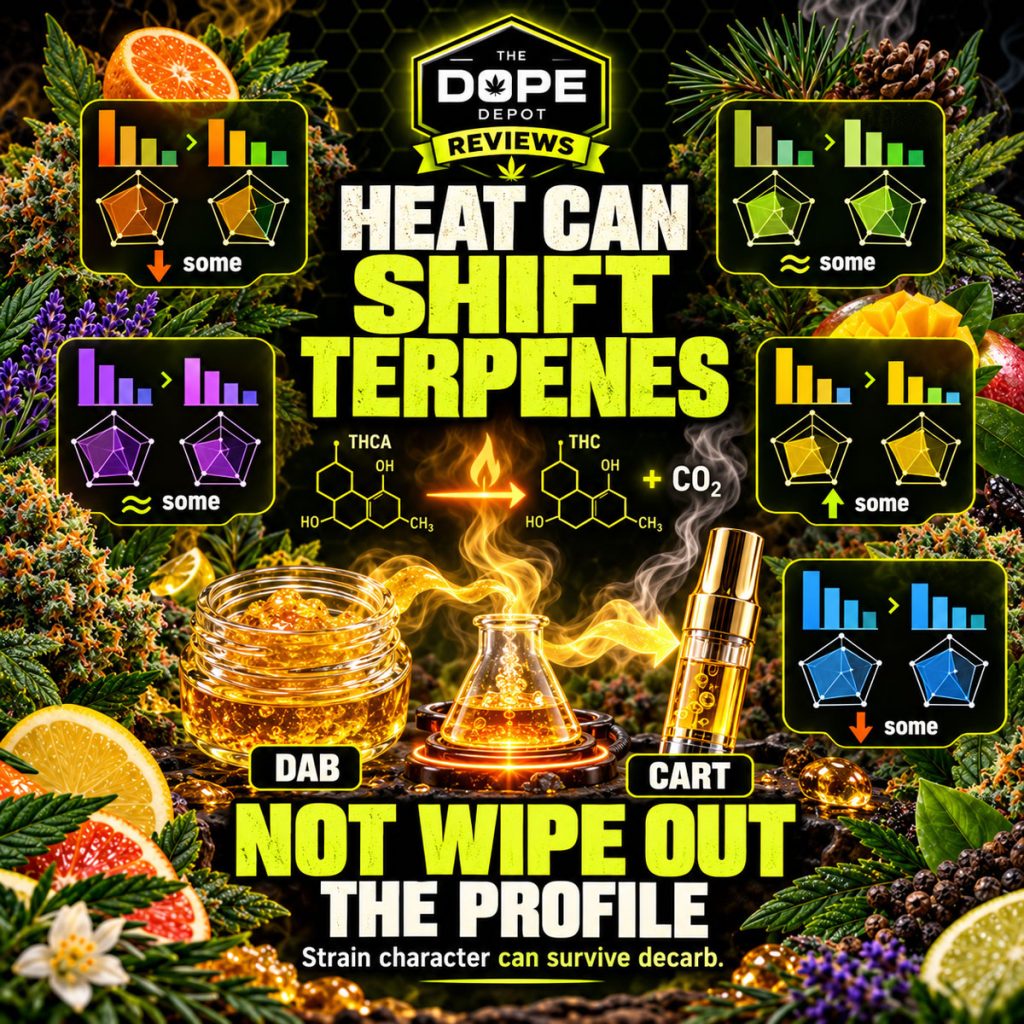
This is where the usual cannabis discussion gets oversimplified. Terpenes are volatile. Heat can absolutely cause terpene loss.
We’ve spent an unreasonable amount of time talking about that throughout our Meet the Terpenes series.
But saying “Heat can cause terpene loss” is not the same as saying:
“Decarboxylation destroys the terpene profile.”
Our own five examples make that pretty obvious. Some total terpene results decrease. Some stay almost identical. Some increase as a percentage of final mass. More importantly, the dominant terpene relationships remain strikingly recognizable across all five pairs.
Grape Rozay stays massively beta-caryophyllene dominant. Rumple Beans stays heavily myrcene dominant. Mango Sapphire keeps its caryophyllene-limonene structure.
Blue Honey Cakes retains its broad caryophyllene, limonene, linalool, humulene, terpinolene, and myrcene profile. Big Tina looks almost hilariously similar before and after.
That tells us something important. Decarboxylation doesn’t have to erase strain or blend expression. The process absolutely matters.
Percentages Aren’t Retention Numbers
This probably deserves its own section because it’s the easiest mistake to make when looking at these sheets. Suppose a terpene tests at 1.0% before decarb and 1.1% afterward.
You cannot automatically say:
“We retained 110%.”
Likewise, if it goes from 1.0% to 0.9%, you cannot confidently say:
“We retained exactly 90%.”
Not without knowing the starting and final weights. The denominator changed. That’s the boring mathematical part that becomes important when somebody starts trying to turn percentages into a process-efficiency score.
For consumers, though, I don’t think we need to make this harder than necessary. The useful question is:
Does the finished decarbed extract still resemble the original material chemically?
Across these five examples, the answer is very clearly yes.
What Good Decarboxylation Is Trying to Accomplish
The goal isn’t to simply “Make THC.”
If that were all we cared about, this would be a much easier job. We’re trying to convert acidic cannabinoids into a form suitable for cart hardware while preserving the parts of the original extract that made it worth putting into a cart in the first place.
That means we’re balancing several things at once. Convert the THCA. Remove the CO₂ generated by that reaction. Produce stable oil. Preserve volatile aromatic compounds. Avoid unnecessary oxidation or degradation.
Maintain as much of the original chemical fingerprint as practical. Cannabis extraction is mostly a long series of attempts to accomplish one necessary thing without ruining three other things. Decarboxylation fits nicely into that tradition.
Dab Versus Cart Isn’t Raw Versus Ruined
There’s a tendency in concentrate culture to treat every processing step as a purity test. More processing must mean worse. More heat must mean less flavor. A dab must therefore be inherently more “true to the plant” than the same extract in a cart.
There is a kernel of truth buried in that idea. Every additional processing step creates another opportunity for volatile chemistry to change. But reality is less cooperative than “more processing equals worse.”
A dabbable resin and its decarbed cart counterpart are different versions of the same extract. The dab keeps most of its cannabinoids in acidic form until the nail, banger, or vaporizer provides the heat needed to decarboxylate them during consumption.
The cart receives that treatment beforehand. That changes the cannabinoid chemistry. It changes the physical properties. It changes the total mass. And yes, it can change some of the volatile chemistry too.
But our test results show that it doesn’t necessarily destroy the aromatic architecture. Sometimes it barely moves at all.
The Lab Rat Takeaway
So what actually happens when a dab becomes cart oil?
Quite a bit. THCA becomes THC. Other acidic cannabinoids like CBGA and CBCA move toward their neutral forms. Carbon dioxide leaves the extract. The total batch weight changes.
Terpene percentages can shift because the denominator is changing along with the chemistry. Some volatile compounds may be lost or transformed. And yet, with careful processing, the central terpene fingerprint can survive remarkably well.
That’s what stood out most when comparing these five pairs.
Grape Rozay went from 9.91% to 9.54% terpenes while beta-caryophyllene stayed above 5%.
Rumple Beans FF actually moved from 9.15% to 10.54% while maintaining its enormous myrcene-dominant structure.
Mango Sapphire dropped modestly from 9.08% to 8.36%, but limonene barely moved.
Blue Honey Cakes climbed from 7.82% to 8.44% while preserving its unusually broad profile.
Big Tina went from 5.51% to 5.46%, with several major terpenes changing by only a few hundredths of a percent.
The cannabinoid side changed dramatically. The aromatic skeleton largely survived. That’s the trick. Turning a dab into cart oil isn’t about cooking an extract until the THCA disappears. It’s about getting the chemistry where it needs to go without unnecessarily destroying the chemistry you wanted to keep.
Because a good cannabis cart shouldn’t just contain THC. It should still taste like the extract it came from. And as usual, the lab sheet gives us a pretty good idea whether the lab rats pulled it off.
TL;DR
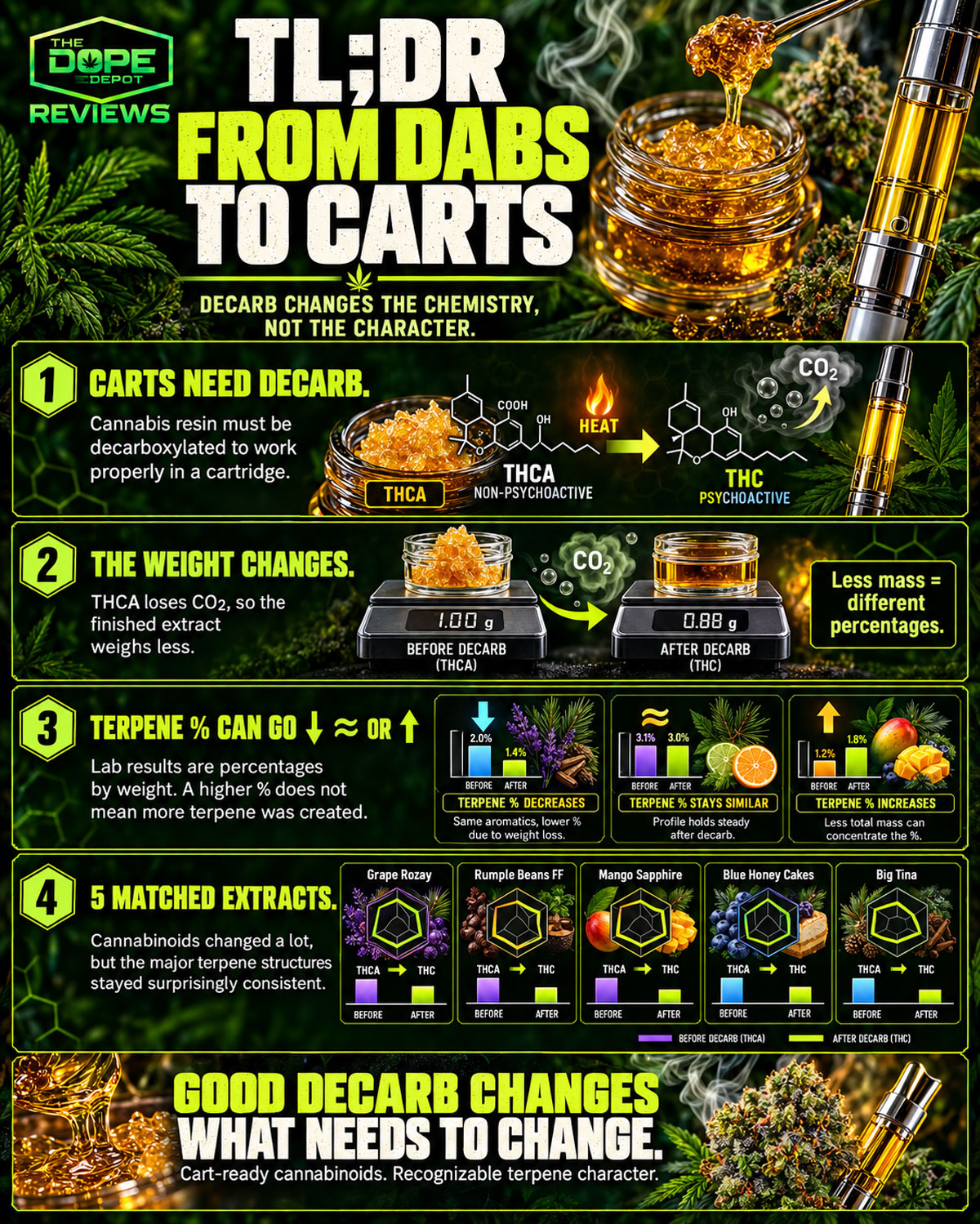
Cannabis resin needs to be decarboxylated before it works properly in a cart. Heat converts THCA into THC while releasing CO₂, which changes the chemistry and reduces the total mass of the extract.
Because laboratory results are percentages by weight, terpene percentages can go down, stay similar, or even rise after decarb. A higher percentage doesn’t necessarily mean more terpenes were created. The finished sample simply weighs and measures differently.
Across five matched Dope Depot extracts, the cannabinoid profiles changed dramatically while the major terpene structures remained surprisingly consistent.