
The Numbers Game
By: Lab Rat Finn
Walk into almost any dispensary here in Oregon, or any other legal recreational cannabis state, and chances are you’ll hear the same question:
“What’s your highest THC?”
For years, cannabis has been marketed like a horsepower contest. Bigger numbers win. A cartridge testing at 95% THC must be better than one testing at 80%, right?
Not necessarily.
THC is certainly important, but focusing on THC percentage alone is a bit like judging a meal entirely by its calorie count. It tells you something useful, but it leaves out most of what actually determines the experience.
The truth is that cannabis is far more complicated than a single number on a package. In fact, after reviewing hundreds of extracts while building out Dope Depot Reviews and digging through our growing library of PhytoFacts data provided by SC Labs, we’ve noticed something interesting.
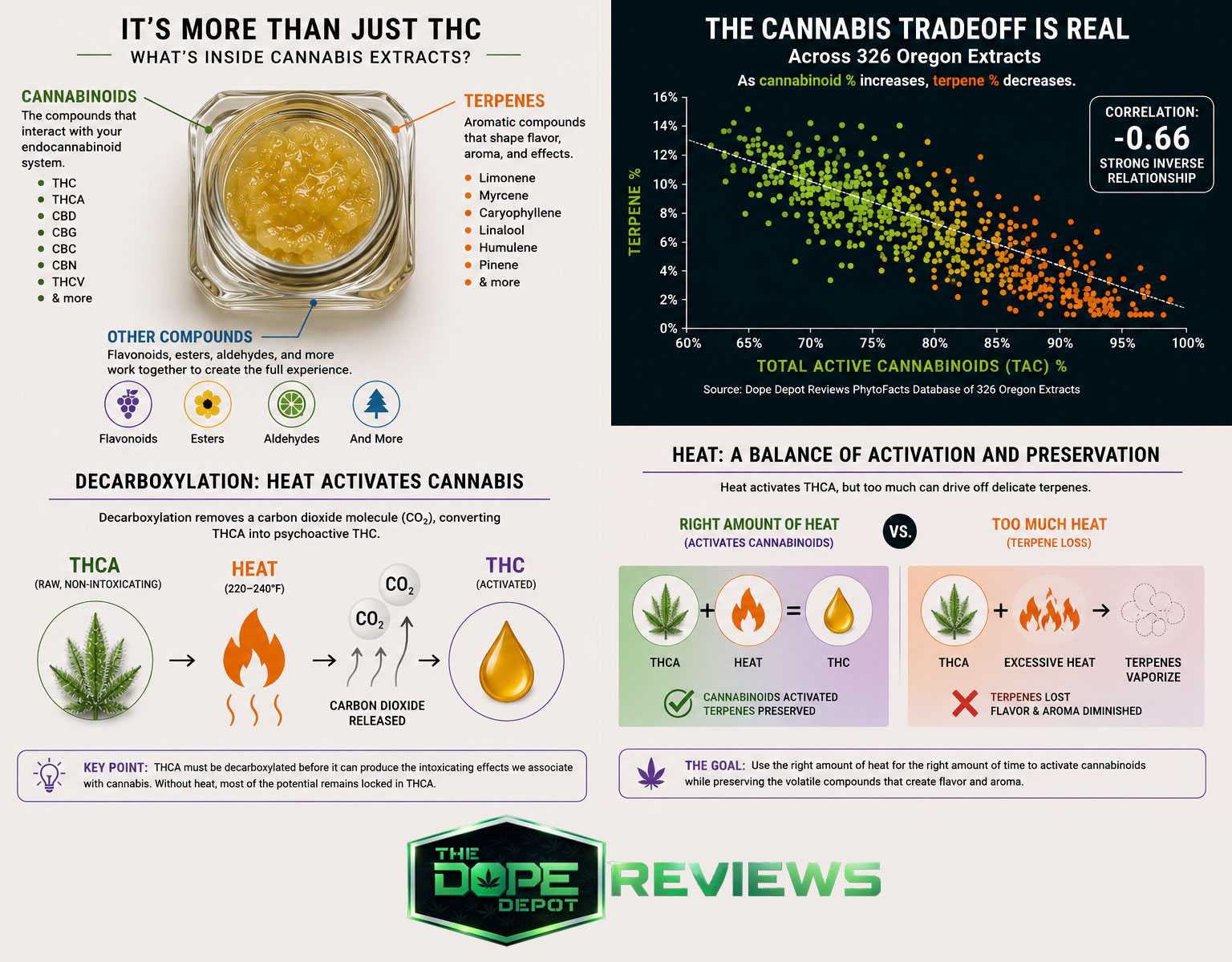
The extracts with the highest cannabinoid percentages are often not the extracts with the highest terpene percentages. That doesn’t mean either approach is wrong. It simply means there’s a tradeoff happening that most consumers never hear about.
Before we dig into the data, let’s define a few terms so we’re all on the same page.
THC | THCA
THC, short for tetrahydrocannabinol, is the primary psychoactive cannabinoid found in cannabis. It’s largely responsible for the euphoric effects most people associate with getting high.
When consumers ask how “strong” a product is, they’re usually talking about THC.
THCA, or tetrahydrocannabinolic acid, is the naturally occurring precursor to THC found in raw cannabis. Fresh flower and many concentrates contain large amounts of THCA but relatively little THC.
This is why many concentrates test high in THCA rather than THC. The THC hasn’t disappeared, it simply hasn’t been activated yet. Once you heat the extract, much of that THCA converts into THC and becomes available to your body.
You can see this difference for yourself by looking at the PhytoFact sheet for a dabbable versus a decarb of the same strain.
You can click the images to see a full size, easier to read version.

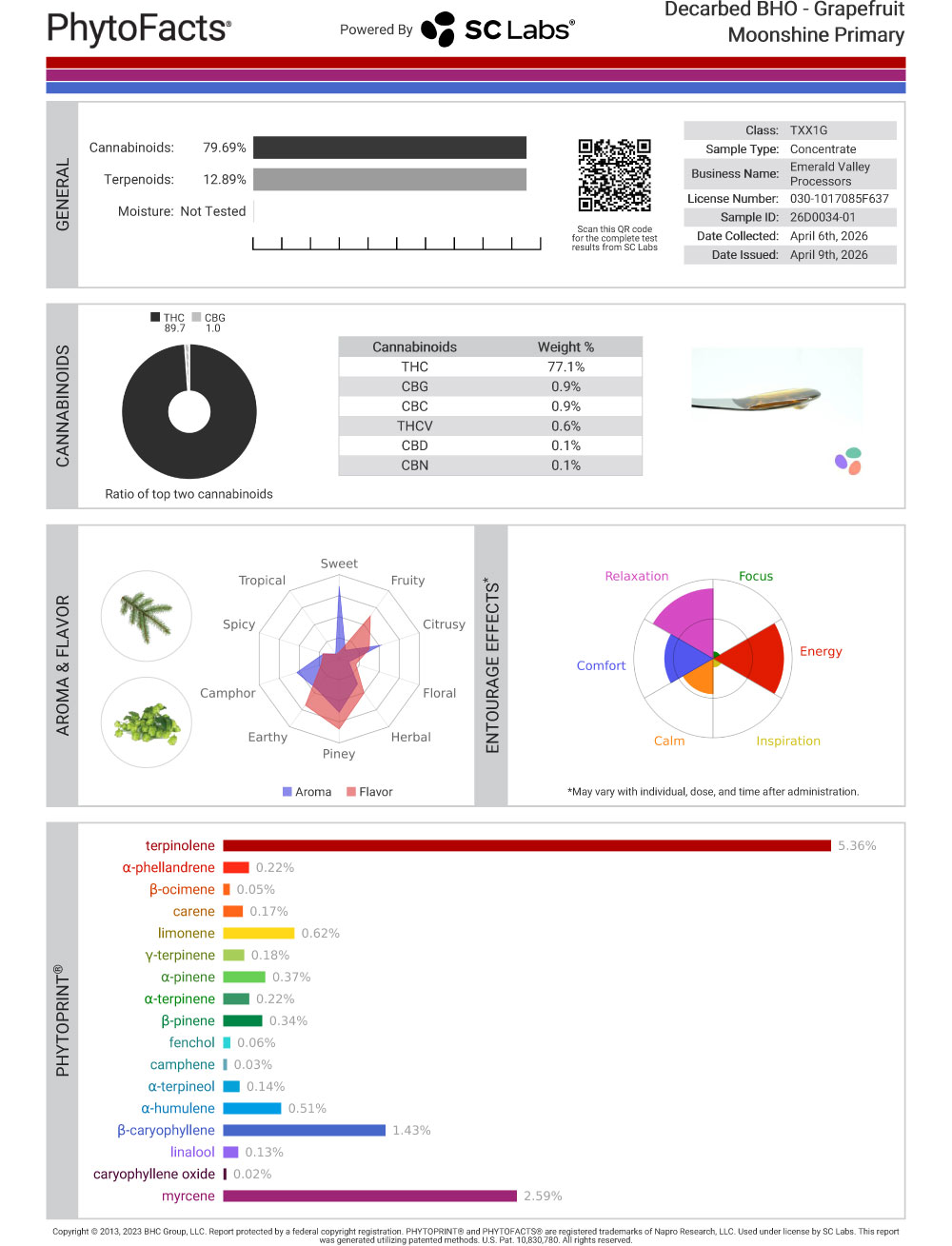
Let’s take our fresh frozen Grapefruit Moonshine for example. Here is the dab review, and here is the cart review. Notice the similarity in numbers, and how the THCA is non-existent in the cart version, and the THC is less than 1% in the dab version.
(NERD ALERT) Quick Lab Rat Side Note (NERD ALERT)
When heat is applied through smoking, vaping, or dabbing, THCA undergoes a process called decarboxylation, which converts the THCA into THC, thus giving anything with an endocannabinoid system that consumes it, a nice psychoactive effect.
This is also why cannabis must be decarboxylated before it’s used to make edibles. Raw cannabis primarily contains THCA, not THC. While THCA has its own areas of scientific interest, it does not produce the same intoxicating effects as THC when consumed.
During decarboxylation, heat converts THCA into THC, which, when ingested, can then be metabolized by the liver into 11-Hydroxy-THC, the potent compound largely responsible for the unique and often long-lasting effects associated with edibles. Without proper decarboxylation, much of the potential THC remains locked in its inactive THCA form, resulting in significantly reduced edible potency.
Blah blah blah weed science nerd stuff. I know, and I apologize. Unless you have a passion for this stuff, it can get pretty boring the deeper into the woods you go. Lucky for you, I have some of that passion, and I’m happy to spread it around. For now, let’s get back on topic. We have a few more terms to define, then we’ll continue forward.
Cannabinoids
Cannabinoids are naturally occurring compounds produced by the cannabis plant. THC is the most famous, but it’s far from the only one.
Other cannabinoids include CBD, CBG, CBC, CBN, and THCV. While these compounds are usually present in smaller amounts, they still contribute to the overall experience.
Terpenes
Terpenes are aromatic compounds responsible for the flavors and aromas found in cannabis. They’re what make one extract smell like citrus while another smells like pine, diesel, fruit, flowers, or fresh earth.
Terpenes are measured separately from cannabinoids and are often one of the strongest indicators of flavor intensity.
Total Active Cannabinoids (TAC)
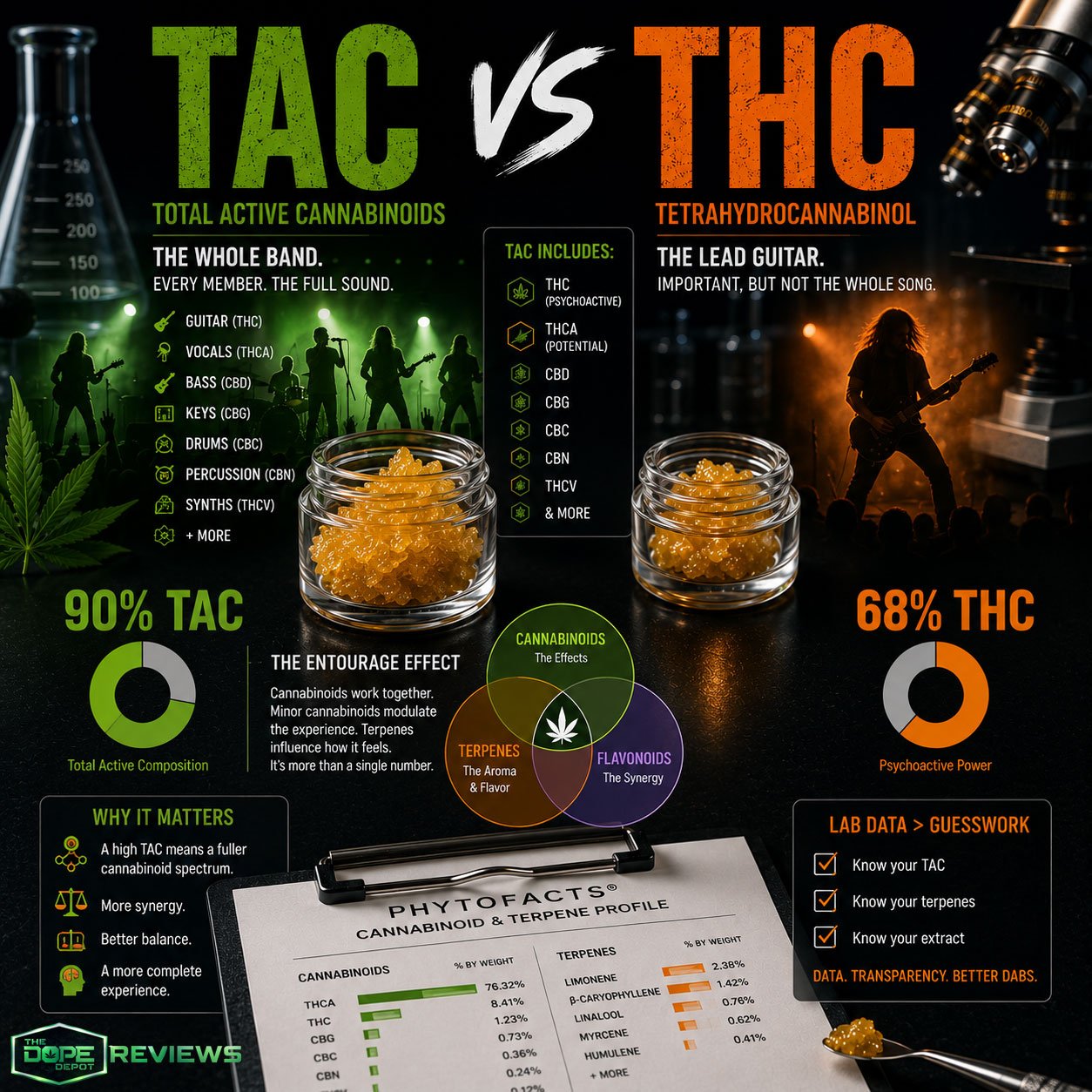
Total Active Cannabinoids, often abbreviated as TAC, represents the combined percentage of active cannabinoids present in a product.
Rather than looking at THC alone, TAC gives you a broader picture of the cannabinoid content. Think of THC as the lead singer in a band. TAC tells you how many musicians are actually on stage.
The Mistake Most Consumers Make
THC matters. Let’s get that out of the way immediately.
If someone tells you THC doesn’t matter, they’re oversimplifying the chemistry just as much as the people who claim THC is the only thing that matters. The real problem is that consumers and budtenders have been trained to focus almost exclusively on THC while ignoring everything else.
Cannabis contains dozens of cannabinoids alongside hundreds of aromatic and volatile compounds. When we reduce all of that complexity down to a single THC percentage, we lose most of the story.
Anyone who has spent time with concentrates has probably experienced this firsthand.
You’ve likely had a product that tested extremely high in THC but felt surprisingly flat. Maybe it lacked aroma. Maybe the flavor disappeared after the first dab. Maybe it got you good and high but the vibes didn’t last long.
You’ve probably also had the opposite experience.
An extract with lower cannabinoid numbers that somehow delivered incredible flavor, complex aromas, and a session you couldn’t stop talking about. If THC were the only thing that mattered, those experiences wouldn’t happen, yet they happen all the time.
The Tradeoff Is Real
Recently, we analyzed hundreds of extracts from our Red Eye and Gem Cart / Pocket Puffer PhytoFacts database and noticed a clear pattern. As cannabinoid percentages increase, terpene percentages generally decrease. That shouldn’t be surprising when you think about it.
A jar only holds 100% chemistry. If more of that chemistry is cannabinoids, less of it can be terpenes. Consumers often behave as if a 97% TAC extract and an 11% terpene extract are competing for the same crown. But in reality, they’re often pursuing different goals.
One approach prioritizes maximum potency. The other prioritizes preserving as much of the plant’s original chemistry as possible. Neither philosophy is inherently better. But they’re not the same thing.

What Our Data Shows
Some of the highest TAC extracts in our database include products testing above 95% cannabinoids while carrying relatively modest terpene percentages.
At the other end of the spectrum, some of the loudest and most flavorful extracts we’ve reviewed contain cannabinoid percentages in the mid-70s to low-80s while carrying terpene content exceeding 10%.
Consider a few examples. Feel free to look through our data sheets over on The Sheets page.
Rumple Berry tests at 97.67% cannabinoids with 2.51% terpenes.
Party Diesel comes in at 94.54% cannabinoids with 2.95% terpenes.
Rainbow Runtz tests at 95.40% cannabinoids with 3.05% terpenes.
Now compare those numbers to a few terpene-rich extracts.
GMO Cookies carries 75.17% cannabinoids alongside an impressive 12.12% terpene content.
Papaya Cake lands at 78.92% cannabinoids with 11.63% terpenes.
Our award-winning Grapefruit Moonshine Fresh Frozen comes in at 81.71% cannabinoids and 11.40% terpenes.
Rainbow Skies tests at 77.90% cannabinoids with 11.32% terpenes.
What’s fascinating is that the highest TAC products in our dataset averaged roughly half the terpene content of the lower TAC products. That’s not an accident baby, that’s pure chemistry.
Why Flavor Chasers Should Pay Attention
As we discussed in our article on terpene preservation, many of the compounds responsible for flavor and aroma are fragile. Heat, oxygen, processing time, and storage conditions can all impact how much of that chemistry survives into the final product.
Better is relative, especially when it comes to the wide world of weed. A product with lower TAC and higher terpene content isn’t necessarily better. Just like a product with higher TAC and lower terpene content isn’t necessarily better.
Better than what? Better for whom? Each person, depending on their tolerance, metabolism, endocannabinoid system, set and setting, brain chemistry, and a myriad other variables, can have a completely different experience than you or I, or anyone else. As the physics lab rats like to say, it’s all relative!
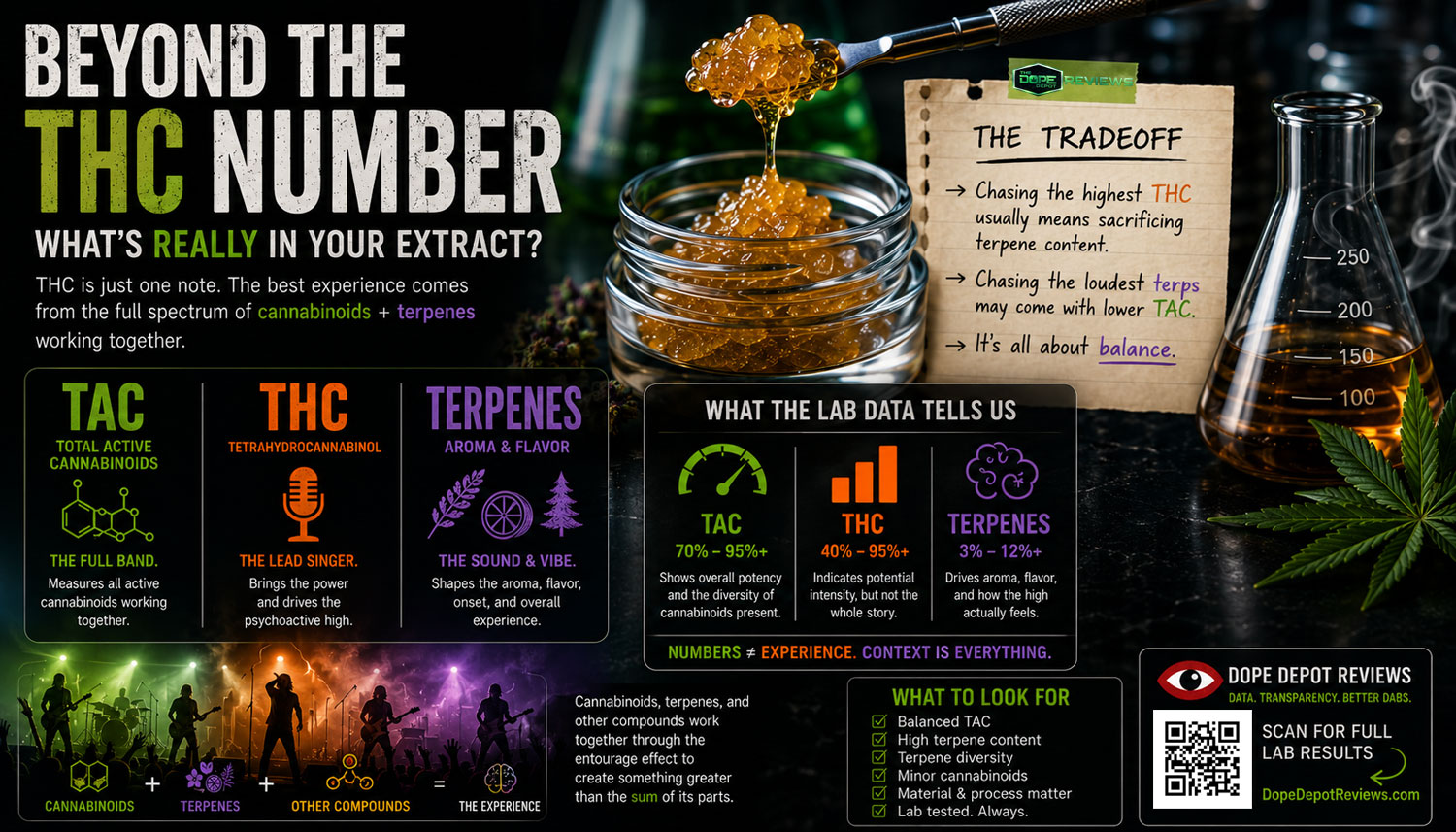
The question is what kind of experience you’re looking for. If your goal is maximizing potency, you’ll probably gravitate toward the highest cannabinoid percentages you can find. If your goal is maximizing flavor, aroma, and strain expression, terpene content becomes far more important.
Many experienced concentrate consumers eventually stop chasing the biggest cannabinoid number and start chasing flavor instead. We want strong and varied cannabinoids. We want a strong and novel terpene profile. We want products that still taste like the plant they came from. We basically all want our Ice Cream Cake, and we want to eat it too!
Looking Beyond a Single Number
The next time you’re comparing extracts, don’t stop at THC. Look at the total active cannabinoids. Look at the terpene content. Look at the terpene diversity. Consider the overall balance of the product rather than chasing a single metric.
A concentrate testing at 80% cannabinoids and 10% terpenes may ultimately deliver a far more memorable experience than a concentrate testing at 95% cannabinoids and 2% terpenes. Not because one is objectively better. But because cannabis is more than potency.
It’s chemistry.
Final Thoughts
THC matters.
Total Active Cannabinoids matter.
Terpenes matter.
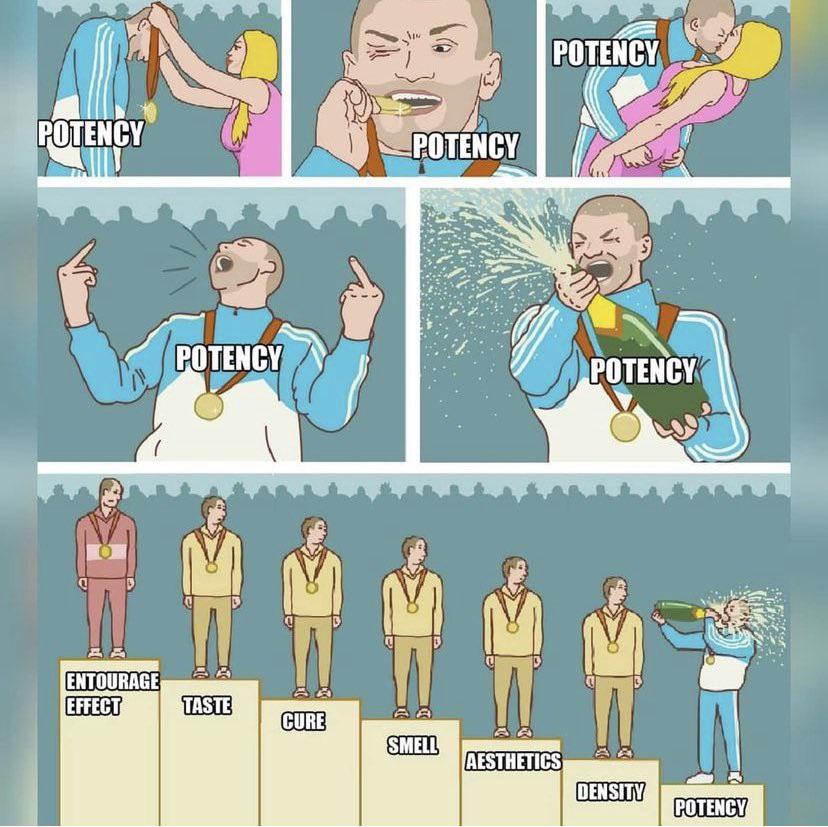
The best extracts aren’t necessarily the ones with the highest THC percentages or the highest TAC numbers. They’re the products that preserve the widest range of compounds responsible for flavor, aroma, and effects.
They’re the extracts that still taste like the plant they came from. Because at the end of the day, nobody remembers the dab with the biggest number.
They remember the one that tasted incredible.