

Podcast: Play in new window | Download (23.6MB)
The posts in this series are a pretty healthy read, so for those of you who lack the curiosity or the attention span, scroll to the end and find the TL;DR, or CLICK HERE!! Otherwise, put on your thinking caps and lets get going!
If you don’t feel like reading, you can listen to Finn read the post to you. Download the mp3 here or tap the play button!.
- Click here to skip to the top 5 Red Eye dab Terpinolene heavy hitters.
- Click here to skip to the top 5 Gem Cart / Pocket Puffer Terpinolene heavy hitters.
Terpinolene: The Cannabis Terpene That Refuses to Pick a Lane
Terpinolene is what happens when a terpene declines to settle on one recognizable aroma.
Limonene gives us citrus. Beta-caryophyllene brings pepper and wood. Myrcene leans toward ripe fruit, earth, herbs, and musk. Terpinolene wanders into the profile carrying flowers, pine needles, citrus peel, sweet herbs, fresh wood, and something vaguely reminiscent of clean soap. That description sounds just like somebody emptied an entire fragrance cabinet into the extract.
Terpinolene is also associated with another contradiction. Cannabis products rich in it are often marketed as energetic, creative, or uplifting, especially when they come from Jack Herer, Durban, or Haze-influenced genetics. Meanwhile, one of the better-known terpinolene studies found a sedative effect in mice. Naturally, cannabis marketing responded to this ambiguity by confidently repeating whichever version was more convenient.
The chemistry deserves a closer look.
What Is Terpinolene?
Terpinolene is a cyclic monoterpene with the molecular formula C10H16. It occurs naturally in cannabis and a variety of other aromatic plants, including:
- Lilac
- Cumin
- Oregano
- Marjoram
- Nutmeg
- Tea tree
- Conifers
- Some citrus rinds
Unlike beta-caryophyllene and alpha-humulene, which are heavier sesquiterpenes, terpinolene is a relatively small and volatile monoterpene. That lighter structure helps it reach the nose quickly. It also makes terpinolene more vulnerable to heat, oxygen, processing time, and poor storage.
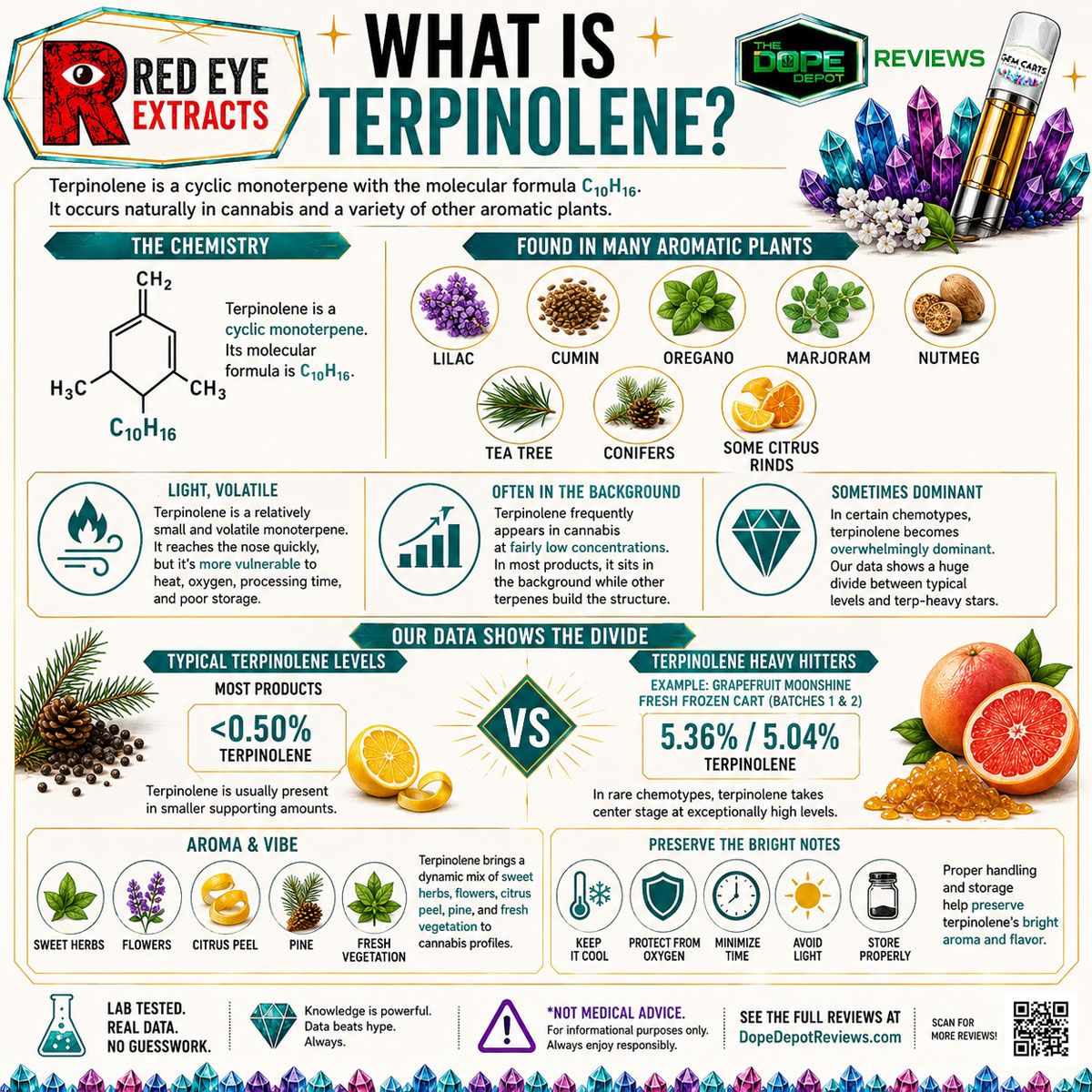
Terpinolene frequently appears in cannabis at fairly low concentrations. In most products, it sits somewhere in the background while caryophyllene, limonene, myrcene, or humulene handle the main structural work.
In certain chemotypes, however, terpinolene becomes overwhelmingly dominant. Our data sheet shows this divide clearly. Some products carry less than half a percent. Grapefruit Moonshine Fresh Frozen exceeds five percent in cart form.
What Does Terpinolene Smell and Taste Like?
Terpinolene is usually described through combinations rather than one defining aroma. It can contribute:
- Sweet herbs
- Fresh pine
- Citrus peel
- Lilac
- Flowers
- Green vegetation
- Fresh wood
- Mild spice
- Sweet fruit
- Clean soap
- Light resin
- Tea-like notes
Its character depends heavily on the compounds surrounding it. Terpinolene with myrcene can become fuller, fruitier, and more herbal. Limonene may pull it toward bright citrus and sweetness. Pinene reinforces the fresh evergreen side. Ocimene can add sweet green fruit and floral lift.
Beta-caryophyllene and humulene give terpinolene a heavier base of pepper, herbs, dry wood, and resin. This is why terpinolene-rich extracts can smell like citrus candy, fresh flowers, pine cleaner, fruit, herbs, or several of those things at once.
The molecule isn’t indecisive. Even our lab rat scent vocabulary is simply inadequate for a profile with that many moving parts.
A Volatile and Reactive Monoterpene
Terpinolene’s light molecular structure makes it highly aromatic, but also relatively fragile. It can be affected by:
- Heat
- Oxygen
- Light
- Prolonged processing
- Aggressive vacuum
- Repeated warming
- Poorly sealed packaging
- Time
Like other unsaturated monoterpenes, terpinolene can react with oxygen and environmental oxidants. Those reactions create new oxygenated compounds with different chemical and sensory properties.
Inside a cannabis product, gradual oxidation can soften the original fresh aroma and move the profile toward duller, sharper, or less recognizable notes. This doesn’t mean every terpinolene-rich extract will collapse the moment the lid opens.
It means storage is important, and commonly overlooked. It might not matter as much if you’re talking about a single gram that’s going to get dabbed before anyone notices the change. But if you’re trying to keep any meaningful amount in pristine condition, like baller jars for example, you’ll want to pay attention to how the extract is stored.
Keep the container sealed. Avoid unnecessary heat. Minimize prolonged exposure to air and light. Stop leaving the jar open while telling a twenty-minute tale. The chemistry doesn’t care how compelling the story is.
Is Terpinolene Energizing or Sedating?
Terpinolene-rich cannabis is frequently associated with alertness, creativity, energy, and mental stimulation. The connection probably comes partly from the cannabis cultivars in which terpinolene commonly appears. Jack Herer, Durban Poison, Dutch Treat, Ghost Train Haze, and other terpinolene-forward varieties are often marketed as sativas.
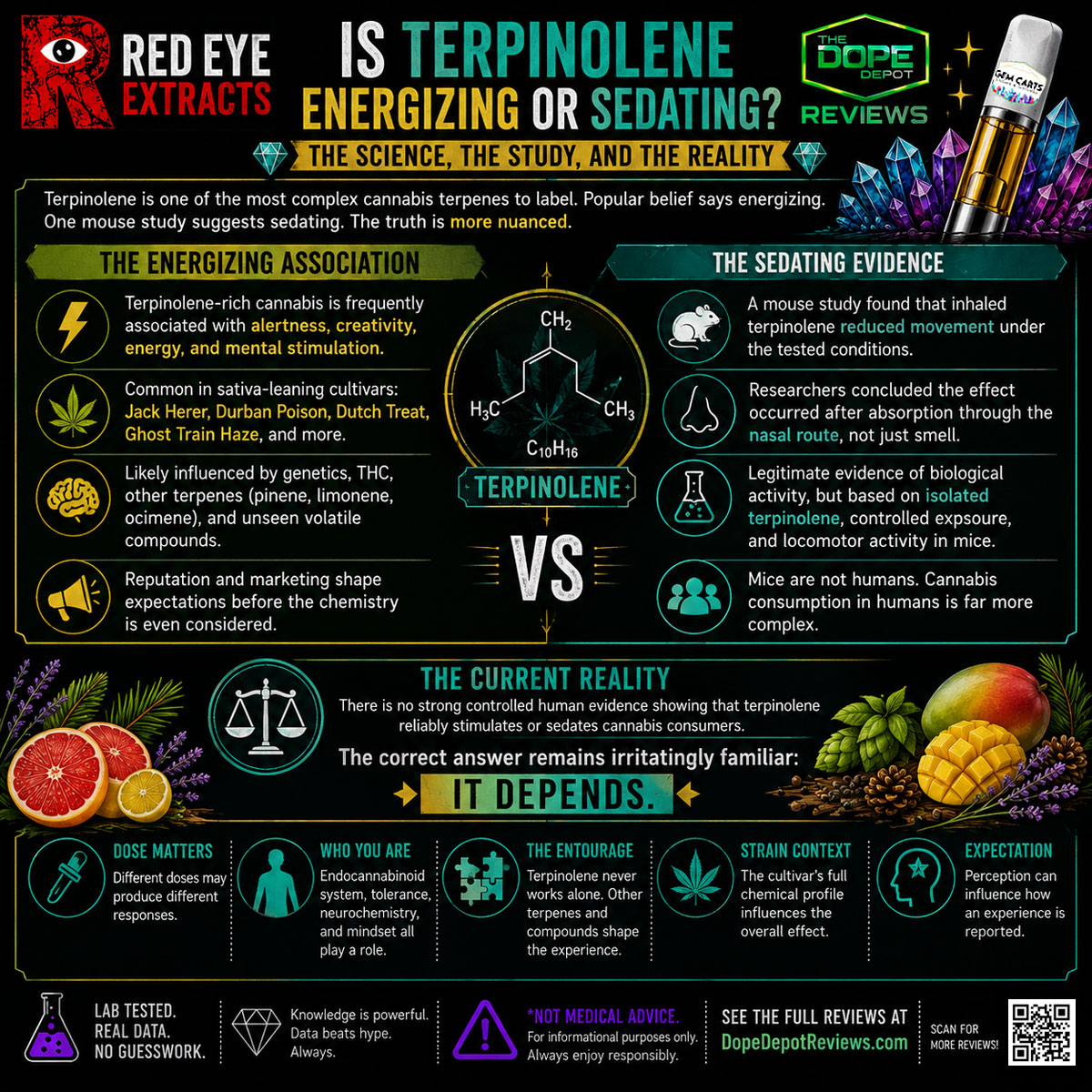
That doesn’t prove terpinolene itself produces stimulation. The product may also contain substantial THC, minor cannabinoids, pinene, limonene, ocimene, and dozens of unmeasured volatile compounds. Genetics and reputation can influence how the experience is described before anyone examines the chemistry.
Meanwhile, a mouse study found that inhaled terpinolene reduced movement under the tested conditions. The researchers concluded that the effect occurred after the compound was absorbed through the nasal route rather than relying entirely on the animal’s sense of smell.
That’s legitimate evidence of biological activity. It is not proof that a terpinolene-heavy dab will make a human sleepy. The study involved mice, isolated terpinolene, controlled exposure, and measurements of locomotor activity. Human cannabis consumption involves a far more complicated mixture and a rather more complicated animal.
At present, there is no strong controlled human evidence showing that terpinolene reliably stimulates or sedates cannabis consumers. The correct answer remains irritatingly familiar: it depends on the dose, the full profile, and the person consuming it.
What Does the Research Say?
Terpinolene has been investigated for sedative, antioxidant, antiproliferative, antimicrobial, and insect-related activity. The evidence is overwhelmingly preclinical. The inhalation study discussed above found sedative activity in mice and examined which parts of the molecule’s structure appeared necessary for that effect.
Another study tested terpinolene in cultured rat neurons and mouse-derived neuroblastoma cells. At lower tested concentrations, terpinolene increased total antioxidant capacity in the primary rat neurons. At higher concentrations, however, it increased total oxidative stress in both cell types.
It also reduced cell proliferation at certain concentrations, including in the neuroblastoma cells. That dose-dependent result is important. Cannabis marketing tends to treat “antioxidant” as a permanent personality trait. The actual study found different outcomes at different concentrations and in different cell types. Dose matters. Cell type matters. Exposure conditions matter.
The research establishes that terpinolene can be biologically active under laboratory conditions. It does not prove that inhaling a cannabis product rich in terpinolene treats insomnia, cancer, oxidative stress, or any other medical condition. Interesting cellular research is not a clinical recommendation.
Does Terpinolene Determine the High?
A terpinolene-dominant product may feel bright and mentally active to one person. Another may experience relaxation or mental fog. A third may become anxious because the product also carries a large amount of THC. Relevant variables include:
- THC and total cannabinoid concentration
- Minor cannabinoids
- Total terpene concentration
- Individual terpenes
- Dose
- Consumption method
- Tolerance
- Metabolism
- Individual endocannabinoid biology
- Set and setting
Our current terpinolene leaders include plenty of sativa-labeled products, especially our fresh frozen Grapefruit Moonshine, Acapulco Moonshine, Grapefruit Daiquiri, Jacks In Five, The Bright, and Jack Herer. That association is real. It still isn’t the same thing as proof that terpinolene alone creates an energetic effect.
The current list also includes indicas and hybrids, especially in the cart data, where Glazed Apricot Gelato, Apricot Puddin’, and Stone Fruit Cider all carry strong terpinolene results despite being labeled indica.
Terpinolene may be associated with many famous sativa cultivars, but association is not causation. A laboratory percentage provides chemistry, not a complete forecast of someone’s evening.
Reading Terpinolene on a Lab Sheet
Terpinolene behaves differently from beta-caryophyllene and humulene in our database. Caryophyllene appears in substantial amounts across a huge number of products. Terpinolene is more polarized.
Most extracts contain very little. A smaller group carries enormous concentrations. That creates two distinct situations. A product with 0.5% terpinolene may still receive meaningful sweet, herbal, floral, or pine-like detail from the compound, but terpinolene probably isn’t controlling the profile.
A product with three, four, or five percent terpinolene is operating in a completely different chemical category. At those concentrations, terpinolene becomes the aromatic framework rather than an accent.
When reading the panel, ask yourself these questions:
- How much terpinolene is present?
- What percentage of the total terpene content does it represent?
- Is terpinolene dominant or merely detectable?
- How much myrcene, limonene, pinene, and ocimene surround it?
- Are beta-caryophyllene and humulene creating a heavier base underneath?
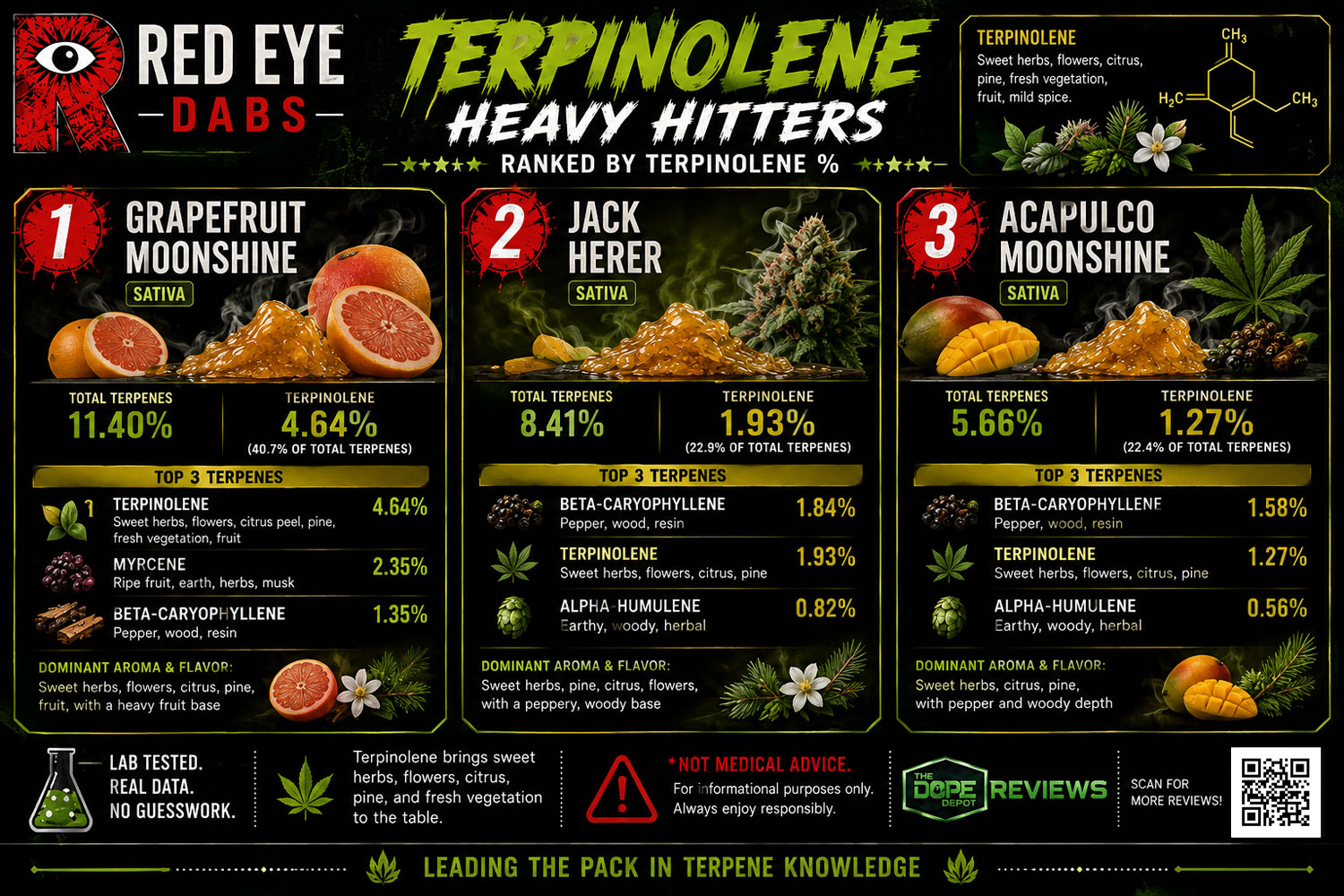
For this article, we went back about a year and selected the five strongest terpinolene results from the Red Eye dab data sheet and five high-terpinolene products from the cart sheet.
Five Red Eye Dab Terpinolene Heavy Hitters
1. Grapefruit Moonshine Fresh Frozen
Type: Sativa
Total Terpenes: 11.40%
Terpinolene: 4.64%
Our fresh frozen Grapefruit Moonshine doesn’t merely lead the current Red Eye dab list. At 4.64%, it contains more than twice as much terpinolene as the next Red Eye product.
Terpinolene represents roughly 41% of the complete measured terpene profile. Myrcene follows at 2.35%, with beta-caryophyllene at 1.35%.
Limonene reaches 0.53%, beta-pinene sits at 0.51%, and smaller amounts of alpha-pinene, phellandrene, ocimene, carene, and gamma-terpinene create additional upper-end detail.
This should produce an unusually broad expression of terpinolene. Expect sweet herbs, flowers, citrus peel, pine, fresh vegetation, and fruit over a substantial myrcene base. Beta-caryophyllene provides enough pepper and resin to keep the profile structured.
The high myrcene concentration is especially important. It adds ripe fruit, earth, herbs, and weight beneath terpinolene’s brighter aromatic character.
This isn’t simply a fresh citrus profile. It’s a dense combination of bright top notes and heavy fruit underneath. There’s a reason the decarbed cart version of this fresh frozen run won a 2026 Oregon Leaf Bowl award.
Check out the full review here.
2. Jack Herer
Type: Sativa
Total Terpenes: 8.41%
Terpinolene: 1.93%
Jack Herer lands in second place with 1.93% terpinolene. That represents almost 23% of the measured terpene profile.
Beta-caryophyllene follows closely at 1.84%, while alpha-humulene reaches 0.82%. Myrcene sits at 0.49%, limonene at 0.42%, and beta-ocimene at 0.35%.
The profile also contains measurable alpha-phellandrene, carene, alpha-pinene, beta-pinene, alpha-terpineol, and gamma-terpinene. This is a broad aromatic cluster, which makes sense for a Jack Herer-style profile.
Terpinolene brings sweet herbs, flowers, citrus, pine, and fresh vegetation. Beta-ocimene reinforces the sweet green and floral side. Pinene, phellandrene, and carene add sharper herbal and forest-like lift. Caryophyllene and humulene provide pepper, wood, resin, and dryness underneath.
Jack Herer is not as wildly terpinolene-dominant as Grapefruit Moonshine, but it still puts terpinolene in a major role. The molecule gets the spotlight. Caryophyllene stands nearby with a clipboard making sure the profile still has structure.
Check out the full review here.
3. Acapulco Moonshine
Type: Sativa
Total Terpenes: 5.66%
Terpinolene: 1.27%
Acapulco Moonshine carries 1.27% terpinolene inside a 5.66% total terpene profile. That means terpinolene accounts for roughly 22% of the measured total, nearly the same proportional role it has in Jack Herer.
Beta-caryophyllene leads at 1.58%, while alpha-humulene contributes 0.56%. Myrcene sits at 0.38%, limonene at 0.32%, and beta-ocimene at 0.18%. The pinenes are present as smaller supporting notes.
This should create a profile where terpinolene adds bright sweet herbs, flowers, pine, and citrus over a peppery, woody, herbal caryophyllene-humulene base. Because the total terpene number is lower than Grapefruit Moonshine or Jack Herer, Acapulco Moonshine may not feel as loud overall. But proportionally, terpinolene has a serious role as part of the architecture.
Check out the full review here.
4. Grapefruit Daiquiri
Type: Sativa
Total Terpenes: 6.41%
Terpinolene: 0.91%
Grapefruit Daiquiri contains 0.91% terpinolene, accounting for a little over 14% of its measured terpene profile.
Beta-caryophyllene leads at 1.66%, followed by alpha-humulene at 0.61%. Myrcene and limonene both contribute meaningful support at 0.61% and 0.56%. Linalool lands at 0.28%, while the combined pinenes add another 0.28%. This is a more balanced profile than the first three.
Terpinolene should contribute sweet herbs, citrus peel, flowers, and pine, while limonene reinforces the citrus side. Myrcene adds fruit and earth. Caryophyllene and humulene bring pepper, dry wood, herbs, and resin.
The grapefruit name probably depends on compounds beyond the standard terpene panel, because real grapefruit aroma is a chaotic little circus of sulfur compounds, aldehydes, terpenes, and other volatile troublemakers.
Check out the full review here.
5. Jacks In Five
Type: Sativa
Total Terpenes: 8.05%
Terpinolene: 0.82%
Jacks In Five rounds out the current Red Eye top five with 0.82% terpinolene. That represents just over 10% of its measured terpene content. Unlike the fresh frozen Grapefruit Moonshine, this is not a terpinolene-dominant profile. Beta-caryophyllene leads at 2.73%, followed by alpha-humulene at 1.10%. Myrcene reaches 0.73%, limonene sits at 0.63%, and the combined pinenes contribute another 0.63%.
Terpinolene should add sweet herbs, floral freshness, and pine-like brightness to a much heavier base of pepper, wood, earth, and resin. The pinenes and limonene reinforce the upper end, while myrcene provides additional fruit and body.
Jacks In Five demonstrates how terpinolene can remain clearly relevant without controlling the entire profile. Sure, it can write a meaningful verse, but beta-caryophyllene still owns the publishing rights.
Check out the full review here.
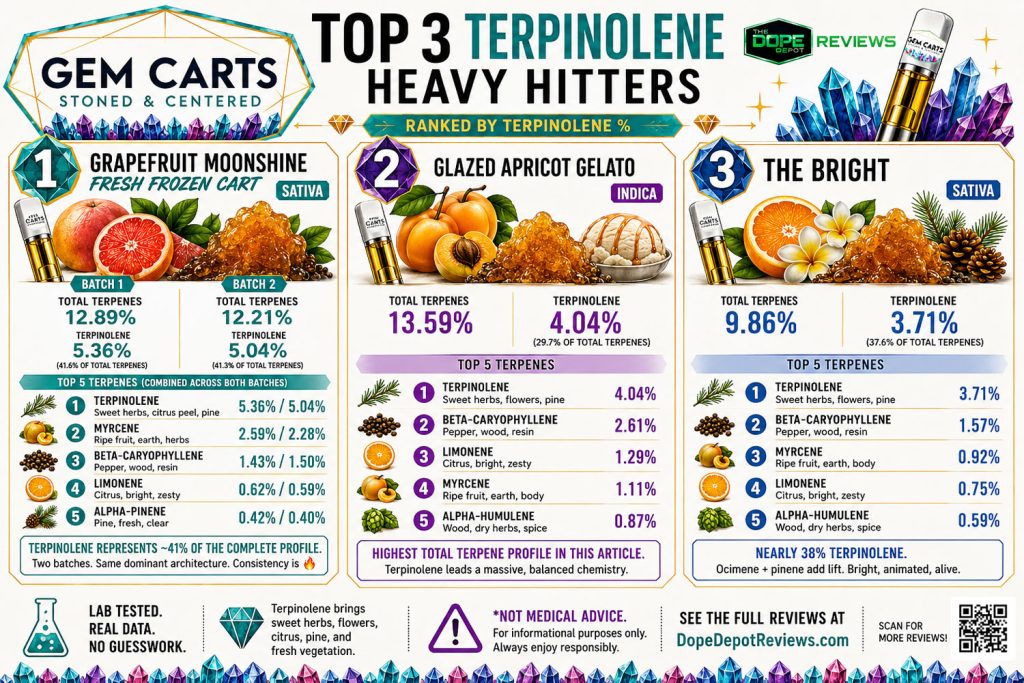
Five Terpinolene Cart Heavy Hitters
1. Grapefruit Moonshine Fresh Frozen V1 & V2 Batches
Type: Sativa
Total Terpenes: 12.89% and 12.21%
Terpinolene: 5.36% and 5.04%
The two Grapefruit Moonshine Fresh Frozen cart batches are in a category of their own. Version one contains 5.36% terpinolene within a 12.89% total profile. Version two carries 5.04% within 12.21% total terpenes.
In both batches, terpinolene represents roughly 41% of everything measured. That consistency is pretty cool to see. Shout out to the lab rats for handling this one perfectly.
Myrcene lands at 2.59% in the first batch and 2.28% in the second. Beta-caryophyllene reaches 1.43% and 1.50%, while limonene sits at 0.62% and 0.59%. The smaller terpenes remain similarly aligned across the two results as well.
This is not a case where one lucky sample produced an unusual number. Two separate batches preserved essentially the same chemical architecture. The cart profile also closely resembles the Grapefruit Moonshine Fresh Frozen dab, which contains 4.64% terpinolene and 2.35% myrcene.
Decarboxylation changes the cannabinoid chemistry, but careful processing preserved the central terpene relationship: huge terpinolene, substantial myrcene, supporting caryophyllene, then a broad collection of lighter compounds.
Check out the batch 1 full review here.
Check out batch 2 full review here.
2. Glazed Apricot Gelato
Type: Indica
Total Terpenes: 13.59%
Terpinolene: 4.04%
Glazed Apricot Gelato contains 4.04% terpinolene within the highest total terpene profile in this article. At 13.59% total terpenes, this cart is loud before the individual numbers even start talking.
Terpinolene represents nearly 30% of the measured profile. Beta-caryophyllene follows at 2.61%, while limonene reaches 1.29%. Myrcene contributes 1.11%, alpha-humulene sits at 0.87%, and alpha-pinene adds 0.41%. This is a much broader structure than a simple terpinolene showcase.
Terpinolene should bring sweet herbs, flowers, citrus peel, pine, and fresh vegetation. Limonene adds more citrus brightness. Myrcene contributes fruit, earth, and body. Caryophyllene and humulene provide pepper, dry herbs, wood, and resin.
The apricot and gelato sides almost certainly depend on volatile compounds beyond the standard terpene panel, especially esters and other trace aromatics. But the measured chemistry gives the profile plenty of fruit, flowers, citrus, herbs, pine, and creamy structural depth to work with.
Glazed Apricot Gelato is what happens when terpinolene gets a giant stage and refuses to perform alone.
Check out the full review here.
3. The Bright
Type: Sativa
Total Terpenes: 9.86%
Terpinolene: 3.71%
The Bright contains 3.71% terpinolene, accounting for nearly 38% of its complete measured terpene profile.
Beta-caryophyllene follows at 1.57%. Myrcene reaches 0.92%, limonene sits at 0.75%, and alpha-humulene contributes 0.59%. Beta-ocimene and alpha-pinene are both substantial at 0.43% and 0.42%.
This is exactly the kind of supporting chemistry that can make terpinolene feel exceptionally bright and animated. Ocimene contributes sweet green fruit and floral lift. Pinene adds fresh evergreen sharpness. Limonene brings citrus, while myrcene gives the profile enough fruit and weight to keep it from becoming thin. Caryophyllene and humulene build the darker foundation underneath.
Check out the full review here.
4. Apricot Puddin’
Type: Indica
Total Terpenes: 11.25%
Terpinolene: 2.53%
Apricot Puddin’ carries 2.53% terpinolene inside an 11.25% total terpene profile. That puts terpinolene at roughly 22.5% of the measured total.
Beta-caryophyllene leads at 2.74%, just slightly above the terpinolene. Myrcene contributes 1.04%, limonene reaches 0.95%, and alpha-humulene lands at 0.93%. Linalool is also notable at 0.32%. This is a well-balanced profile with no single terpene completely running away from the others.
Terpinolene supplies the sweet herbs, flowers, pine, citrus, and fresh lift. Beta-caryophyllene and humulene build the peppery, woody, resinous frame. Myrcene adds fruit and earth, while limonene brightens the upper end. The result should be richer and more grounded than a purely bright terpinolene profile.
Apricot Puddin’ is high in terpinolene, but it doesn’t let the molecule turn the cart into a pine-flower laser beam. It has dessert energy with actual structural support.
Check out the full review here.
5. Stone Fruit Cider
Type: Indica
Total Terpenes: 10.02%
Terpinolene: 2.08%
Stone Fruit Cider rounds out the current distinct cart top five with 2.08% terpinolene. That represents almost 21% of its measured terpene content.
Beta-caryophyllene leads at 2.28%, while alpha-humulene reaches 0.85%. Limonene lands at 0.80%, and myrcene contributes 0.68%. Alpha-terpineol is also unusually high at 0.28%, with linalool at 0.36%.
This creates a layered profile where terpinolene brings sweet herbs, flowers, citrus peel, and pine, while caryophyllene and humulene provide pepper, dry wood, resin, and herbal bitterness. Limonene adds additional citrus brightness. Myrcene contributes fruit and earthy weight. Alpha-terpineol and linalool may reinforce the softer floral and woody side.
The stone fruit and cider impressions likely involve unmeasured volatile chemistry, because fruit aromas are never satisfied with being explained by one spreadsheet column. Still, the terpene panel shows a strong bright-herbal framework with enough soft floral and fruit-supporting chemistry to make the name plausible.
Check out the full review here.
What These Ten Products Show Us
The strongest pattern is the enormous gap between terpinolene-dominant products and ordinary terpene profiles. On the Red Eye side, Grapefruit Moonshine reaches 4.64%. Second-place Jack Herer lands at 1.93%, and the rest of the Red Eye top five fall between 0.82% and 1.27%.
Among the carts, Grapefruit Moonshine reaches 5.36% and 5.04% across the two batches. Glazed Apricot Gelato hits 4.04%, and The Bright lands at 3.71%.
Then the numbers start dropping into the two-percent range and below. This suggests that terpinolene isn’t distributed gradually across the current products. Certain chemotypes produce it as a major aromatic framework. Most others create it as a minor supporting compound.
The second pattern is that high-terpinolene products often carry a broad range of other monoterpenes. Grapefruit Moonshine carries phellandrene, ocimene, carene, limonene, pinene, gamma-terpinene, and alpha-terpinene alongside its dominant terpinolene.
Jack Herer and The Bright also include meaningful ocimene, pinene, phellandrene, carene, limonene, and other lighter compounds. That diversity helps explain why these products can smell unusually vivid and difficult to summarize.
Third, myrcene and beta-caryophyllene often decide whether the terpinolene profile feels airy or grounded. Grapefruit Moonshine contains between 2.28% and 2.59% myrcene across the two cart batches. Glazed Apricot Gelato carries 1.11% myrcene and 2.61% beta-caryophyllene.
Apricot Puddin’ contains 1.04% myrcene and 2.74% beta-caryophyllene. Myrcene supplies fruit, herbs, earth, and weight underneath terpinolene’s brighter floral and pine-like character. Beta-caryophyllene adds pepper, wood, and resin.
Finally, terpinolene concentration doesn’t produce a guaranteed effect category. Several of the strongest examples are labeled sativa, including the fresh frozen Grapefruit Moonshine, Jack Herer, Acapulco Moonshine, Grapefruit Daiquiri, Jacks In Five, and The Bright.
But the cart list also includes indica blends like Glazed Apricot Gelato, Apricot Puddin’, and Stone Fruit Cider. The high-terpinolene sativa association is real within cannabis genetics and marketing. It still doesn’t prove that terpinolene itself creates a stimulating human effect.
The Lab Rat Verdict
Terpinolene is one of the most complex major aroma compounds found in cannabis. It can contribute flowers, sweet herbs, citrus peel, fresh pine, fruit, green vegetation, wood, and light spice. Its exact presentation depends heavily on the other terpenes and volatile compounds surrounding it.
As a relatively volatile monoterpene, it’s vulnerable to heat, oxygen, time, and careless storage. Strong concentrations provide measurable evidence that a substantial amount of lighter aromatic chemistry survived processing.
The biological research remains preliminary. Inhaled terpinolene produced sedative effects in mice under controlled conditions. Cell studies have reported antioxidant and antiproliferative effects at some concentrations, while higher concentrations increased oxidative stress.
None of that establishes a predictable medical or psychological effect from consuming a terpinolene-rich cannabis extract. The lab sheet can tell us whether terpinolene is running the profile, supporting it, or barely present. It cannot tell us exactly how a particular human endocannabinoid system will respond.
Be sure to check out the Sheets page if you want to check out the full spreadsheet of our test results!
TL;DR: Terpinolene
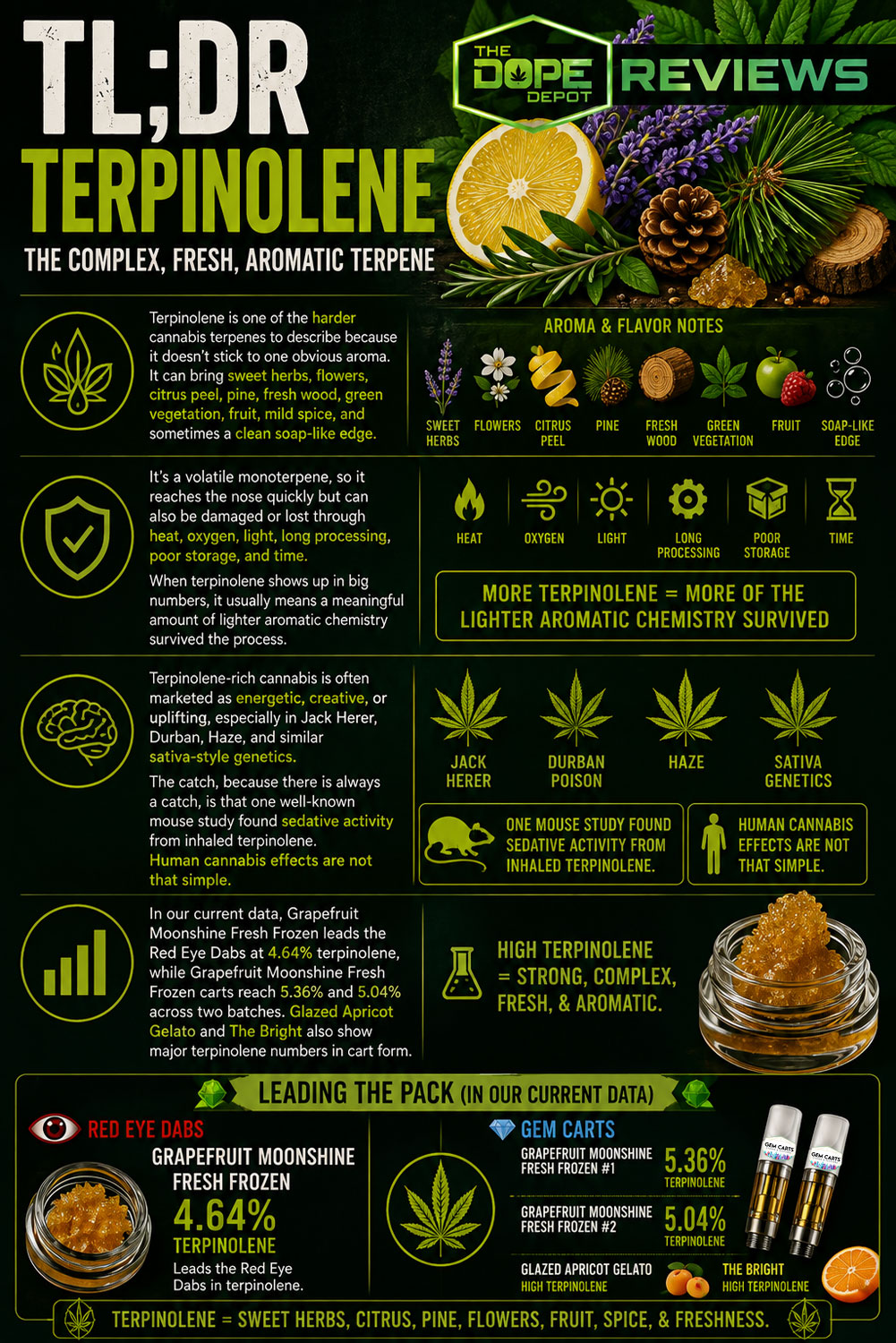
Terpinolene is one of the harder cannabis terpenes to describe because it doesn’t stick to one obvious aroma. It can bring sweet herbs, flowers, citrus peel, pine, fresh wood, green vegetation, fruit, mild spice, and sometimes a clean soap-like edge.
It’s a volatile monoterpene, so it reaches the nose quickly but can also be damaged or lost through heat, oxygen, light, long processing, poor storage, and time. When terpinolene shows up in big numbers, it usually means a meaningful amount of lighter aromatic chemistry survived the process.
Terpinolene-rich cannabis is often marketed as energetic, creative, or uplifting, especially in Jack Herer, Durban, Haze, and similar sativa-style genetics. The catch, because there is always a catch, is that one well-known mouse study found sedative activity from inhaled terpinolene. Human cannabis effects are not that simple.
In our current data, Grapefruit Moonshine Fresh Frozen leads the Red Eye Dabs at 4.64% terpinolene, while Grapefruit Moonshine Fresh Frozen carts reach 5.36% and 5.04% across two batches. Glazed Apricot Gelato and The Bright also show major terpinolene numbers in cart form.
The short squirrel version:
Terpinolene brings bright, complex, sweet-herbal-fresh chemistry to cannabis. It can dominate certain profiles, especially Grapefruit Moonshine Fresh Frozen, but it does not guarantee energy, sedation, creativity, or any other neat little effect label humans keep trying to staple onto it.