
Podcast: Play in new window | Download (Duration: 30:02 — 21.9MB)
The posts in this series are a pretty healthy read, so for those of you who lack the curiosity or the attention span, scroll to the end and find the TL;DR, or CLICK HERE!! Otherwise, put on your thinking caps and lets get going!
If you don’t feel like reading, you can listen to Finn read the post to you. Download the mp3 here or tap the play button!
- Click here to skip to the top 5 Red Eye dab Linalool heavy hitters.
- Click here to skip to the top 5 Gem Cart / Pocket Puffer Linalool heavy hitters.
Linalool: The Floral Softener in Cannabis
Linalool has spent most of its public life trapped inside one word: lavender.
That association makes sense. Lavender can contain substantial amounts of linalool, and the terpene contributes heavily to its recognizable floral aroma. But linalool isn’t lavender in molecular form.
It also appears in coriander, basil, mint, citrus blossoms, rosewood, and numerous other aromatic plants. In cannabis, it can contribute flowers, sweet herbs, soft wood, citrus, spice, and a faint clean freshness that rounds off sharper terpenes.
Linalool rarely dominates the cannabis profiles in our database. It usually works as a supporting compound, softening the edges of limonene, beta-caryophyllene, humulene, myrcene, and pinene. That quieter role makes it easy to underestimate. Linalool may not build the entire profile, but it can change how nearly every other part of the profile feels.
What Is Linalool?
Linalool is an acyclic monoterpene alcohol with the molecular formula C10H18O.
The word “acyclic” means the molecule has an open-chain structure rather than the carbon ring found in compounds such as limonene or terpinolene. The “alcohol” part refers to the hydroxyl group built into its molecular structure. It doesn’t mean linalool behaves like beverage alcohol or produces alcohol intoxication.
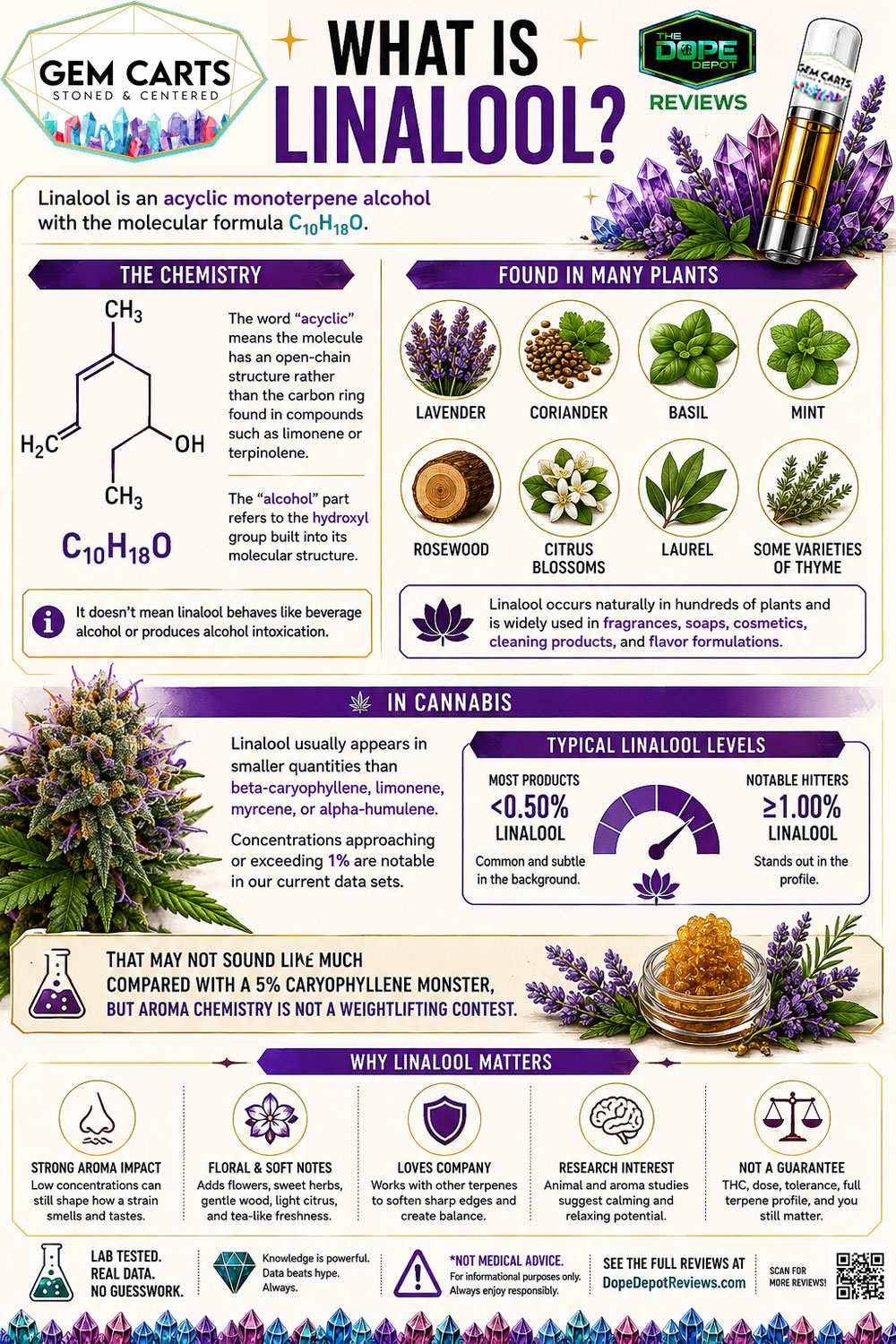
Linalool occurs naturally in hundreds of plants and is widely used in fragrances, soaps, cosmetics, cleaning products, and flavor formulations. Common botanical sources include:
- Lavender
- Coriander
- Basil
- Mint
- Rosewood
- Citrus blossoms
- Laurel
- Some varieties of thyme
In cannabis, linalool usually appears in smaller quantities than beta-caryophyllene, limonene, myrcene, or alpha-humulene. Concentrations approaching or exceeding 1% are notable in our current data sets.
That may not sound like much compared with a 5% caryophyllene monster, but aroma chemistry is not a weightlifting contest. Smaller compounds can still reshape the room.
Linalool Has Two Molecular Forms
Like limonene, linalool exists in two mirror-image forms called enantiomers. These are commonly identified as:
- R-(-)-linalool
- S-(+)-linalool
The two molecules contain the same atoms connected in the same basic order, but their three-dimensional structures mirror one another. Biological systems can distinguish between them.
The two forms may produce somewhat different odor impressions and have produced different physiological responses in experimental research. Both remain recognizably floral, but one sample of linalool may lean woodier, sweeter, fresher, or more herbal depending on which form is present and what surrounds it.
Standard cannabis terpene panels generally report one combined linalool result rather than separating the enantiomers. That means a PhytoFact sheet tells us the total amount detected, but not the exact three-dimensional composition responsible for the aroma.
What Does Linalool Smell and Taste Like?
Linalool is most strongly associated with floral aroma, but its sensory range extends beyond lavender. It can contribute:
- Lavender
- Fresh flowers
- Sweet herbs
- Soft wood
- Light citrus
- Coriander
- Mild spice
- Clean freshness
- Tea-like notes
- Gentle fruit sweetness
- Faint balsamic notes
Linalool usually doesn’t strike the nose as aggressively as limonene, terpinolene, or pinene. It tends to sit in the middle of the profile, connecting brighter top notes with heavier compounds underneath.
With limonene, linalool can create a sweeter and more floral citrus profile. With beta-caryophyllene and humulene, it can soften pepper, dry wood, herbs, and bitterness. With myrcene, it may produce a deeper combination of flowers, ripe fruit, earth, and musk.
Pinene can sharpen the profile around it, while ocimene may emphasize sweet floral and green fruit qualities. This makes linalool particularly important in blends. It often acts less like the main flavor and more like the chemical transition between several different flavors.
Basically, linalool is the molecule standing between louder terpenes and asking everyone to stop throwing chairs.
Lavender Is More Than Linalool
Lavender is the standard sensory reference for linalool, but real lavender aroma comes from a much larger mixture of compounds. Depending on the lavender species and growing conditions, its essential oil can contain:
- Linalool
- Linalyl acetate
- Camphor
- Terpinen-4-ol
- Lavandulol
- Ocimene
- Cineole
- Numerous minor volatile compounds
Linalyl acetate is particularly important. It’s a related ester with its own soft, sweet, floral character. Linalool and linalyl acetate are separate molecules. A laboratory result showing linalool does not tell us whether linalyl acetate or the rest of lavender’s chemistry is present.
This is why a linalool-rich cannabis extract may smell floral without smelling exactly like lavender. One compound provides part of the vocabulary. The full volatile profile writes the sentence.
Linalool Is Volatile, but Oxygenated
Linalool is a monoterpene, meaning it’s still relatively volatile and vulnerable to processing and storage conditions. Heat, oxygen, light, extended handling, and repeated temperature changes can all alter the profile.
Linalool may be affected by:
- Excessive processing temperatures
- Prolonged air exposure
- Aggressive vacuum
- Repeated heating
- Light exposure
- Poor container seals
- Long storage periods
Its oxygen atom doesn’t make it immune to evaporation or degradation. Careful extraction and storage remain important, especially when trying to preserve a broad range of lighter aromatic compounds rather than only the heavier sesquiterpenes.
What Happens When Linalool Oxidizes?
Linalool reacts with oxygen during air exposure. That process can create several oxidation products, including linalool hydroperoxides. These compounds are chemically different from fresh linalool and can alter the sensory profile. Oxidation may reduce some of the terpene’s fresh floral character while introducing duller or sharper notes.
Oxidized linalool products are also well established as fragrance contact allergens in some people. That research primarily involves skin exposure, cosmetics, fragrances, and patch testing. It does not directly establish the respiratory risk of consuming a cannabis extract containing linalool.
Those are different exposure routes and shouldn’t be casually treated as interchangeable. The practical storage lesson remains straightforward: keep the container sealed, cool, and protected from unnecessary light and oxygen. Fresh chemistry generally smells more like the profile the processor intended. Old oxygen gets creative, and almost never in a helpful way.
Does Linalool Make Cannabis Calming?
Linalool-rich cannabis is frequently described as relaxing, calming, sedating, soothing, or helpful for sleep. There is more scientific justification for studying those possibilities than there is for many common terpene claims.
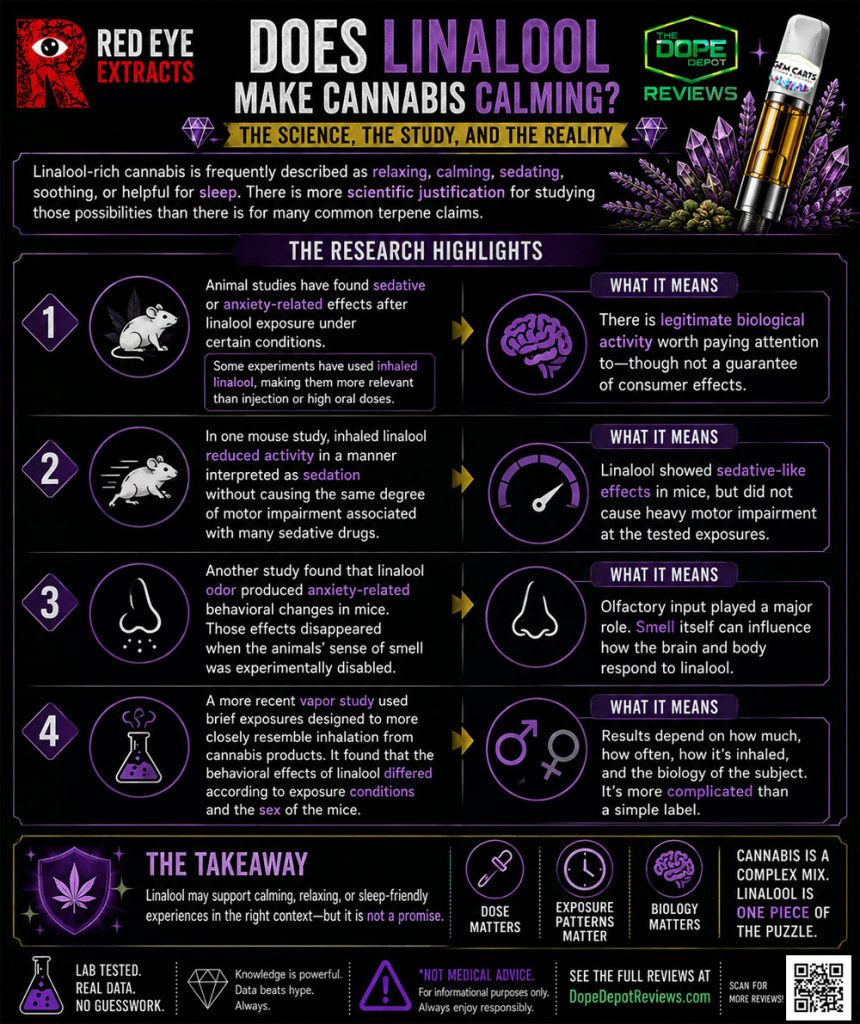
That still doesn’t make them guaranteed consumer effects. Animal studies have found sedative or anxiety-related effects after linalool exposure under certain conditions. Some experiments have used inhaled linalool, making them more relevant than studies relying entirely on injection or high oral doses.
In one mouse study, inhaled linalool reduced activity in a manner interpreted as sedation without causing the same degree of motor impairment associated with many sedative drugs.
Another study found that linalool odor produced anxiety-related behavioral changes in mice. Those effects disappeared when the animals’ sense of smell was experimentally disabled, suggesting that olfactory input itself played an important role.
A more recent vapor study used brief exposures designed to more closely resemble inhalation from cannabis products. It found that the behavioral effects of linalool differed according to exposure conditions and the sex of the mice.
That result is less convenient than a label reading “calming,” but considerably more informative. As we’ve stated many times, the dose matters, exposure patterns matter, and of course, biology matters.
What About Human Research?
Some human aroma studies have reported changes in stress-related physiological measures, mood, or perceived relaxation after exposure to linalool or linalool-rich essential oils. The evidence has several limitations. Many studies use lavender oil or another complete essential oil rather than isolated linalool. Those oils contain numerous active aromatic compounds.
Aromatherapy studies can also be difficult to blind. Participants know when they’re smelling a strong fragrance, and their expectations may influence subjective results. Sample sizes are often small, and the exposure conditions rarely resemble taking a dab or using a cannabis cartridge.
This doesn’t make human research worthless. It means the findings cannot be directly converted into a promise that an extract containing 0.8% or 1.2% linalool will reduce anxiety or improve sleep.
Cannabis adds THC, minor cannabinoids, additional terpenes, dose variability, personal tolerance, and individual endocannabinoid biology to the equation. A floral molecule doesn’t get veto power over all of that.
Does Linalool Determine the High?
Linalool may contribute to the character of a cannabis experience, but it cannot independently predict it. A linalool-rich product can be labeled indica, sativa, or hybrid.
Our current linalool-heavy products include all three categories. Gold Cash Candy and Blueberry Consort are indicas. Sugar Rim is a sativa. Zangria Walker and Forbidden Nerds are hybrids. On the cart side, Rainbow Runtz, Forbidden Blue, and Appletite are indicas, while Sugar Rim and Milkberry Funk are sativas.
That alone should make anyone suspicious of a simple “linalool equals sleepy indica” rule. The complete experience depends on:
- THC and total cannabinoid content
- Minor cannabinoids
- Total terpene concentration
- The ratio of linalool to other terpenes
- Dose
- Consumption method
- Tolerance
- Metabolism
- Individual sensitivity
Linalool can soften a profile chemically without guaranteeing that the human experience will feel soft. Those are related ideas, not identical ones.
Reading Linalool on a Lab Sheet
Linalool rarely appears as the dominant terpene in our production data.
Its influence is usually found in how it interacts with larger concentrations of beta-caryophyllene, limonene, myrcene, humulene, and pinene. When reading a terpene panel, ask:
- How much linalool is present?
- What percentage of the total terpene profile does it represent?
- Is the profile bright, heavy, fruity, or peppery without it?
- Which qualities might linalool soften or connect?
A product containing 0.8% linalool within a 5% total terpene profile is proportionally more floral than one containing the same 0.8% inside a 12% profile. The raw percentage matters as much as the ratio.
For this article, we went back a year and selected the five strongest linalool results from the Red Eye dab data sheet and the five strongest from the cart sheet.
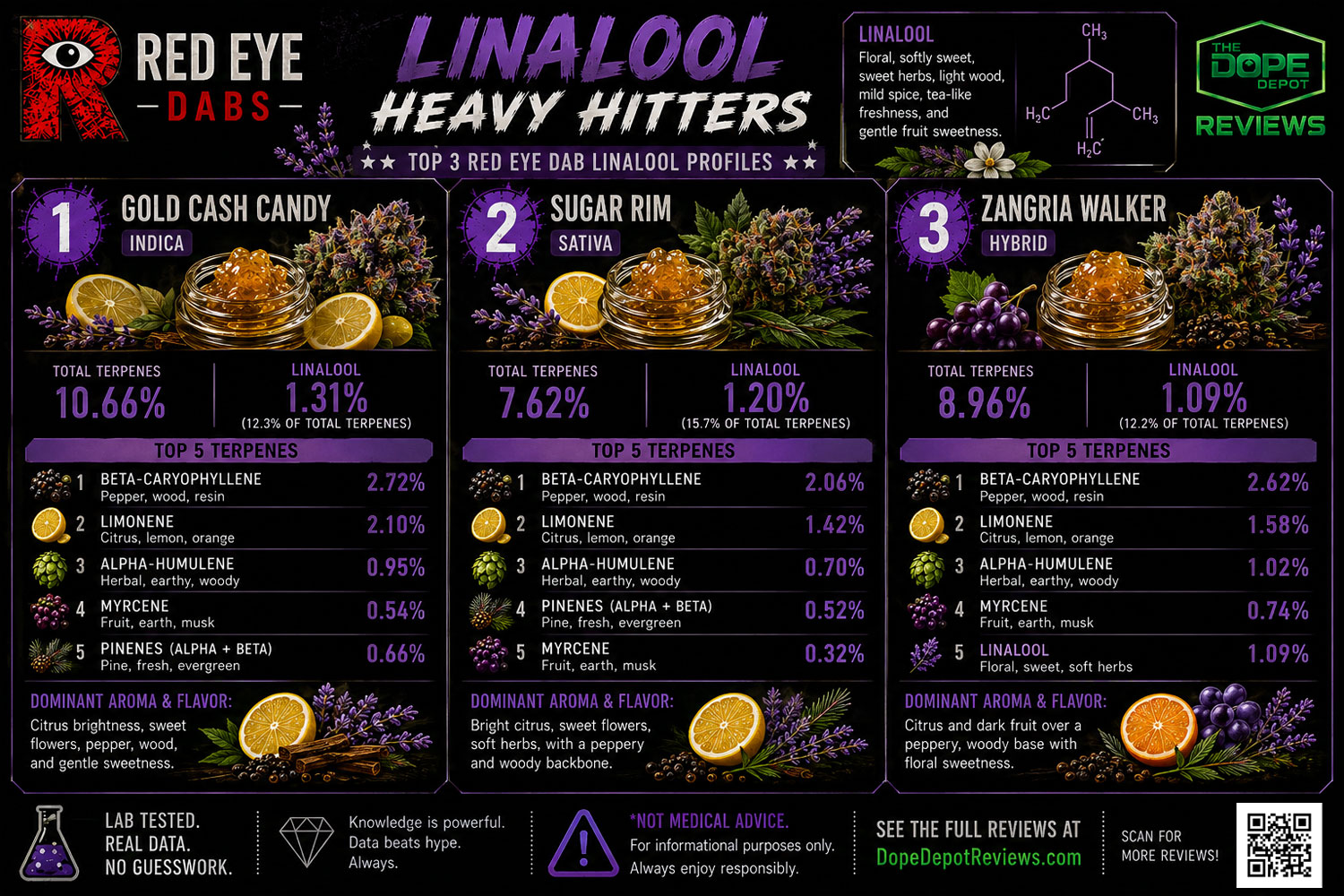
Five Red Eye Dab Heavy Hitters
1. Gold Cash Candy
Type: Indica
Total Terpenes: 10.66%
Linalool: 1.31%
Gold Cash Candy leads the current Red Eye Dab group with 1.31% linalool. That represents more than 12% of its total measured terpene profile.
Beta-caryophyllene leads at 2.72%, while limonene reaches 2.10%. Alpha-humulene contributes 0.95%, myrcene sits at 0.54%, and the combined pinenes add another 0.66%. Alpha-terpineol is also notable at 0.40%, which may add additional soft floral and woody character around the linalool.
This is one of the more polished profiles in the current linalool group.
Limonene brings citrus brightness. Beta-caryophyllene and humulene add pepper, dry wood, herbs, and resin. Linalool and alpha-terpineol soften the middle with flowers and gentle sweetness, while myrcene gives the lower end a little fruit and earth.
Gold Cash Candy sounds like it should be pure sweetness. The lab sheet says the candy has citrus, flowers, pepper, wood, and actual structure. A small victory against the tyranny of naming things like a gas station edible.
Check out the full review here.
2. Sugar Rim
Type: Sativa
Total Terpenes: 7.62%
Linalool: 1.20%
Sugar Rim comes in second with 1.20% linalool. That represents nearly 16% of the total measured terpene profile, making Sugar Rim one of the most proportionally linalool-rich Red Eye Dabs in the current group.
Beta-caryophyllene leads at 2.06%, while limonene follows at 1.42%. Alpha-humulene reaches 0.70%, and the combined pinenes contribute 0.52%. Myrcene is lower at 0.32%, which means the profile should rely less on heavy earth and musk than several other products in this article.
This should be a bright, floral, citrus-forward profile with a solid peppery and woody frame underneath. Linalool sits close enough to limonene to significantly soften and sweeten the citrus side, while beta-caryophyllene and humulene keep the structure from floating away.
Sugar Rim may be labeled sativa, but it carries more linalool than plenty of indicas. The molecule has once again ignored the brochure.
Check out the full review here.
3. Zangria Walker
Type: Hybrid
Total Terpenes: 8.96%
Linalool: 1.09%
Zangria Walker carries 1.09% linalool. It’s still one of the strongest linalool results on the current Red Eye sheet, with linalool accounting for roughly 12% of the complete measured terpene profile.
Beta-caryophyllene leads at 2.62%, followed by limonene at 1.58% and alpha-humulene at 1.02%. Myrcene contributes another 0.74%. That creates a dense foundation of pepper, dry wood, herbs, citrus, fruit, and earth.
Linalool adds a substantial floral and softly sweet layer through the middle. Its concentration is nearly identical to the humulene content, creating an interesting balance between floral softness and dry herbal bitterness.
Zangria Walker should be neither purely bright nor purely heavy. The chemistry resembles citrus and dark fruit being arranged over a peppery wooden frame, then somebody places flowers on the table to make the room look less hostile.
Check out the full review here.
4. Blueberry Consort
Type: Indica
Total Terpenes: 6.27%
Linalool: 0.97%
Blueberry Consort lands fourth with 0.97% linalool. That represents more than 15% of its total terpene profile, making it very linalool-forward by ratio even though the raw number is lower than Zangria Walker.
Beta-caryophyllene leads at 1.45%, while limonene reaches 0.93%. Myrcene sits at 0.58%, alpha-humulene at 0.50%, and the combined pinenes contribute 0.33%. Alpha-terpineol is also present at 0.24%. This is a compact but nicely balanced profile.
Linalool and alpha-terpineol should add floral sweetness and a soft woody middle. Limonene brings citrus brightness, myrcene adds fruit and earth, and beta-caryophyllene with humulene provides pepper, dry herbs, and structure.
Blueberry aroma usually depends on compounds beyond a standard terpene panel, so we shouldn’t pretend linalool explains the whole thing. It does, however, give the profile more floral softness and roundness, which is exactly the kind of supporting work people only notice when it’s missing.
Check out the full review here.
5. Forbidden Nerds
Type: Hybrid
Total Terpenes: 6.35%
Linalool: 0.96%
Forbidden Nerds rounds out the current Red Eye top five with 0.96% linalool. That represents just over 15% of its total terpene content, putting it nearly even with Blueberry Consort by proportion.
Beta-caryophyllene reaches 1.49%, while limonene sits close behind at 1.29%. Myrcene and alpha-humulene contribute 0.55% and 0.50%.
This is one of the most evenly distributed profiles on the list. Caryophyllene provides pepper and wood. Limonene adds citrus brightness. Myrcene brings fruit and earth, while humulene contributes dry herbs.
Linalool sits close enough to the leading compounds to have a major influence, adding flowers and sweetness rather than merely decorating the finish. The profile has no overwhelming single leader.
Check out the full review here.
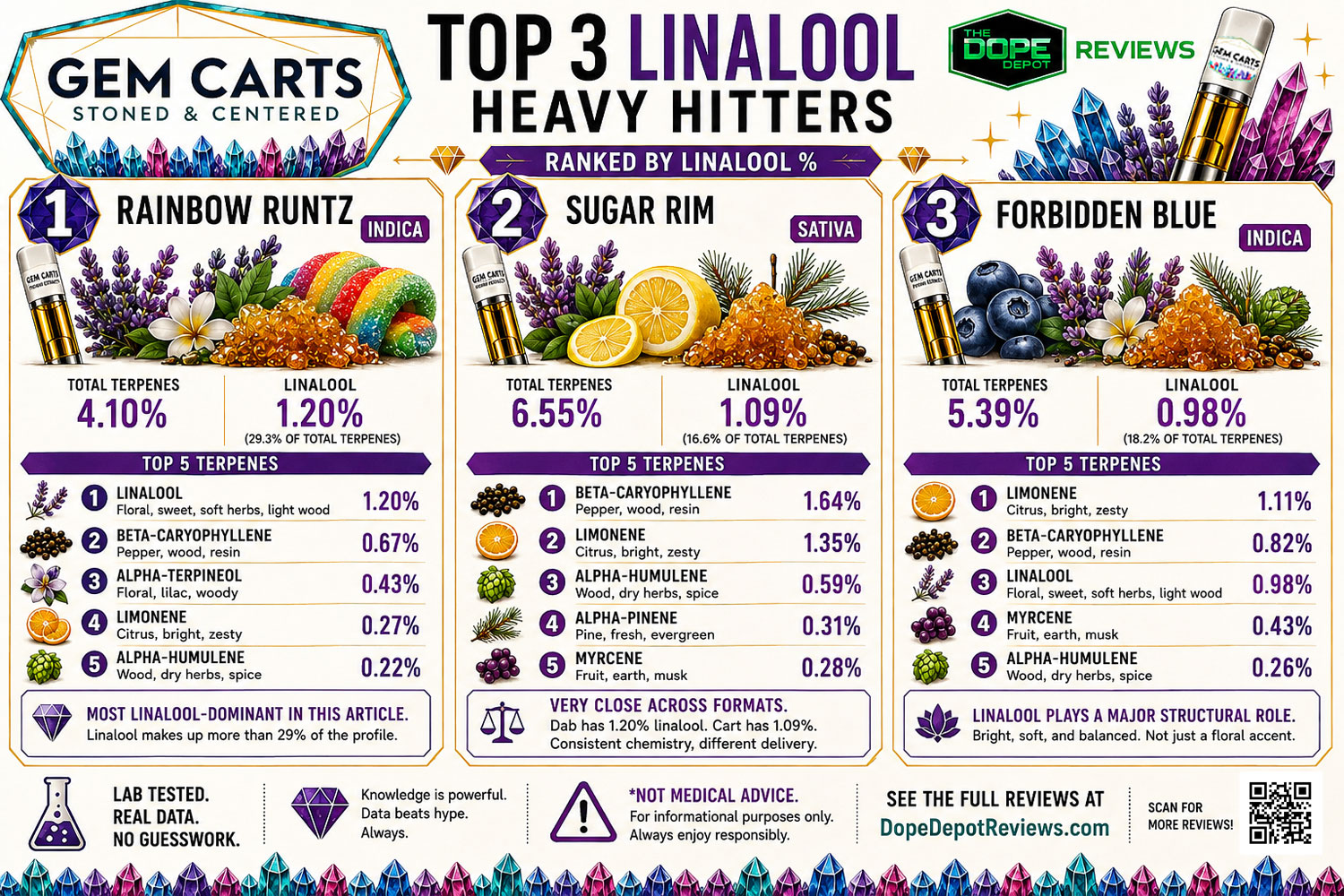
Five Cart Heavy Hitters
1. Rainbow Runtz
Type: Indica
Total Terpenes: 4.10%
Linalool: 1.20%
Rainbow Runtz leads the current cart group with 1.20% linalool. That is a huge result in context, because the total terpene profile is only 4.10%.
Linalool accounts for more than 29% of the entire measured terpene profile, making Rainbow Runtz the most linalool-dominant product in this article by proportion. Beta-caryophyllene follows at 0.67%, while alpha-terpineol reaches 0.43%. Limonene sits at 0.27%, alpha-humulene at 0.22%, and myrcene at 0.07%.
This is not a typical caryophyllene-led profile with linalool playing backup. Here, linalool is the main event. Expect floral sweetness, soft wood, gentle herbs, and a smoother aromatic middle rather than a loud peppery or citrus-dominant structure. The alpha-terpineol may reinforce that softer floral and woody direction.
Rainbow Runtz is one of the clearest examples in the current data of linalool stepping forward instead of politely holding the door for bigger terpenes. It apparently got tired of being “the lavender one” and filed for creative control.
Check out the full review here.
2. Sugar Rim
Type: Sativa
Total Terpenes: 6.55%
Linalool: 1.09%
Sugar Rim also appears in the cart list with 1.09% linalool. That represents nearly 17% of the measured terpene profile.
Beta-caryophyllene leads at 1.64%, while limonene reaches 1.35%. Alpha-humulene contributes 0.59%, alpha-pinene reaches 0.31%, and myrcene sits at 0.28%. The broad structure closely matches the Red Eye version: citrus, flowers, pepper, wood, herbs, and a touch of pine.
The dab contains 1.20% linalool, while the cart contains 1.09%. That is a very close result across formats, especially considering the decarboxylation needed for cart production. The linalool remains a major part of the profile.
This is exactly what we want from a cart version: recognizable terpene architecture, not a vague memory of the original extract wearing a battery.
Check out the full review here.
3. Forbidden Blue
Type: Indica
Total Terpenes: 5.39%
Linalool: 0.98%
Forbidden Blue contains 0.98% linalool, accounting for more than 18% of the total measured terpene profile. Limonene leads at 1.11%, while beta-caryophyllene follows at 0.82%. Myrcene contributes 0.43%, alpha-humulene sits at 0.26%, and alpha-terpineol reaches 0.24%.
This is another profile where linalool is not buried. It’s nearly tied with limonene and higher than beta-caryophyllene. That should create a bright but soft profile, with citrus, flowers, gentle wood, fruit, earth, and mild pepper all sharing space.
Forbidden Blue is especially useful because it shows linalool behaving as a major structural terpene in a cart rather than merely adding a small floral accent. It doesn’t dominate as strongly as Rainbow Runtz, but it has clearly escaped the background.
Check out the full review here.
4. Milkberry Funk
Type: Sativa
Total Terpenes: 4.58%
Linalool: 0.94%
Milkberry Funk carries 0.94% linalool inside a 4.58% total terpene profile. That puts linalool at more than 20% of the measured total.
Beta-caryophyllene sits at 0.86%, limonene at 0.59%, myrcene at 0.40%, alpha-humulene at 0.32%, and alpha-terpineol at 0.29%. This is another highly proportionally linalool-forward cart.
The profile should lean floral, soft, and gently sweet through the middle, with beta-caryophyllene adding pepper and wood, limonene adding brightness, and myrcene contributing fruit and earth. Alpha-terpineol may further reinforce the soft floral and woody character.
The “funk” side of the name probably involves chemistry beyond the standard terpene panel, because funk is rarely polite enough to fit inside one column. Still, the measured profile shows a cart with a surprisingly floral backbone for something labeled sativa.
Check out the full review here.
5. Appletite
Type: Indica
Total Terpenes: 5.73%
Linalool: 0.88%
Appletite rounds out the current cart top five with 0.88% linalool. That represents more than 15% of the total terpene profile.
Beta-caryophyllene leads at 2.11%, while alpha-humulene reaches 0.66%. Limonene sits lower at 0.35%, and myrcene contributes 0.12%. Alpha-terpineol is present at 0.23%. This is a very different structure from Rainbow Runtz or Forbidden Blue.
Appletite is more clearly built on the caryophyllene-humulene foundation of pepper, dry wood, herbs, and resin. Linalool provides a strong floral and sweet counterweight inside that heavier structure, while alpha-terpineol adds more soft wood and floral character.
The apple-like side likely depends on esters and other volatile compounds that don’t appear on this panel. But the linalool number tells us the profile has a meaningful floral softness beneath the drier, peppery backbone. Appletite isn’t just fruit. It’s fruit invited to a wood-paneled room full of dry herbs and judgment.
Check out the full review here.
What These Ten Products Show Us
The current master sheet gives us an interesting linalool story. First, linalool can be a major supporting terpene in dabs and carts, but it rarely travels alone. Most featured products still contain meaningful beta-caryophyllene, limonene, humulene, myrcene, or alpha-terpineol.
Gold Cash Candy, Sugar Rim, Zangria Walker, and Forbidden Nerds all combine linalool with strong limonene and beta-caryophyllene. That creates a recurring citrus-flower-pepper structure. Blueberry Consort adds more myrcene and alpha-terpineol, giving the profile more fruit, earth, soft wood, and floral roundness.
Second, raw concentration and proportional influence are different. Gold Cash Candy has the highest Red Eye linalool result at 1.31%. Sugar Rim follows at 1.20%. But Blueberry Consort and Forbidden Nerds devote more than 15% of their total terpene content to linalool even though their raw numbers are slightly lower.
The cart side makes that point even more clearly. Rainbow Runtz contains 1.20% linalool inside a 4.10% total terpene profile, making linalool more than 29% of the measured total. That is proportionally much more linalool-forward than many products with higher total terpene content.
Third, linalool-heavy products appear across traditional categories. The list includes indicas, sativas, and hybrids. Linalool may contribute floral aroma and potentially interact with the experience, but it doesn’t assign the product to an effect category.
Finally, Sugar Rim appears on both lists, giving us a useful format comparison. The Red Eye dab contains 1.20% linalool. The cart contains 1.09%. That’s close enough to show the core floral-citrus structure survived the transition into cart form.
Decarboxylation changes cannabinoid chemistry. It doesn’t have to erase the terpene identity when the process is handled properly.
The Lab Rat Verdict
Linalool is one of the main floral compounds found in cannabis, but reducing it to “the lavender terpene” leaves most of the story out. It can contribute flowers, sweet herbs, soft wood, citrus, mild spice, tea-like freshness, and gentle fruit sweetness.
Its most important role is often structural rather than dominant. Linalool can soften pepper, bridge citrus and earth, add flowers to fruit, and round off profiles built around beta-caryophyllene, humulene, myrcene, pinene, and alpha-terpineol.
The research into sedation, anxiety, pain signaling, and neurological activity is scientifically interesting but still dominated by animal studies, essential oils, laboratory models, and exposure conditions that don’t directly reproduce cannabis use.
Linalool-rich cannabis may feel calming to some people. The lab result cannot promise that outcome. What the number can tell us is whether meaningful floral chemistry survived into the finished product and how that chemistry fits alongside the rest of the profile.
Linalool doesn’t usually run the room. But when it shows up in enough concentration, it changes how everyone else sounds once they’re inside it.
Be sure to check out the Sheets page if you want to check out the full spreadsheet of our test results!
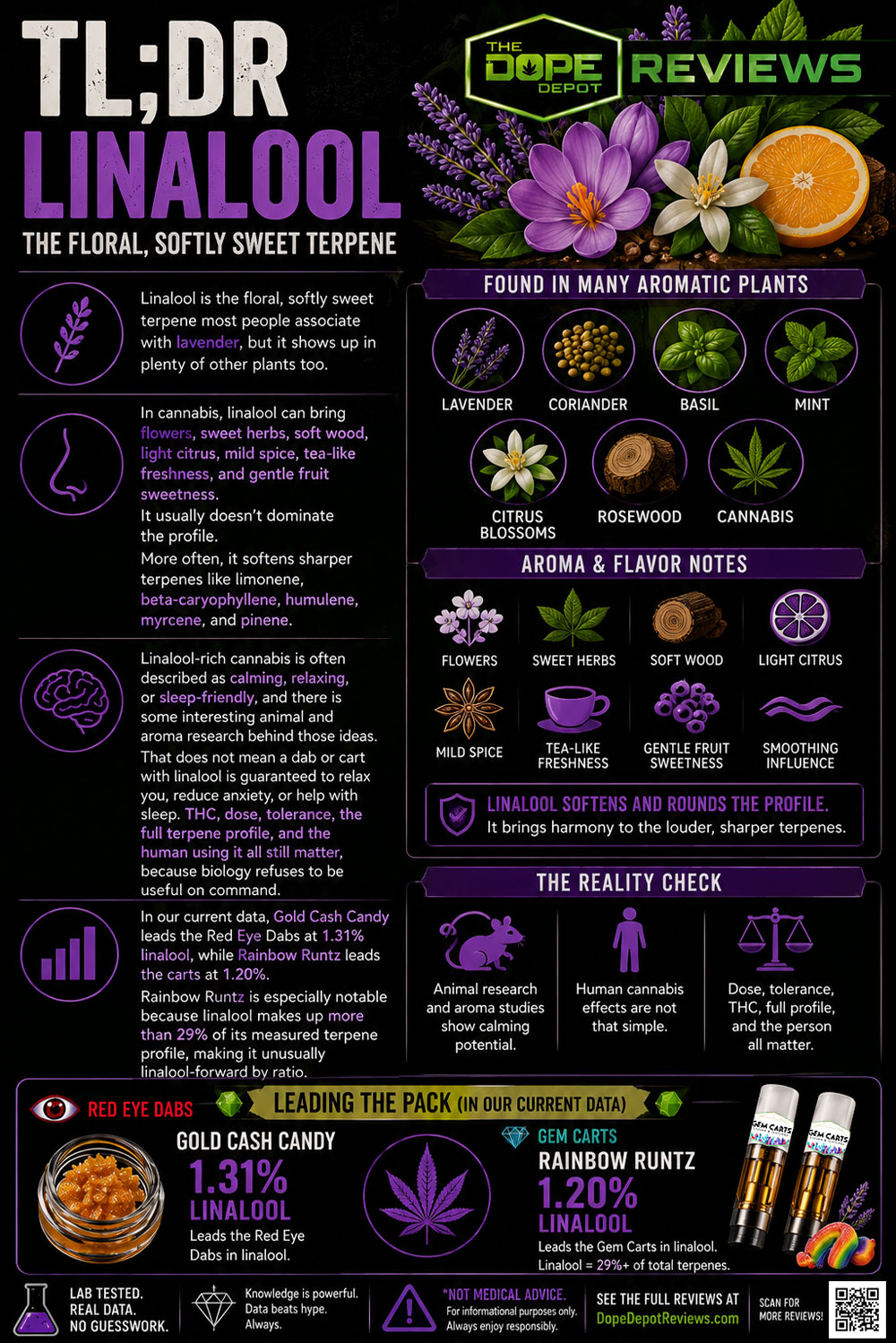
TL;DR: Linalool
Linalool is the floral, softly sweet terpene most people associate with lavender, but it shows up in plenty of other plants too, including coriander, basil, mint, citrus blossoms, rosewood, and cannabis.
In cannabis, linalool can bring flowers, sweet herbs, soft wood, light citrus, mild spice, tea-like freshness, and gentle fruit sweetness. It usually doesn’t dominate the profile. More often, it softens sharper terpenes like limonene, beta-caryophyllene, humulene, myrcene, and pinene.
Linalool-rich cannabis is often described as calming, relaxing, or sleep-friendly, and there is some interesting animal and aroma research behind those ideas. That does not mean a dab or cart with linalool is guaranteed to relax you, reduce anxiety, or help with sleep. THC, dose, tolerance, the full terpene profile, and the human using it all still matter, because biology refuses to be useful on command.
In our current data, Gold Cash Candy leads the Red Eye Dabs at 1.31% linalool, while Rainbow Runtz leads the carts at 1.20%. Rainbow Runtz is especially notable because linalool makes up more than 29% of its measured terpene profile, making it unusually linalool-forward by ratio.
The short squirrel version:
Linalool adds floral softness and smoother middle notes to cannabis. It can make a profile feel sweeter, rounder, and less sharp, but it does not automatically mean lavender, sleep, sedation, or calm. It’s a supporting molecule with real influence, not a tiny purple weighted blanket.