

Podcast: Play in new window | Download (Duration: 35:37 — 25.7MB)
The posts in this series are a pretty healthy read, so for those of you who lack the curiosity or the attention span, scroll to the end and find the TL;DR, or CLICK HERE!! Otherwise, put on your thinking caps and lets get going!
If you don’t feel like reading, you can listen to Finn read the post to you. Download the mp3 here or tap the play button!
- Click here to skip to the top 5 Red Eye dab Ocimene heavy hitters.
- Click here to skip to the top 5 Gem Cart Ocimene heavy hitters.
Beta-Ocimene: The Sweet Green Messenger in Cannabis
Beta-ocimene is one of the quieter names on a cannabis terpene panel. It rarely reaches the massive concentrations we see from beta-caryophyllene, myrcene, limonene, or terpinolene. In many extracts, beta-ocimene appears at a few hundredths of a percent.
Even our current heavy hitters remain below 1%. That makes it easy to dismiss. It would also be a mistake. Beta-ocimene is a highly aromatic monoterpene associated with sweet flowers, fresh herbs, green fruit, citrus peel, and living vegetation. It often works near the upper end of a profile, adding lift and freshness around larger concentrations of fruit, earth, pepper, flowers, or pine.
It’s also one of the most ecologically interesting terpenes in this series. Plants release beta-ocimene from flowers, leaves, and damaged tissues. It participates in scent bouquets that interact with pollinators, herbivores, neighboring plants, and insects that prey on plant pests.
To us lab rats and humans, it may smell pleasantly sweet and green. To the plant, it can be part perfume, part alarm system, and part interspecies group chat. Which is honestly more social coordination than most of us can manage.
What Is Beta-Ocimene?
Beta-ocimene is an acyclic monoterpene with the molecular formula C10H16. “Acyclic” means its carbon skeleton forms an open chain rather than the rings found in limonene, terpinolene, or pinene.
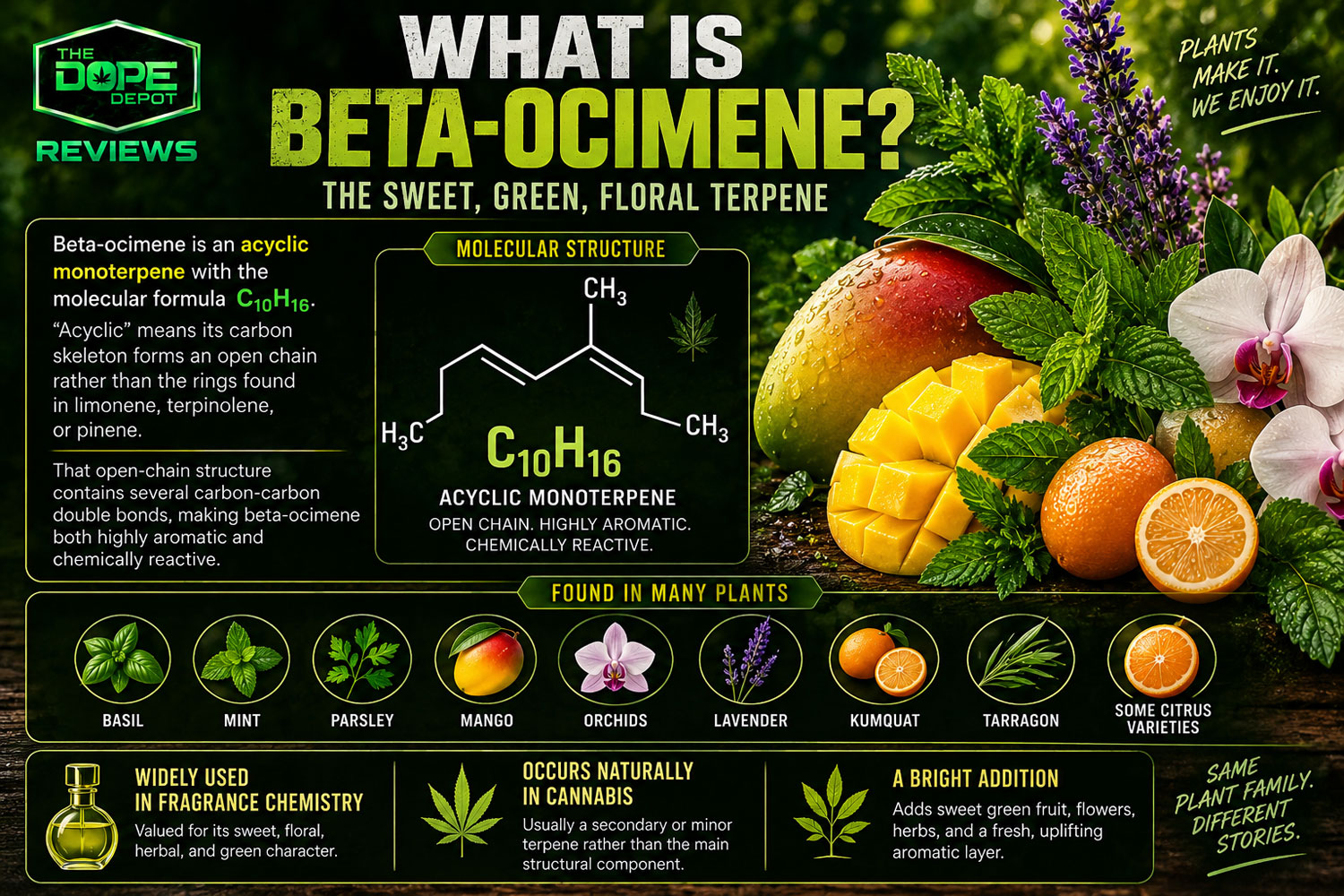
That open-chain structure contains several carbon-carbon double bonds, making beta-ocimene both highly aromatic and chemically reactive. It occurs naturally in cannabis and numerous other plants, including:
- Basil
- Mint
- Parsley
- Mango
- Orchids
- Lavender
- Kumquat
- Tarragon
- Some citrus varieties
Beta-ocimene is widely used in fragrance chemistry because of its sweet, floral, herbal, and green character. In cannabis, it usually acts as a secondary or minor terpene rather than the main structural component.
That doesn’t make it irrelevant. A small amount of a highly aromatic compound can have a greater sensory effect than its percentage suggests. Human smell is determined partly by odor thresholds, not merely by which molecule occupies the most space on a laboratory report.
The biggest number isn’t always the whole story. It’s merely the loudest spreadsheet cell.
Beta-Ocimene Has Multiple Forms
Beta-ocimene exists in different geometric forms called isomers. The two most commonly discussed are:
- (E)-beta-ocimene, also called trans-beta-ocimene
- (Z)-beta-ocimene, also called cis-beta-ocimene
They share the same molecular formula and basic carbon framework. The difference is how portions of the molecule are arranged around one of its double bonds. That change in geometry can affect aroma, chemical reactivity, biological interactions, and how the compound behaves in a mixture.
Standard cannabis terpene panels often list one beta-ocimene result without separating the E and Z forms. That’s what we see on our SC Labs PhytoFact sheets. The number tells us how much beta-ocimene was detected. It doesn’t reveal the exact isomeric mixture responsible for the finished aroma.
What Does Beta-Ocimene Smell and Taste Like?
Beta-ocimene is usually described as sweet, floral, herbal, and green. Depending on its concentration and surrounding chemistry, it can contribute:
- Sweet flowers
- Fresh herbs
- Green fruit
- Citrus peel
- Tropical fruit
- Young vegetation
- Basil
- Mint
- Light wood
- Tea-like freshness
- Clean sweetness
- Mild spice
It generally behaves like a bright top or upper-middle note. Beta-ocimene doesn’t usually provide the heavy foundation of an extract. That job belongs more often to beta-caryophyllene, humulene, or myrcene.
Instead, ocimene adds movement above the foundation.
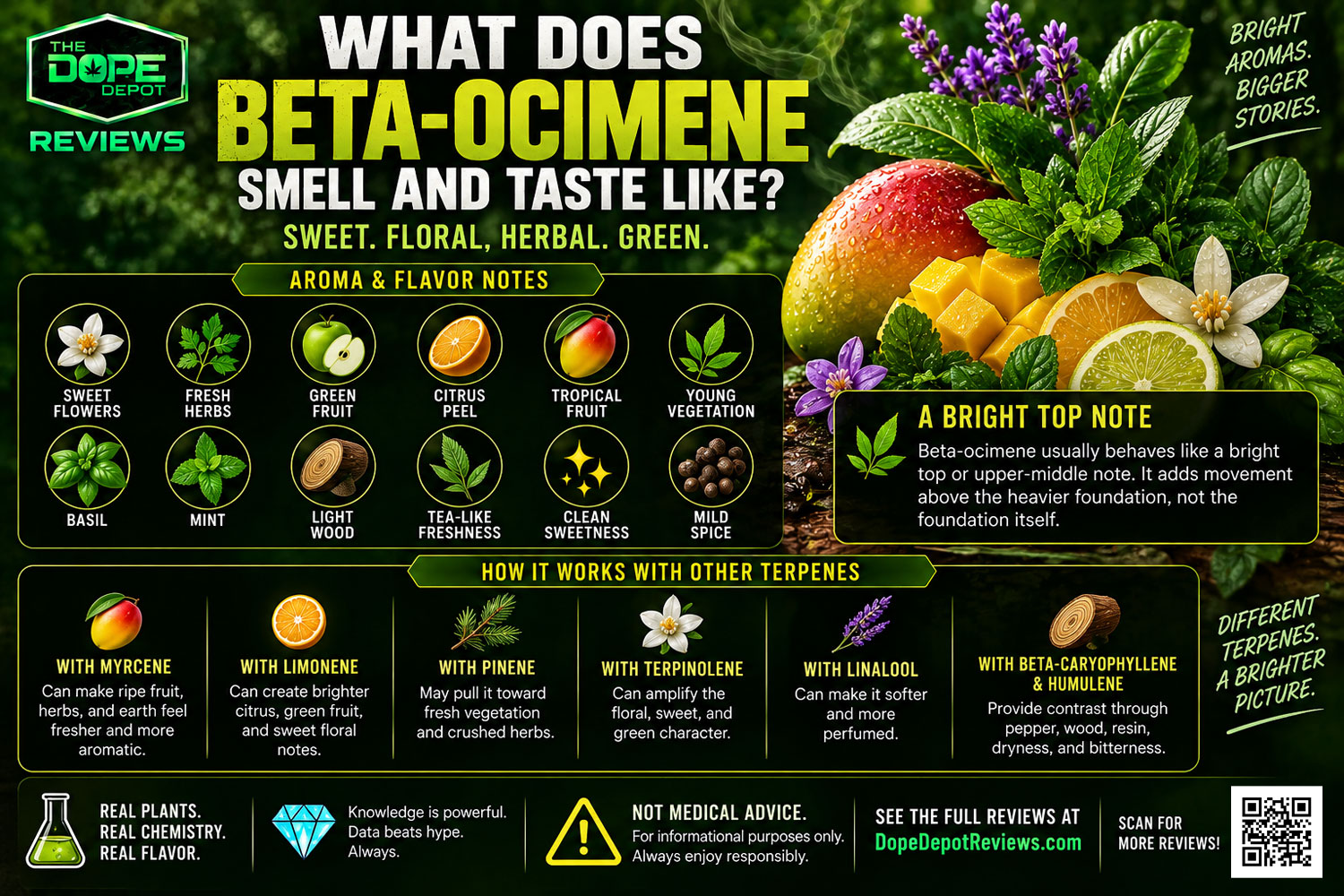
With myrcene, it can make ripe fruit, herbs, and earth feel fresher and more aromatic. With limonene, it can create brighter citrus, green fruit, and sweet floral notes. Pinene may pull it toward fresh vegetation and crushed herbs.
Terpinolene can amplify the floral, sweet, and green character, while linalool can make it softer and more perfumed. Beta-caryophyllene and humulene provide contrast through pepper, wood, resin, dryness, and bitterness. This is why ocimene may matter even when it represents only two, three, or five percent of the total terpene profile.
It changes the air above the heavier chemistry.
Ocimene Is Not the Entire Smell of Sweet Fruit
Beta-ocimene is sometimes described as fruity, tropical, or mango-like. Those descriptions can be useful, but beta-ocimene doesn’t recreate an entire piece of fruit by itself.
Fruit aroma depends on complex mixtures of:
- Esters
- Aldehydes
- Alcohols
- Ketones
- Other Terpenes
- Sulfur compounds
- Other trace volatiles
Many of those compounds don’t appear on a standard cannabis terpene panel.
An extract containing beta-ocimene may smell sweeter or greener because of it. Whether that aroma becomes mango, citrus, berries, flowers, candy, or something harder to name depends on the rest of the volatile fingerprint.
The laboratory sheet gives us part of the explanation. The nose receives the finished argument.
A Highly Volatile and Reactive Monoterpene
Beta-ocimene is a small, unsaturated monoterpene.
Its multiple double bonds make it chemically reactive, particularly in the presence of oxygen, ozone, light, and other environmental oxidants. It can be affected by:
- Excessive heat
- Oxygen exposure
- Ozone
- Light
- Extended processing
- Aggressive vacuum
- Repeated warming
- Poorly sealed packaging
- Time
Because it’s volatile, beta-ocimene can evaporate or degrade more easily than heavier sesquiterpenes such as beta-caryophyllene and alpha-humulene. This makes meaningful beta-ocimene concentrations another indicator of volatile preservation.
A result of 0.3% or 0.5% may not look dramatic beside 4% myrcene or 5% caryophyllene, but it means this lighter aromatic compound survived harvesting, extraction, purging, handling, storage, and testing. That survival is especially notable in decarboxylated cartridges.
Heat is required to convert THCA into THC and make the extract suitable for cart hardware. Every volatile monoterpene that remains afterward represents chemistry the process managed not to erase. Small victories still count, especially when chemistry is actively trying to leave the room.
What Happens When Beta-Ocimene Oxidizes?
Beta-ocimene reacts readily with ozone and other oxidizing agents. Those reactions break apart or modify the original molecule, producing a collection of oxygenated compounds with different chemical properties.
The exact products depend on the beta-ocimene isomer, oxidant, temperature, humidity, and surrounding environment. In practical cannabis terms, oxidation can gradually change a fresh sweet-green profile into something flatter, sharper, or less recognizable. This is one reason aroma declines during poor storage even if the extract still looks usable.
The original molecules haven’t simply disappeared. Some have been converted into new compounds that no longer smell like the starting material. Cool, airtight, light-protected storage slows those reactions.
Oxygen will eventually win. The goal is to avoid helping it.
Beta-Ocimene as Plant Communication
Beta-ocimene is especially interesting because plants use it in multiple ecological contexts.
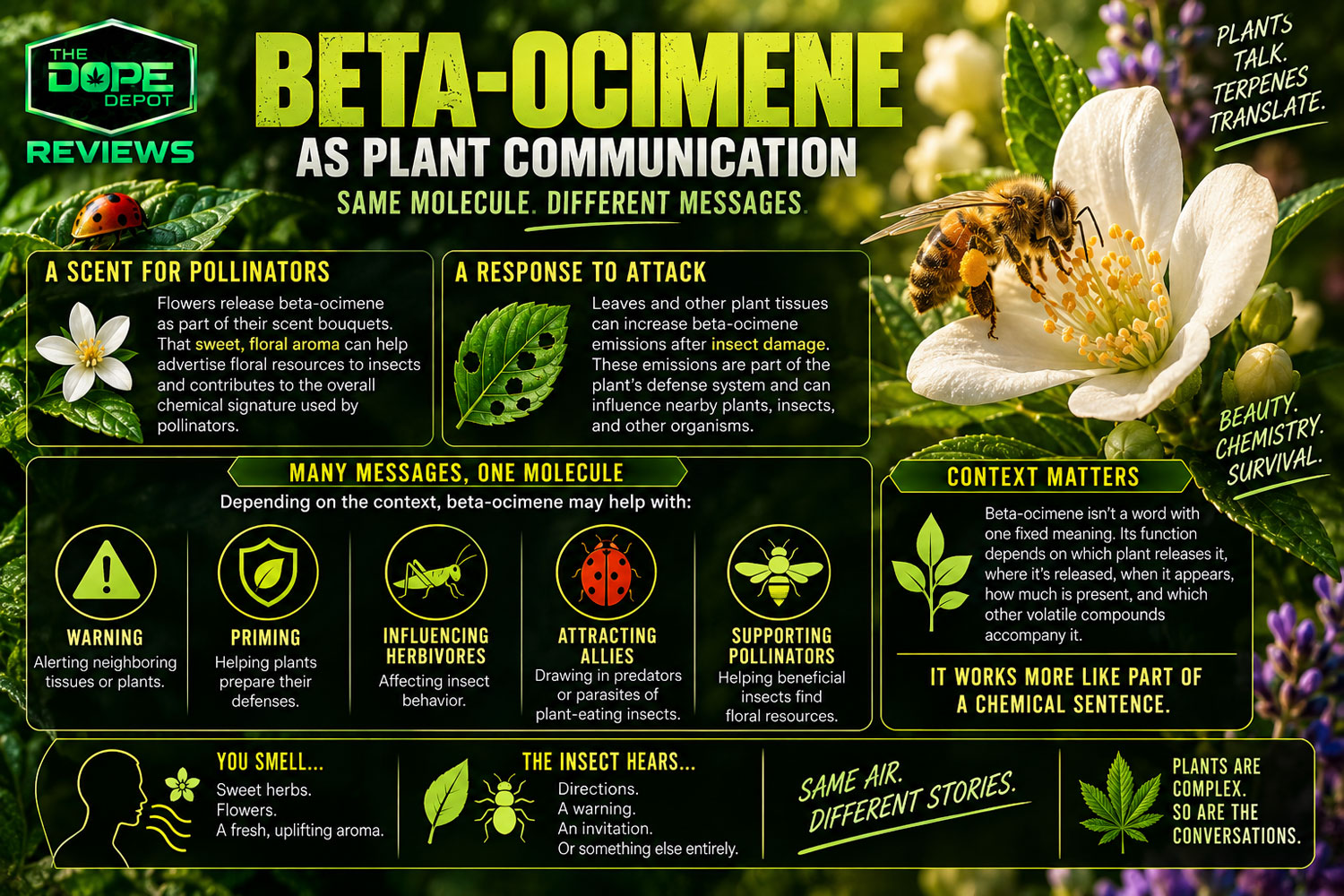
Flowers release it as part of their scent bouquets. That aroma can help advertise floral resources to insects and contribute to the overall chemical signature used by pollinators. Leaves and other plant tissues can also increase beta-ocimene emissions after insect damage.
Those emissions may participate in several kinds of communication:
- Warning neighboring tissues or plants
- Priming defensive responses
- Affecting herbivore behavior
- Attracting predators or parasites of plant-eating insects
- Altering interactions with pollinators
Beta-ocimene isn’t a word with one fixed meaning. Its function depends on which plant releases it, where it’s released, when it appears, how much is present, and which other volatile compounds accompany it.
It works more like part of a chemical sentence. Humans smell sweet herbs and flowers. A nearby insect may receive directions, a warning, an invitation, or deeply misleading advertising.
Does Beta-Ocimene Make Cannabis Uplifting?
Beta-ocimene is frequently described by cannabis websites as energizing, stimulating, uplifting, creative, or mentally refreshing. Direct human evidence supporting those descriptions is essentially absent.
There are no strong controlled human studies showing that isolated beta-ocimene reliably improves energy, mood, focus, creativity, or alertness during cannabis use. The reputation may come partly from the cultivars in which ocimene appears.
Ocimene is commonly associated with aromatic sativa and hybrid varieties that also contain substantial limonene, pinene, terpinolene, and THC. Consumers may experience those products as bright or mentally active. That does not establish beta-ocimene as the cause.
Our own current results show the problem.
The ocimene-heavy Red Eye Dab group includes sativas and hybrids. The cart group contains sativas, hybrids, and an indica. The molecule has no obligation to honor the marketing category printed on the package.
Beta-ocimene may influence the profile and possibly contribute to the experience. The available evidence doesn’t allow us to assign it a predictable psychological effect. The terpene adds chemistry. It does not hand out motivational speeches.
Is Beta-Ocimene a Decongestant or Expectorant?
Another common claim says beta-ocimene acts as a decongestant or expectorant. This claim is widely repeated in cannabis terpene guides. Strong direct evidence is difficult to find.
Some aromatic plants and essential oils containing ocimene have traditional respiratory uses. Those preparations contain many compounds, and their effects cannot automatically be assigned to beta-ocimene. There are no convincing controlled human trials showing that inhaled beta-ocimene clears mucus, opens airways, treats congestion, or improves respiratory function.
Cannabis smoke and vapor should not be treated as respiratory medicine because a terpene chart used the word “decongestant.” A fresh green aroma may create a sensory impression of openness. That is not the same as a measured change in pulmonary function.
What Does the Research Say?
Compared with limonene, linalool, beta-caryophyllene, and pinene, beta-ocimene has received relatively little human pharmacology research. Most of the scientific work concerns:
- Plant signaling
- Pollinator and insect behavior
- Herbivore-induced plant defenses
- Fragrance chemistry
- Atmospheric oxidation
- Antimicrobial or antifungal activity
- Cell studies
- Essential oils
One laboratory study tested an essential oil rich in alpha-pinene and cis-beta-ocimene against several fungi. The complete essential oil and isolated compounds displayed antifungal activity against some dermatophytes and Cryptococcus neoformans. Alpha-pinene was generally the more active isolated compound.
That result establishes that cis-beta-ocimene can affect certain fungi under controlled laboratory conditions. It doesn’t prove that consuming an ocimene-rich cannabis product prevents or treats fungal infection in a human.
Concentration matters. Exposure route matters. The organism matters. Cells in laboratory media are not interchangeable with a patient. The same caution applies to other antimicrobial, antioxidant, anti-inflammatory, or anticancer claims.
Beta-ocimene is chemically and biologically interesting. Its therapeutic role in human cannabis use remains largely untested. “Interesting” is not the same as “medical claim,” though plenty of marketers keep trying to shove those words into the same trench coat.
Does Beta-Ocimene Determine the High?
No single terpene determines a cannabis experience. Beta-ocimene concentrations in our current featured products range from 0.24% to 0.52% in the cart list and 0.26% to 0.40% in the Red Eye Dab list.
Those amounts may contribute meaningfully to aroma, but the products also contain much larger quantities of THC and other terpenes. Relevant variables include:
- THC and total cannabinoid content
- Minor cannabinoids
- Other Terpenes
- Total terpene concentration
- Dose
- Consumption method
- Tolerance
- Metabolism
- Set and setting
Pineapple OG contains a broad caryophyllene, limonene, myrcene, humulene, and ocimene structure. Guava Toss and Guava Pie are dominated by myrcene. The Bright and Jack Herer are dominated by terpinolene.
Blue Dream Berry is driven heavily by limonene and beta-caryophyllene. Beta-ocimene performs a different job inside each of those profiles. One percentage cannot be separated from the chemistry surrounding it.
The spreadsheet gives the ingredient. The full profile decides whether it becomes fruit, flowers, herbs, green lift, or aromatic background wiring.
Reading Beta-Ocimene on a Lab Sheet
Beta-ocimene is usually a minor terpene in cannabis. That makes interpretation slightly different from reading a dominant compound such as myrcene or beta-caryophyllene.
A beta-ocimene result of 0.3% may represent only a small fraction of the total terpene content, but it can still contribute recognizable sweet, floral, green, or herbal details. When reading the panel, ask:
- How much beta-ocimene is present?
- What percentage of the total terpene profile does it represent?
- Which terpene dominates the product?
- Is ocimene reinforcing fruit, citrus, flowers, herbs, or fresh vegetation?
- Are other bright monoterpenes present?
Ocimene alongside terpinolene may increase sweet floral and green qualities. With limonene, it can contribute fresh citrus and fruit. With myrcene, it can lift an otherwise heavy earthy profile. With pinene, it may reinforce herbs and living vegetation.
For this article, we went back about a year and selected the five strongest beta-ocimene results from the Red Eye dab data sheet and the five strongest results from the cart sheet.
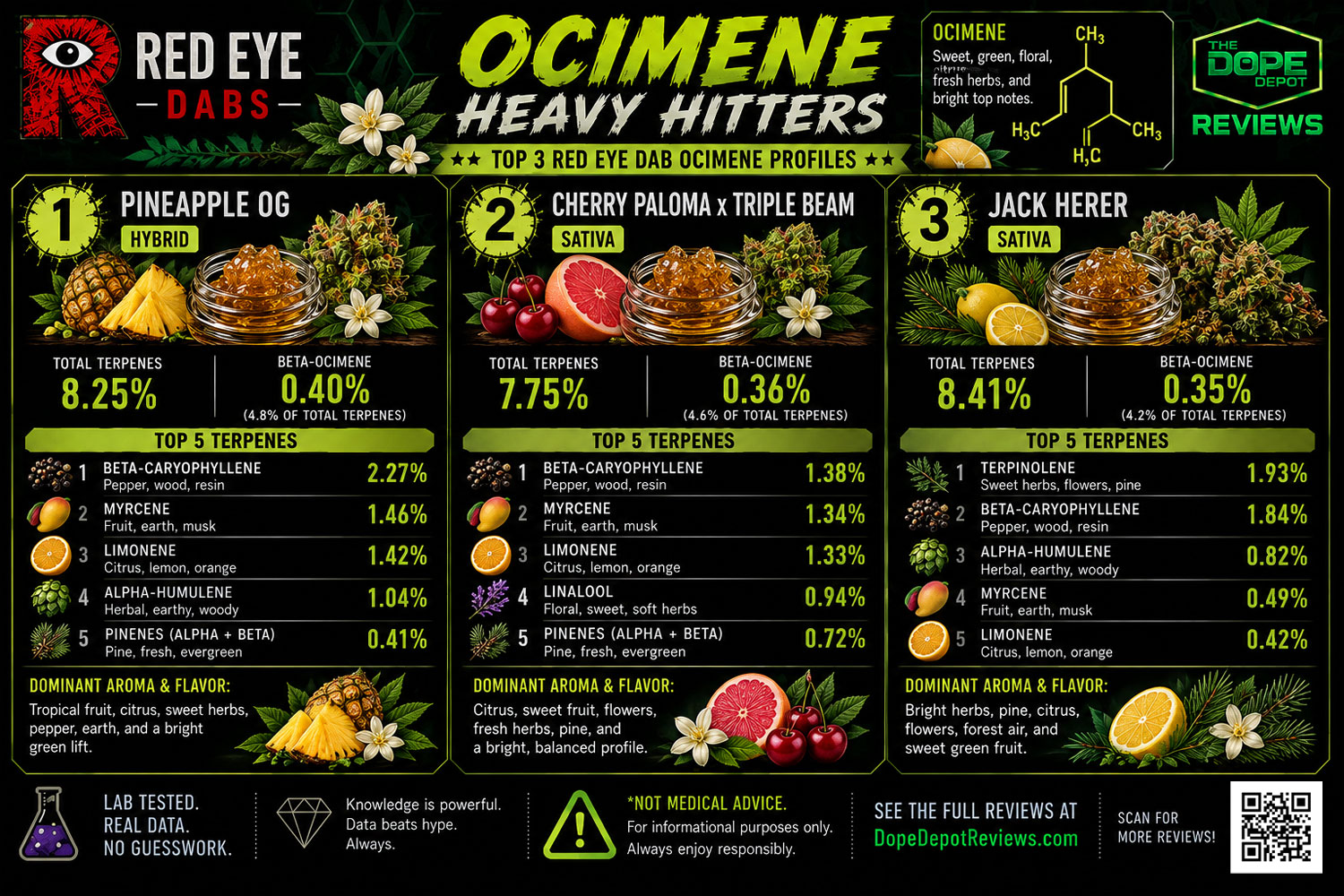
Five Red Eye Dab Heavy Hitters
1. Pineapple OG
Type: Hybrid
Total Terpenes: 8.25%
Beta-Ocimene: 0.40%
Pineapple OG leads the current Red Eye dab group with 0.40% beta-ocimene. That represents roughly 4.8% of the complete measured terpene profile.
Beta-caryophyllene leads at 2.27%, followed by myrcene at 1.46% and limonene at 1.42%. Alpha-humulene contributes 1.04%, while the combined pinenes add another 0.41%.
This is a broad profile, not an ocimene-dominant one. The major structure should include pepper, dry wood, ripe fruit, earth, citrus, herbs, and resin. Beta-ocimene adds sweet green fruit and floral lift between the myrcene and limonene.
The pineapple side cannot be explained by beta-ocimene alone. Pineapple aroma depends heavily on esters and other volatile compounds that standard terpene panels don’t capture. Still, ocimene gives the brighter fruit side more room to exist. At 0.40%, it is not steering the whole profile. It is absolutely sitting near the front and touching buttons.
Check out the full review here.
2. Cherry Paloma x Triple Beam
Type: Sativa
Total Terpenes: 7.75%
Beta-Ocimene: 0.36%
Cherry Paloma x Triple Beam comes in second with 0.36% beta-ocimene. That represents roughly 4.6% of the complete measured terpene profile.
The leading terpenes are remarkably balanced. Beta-caryophyllene reaches 1.38%, myrcene sits at 1.34%, and limonene lands at 1.33%. Linalool follows at 0.94%, while alpha-pinene and beta-pinene combine for another 0.72%.
Beta-ocimene enters a profile already crowded with citrus, fruit, flowers, pepper, earth, and pine. Its likely role is to reinforce the sweet floral and green-fruit portion, helping connect the limonene, linalool, myrcene, and pinene.
This is an unusually broad chemical arrangement. No single terpene controls the entire profile. Ocimene is part of the connective tissue holding several aromatic families together. It’s a group project where everyone contributed, an event rare enough to preserve in a laboratory database.
Check out the full review here.
3. Jack Herer
Type: Sativa
Total Terpenes: 8.41%
Beta-Ocimene: 0.35%
Jack Herer carries 0.35% beta-ocimene inside an 8.41% total terpene profile. That puts beta-ocimene at a little over 4% of the measured total.
Terpinolene leads at 1.93%, followed closely by beta-caryophyllene at 1.84%. Alpha-humulene reaches 0.82%, while myrcene sits at 0.49% and limonene at 0.42%. The profile also includes alpha-phellandrene, carene, alpha-pinene, beta-pinene, and alpha-terpineol in measurable amounts.
That matters because beta-ocimene makes the most sense here as part of a larger bright aromatic cluster. Terpinolene brings sweet herbs, flowers, citrus, pine, and fresh vegetation. Ocimene reinforces the sweet green and floral side. The phellandrene, carene, and pinenes push the profile toward sharper herbs, forest air, and living plant material.
Beta-caryophyllene and humulene keep the whole thing from floating away by adding pepper, wood, resin, and bitterness. Jack Herer is not just high in ocimene. It’s high in the kind of surrounding chemistry that gives ocimene something useful to do.
Check out the full review here.
4. Guava Toss
Type: Hybrid
Total Terpenes: 7.27%
Beta-Ocimene: 0.27%
Guava Toss contains 0.27% beta-ocimene, representing roughly 3.7% of its measured terpene content. The profile is overwhelmingly dominated by myrcene at 4.18%. Beta-caryophyllene follows at 1.04%, while limonene contributes 0.55%. Every other measured terpene remains below 0.35%.
This gives beta-ocimene a useful role. Myrcene supplies the massive foundation of ripe fruit, earth, herbs, musk, and balsamic weight. Ocimene adds a smaller layer of sweet green fruit and floral freshness above it.
Limonene contributes additional brightness, while caryophyllene provides pepper and wood. Guava Toss demonstrates how a minor terpene can influence an extremely dominant profile. Ocimene doesn’t challenge myrcene for control. It opens a window.
Check out the full review here.
5. Super Cindy
Type: Sativa
Total Terpenes: 8.76%
Beta-Ocimene: 0.26%
Super Cindy rounds out the current Red Eye Dab top five with 0.26% beta-ocimene.
Space Pistil also lands at 0.26%, but Super Cindy gets the feature here because beta-ocimene occupies a slightly larger share of its total terpene profile and appears inside a brighter limonene-forward structure.
Limonene leads Super Cindy at 2.64%, followed by beta-caryophyllene at 1.93%. Alpha-humulene contributes 0.77%, myrcene sits at 0.65%, and the combined pinenes add another 0.70%.
This is a bright citrus-forward profile with enough pepper, herbs, wood, fruit, and pine to keep it layered. Beta-ocimene adds sweet green fruit and floral freshness around the limonene and pinene.
At about 3% of the total profile, ocimene is not going to dominate the aroma. But in a profile already loaded with bright monoterpenes, it can help make the top end feel fresher, greener, and more dimensional. Super Cindy is not ocimene-heavy in the dramatic sense. It is ocimene-relevant, which is less exciting on a label but more accurate.
Check out the full review here.
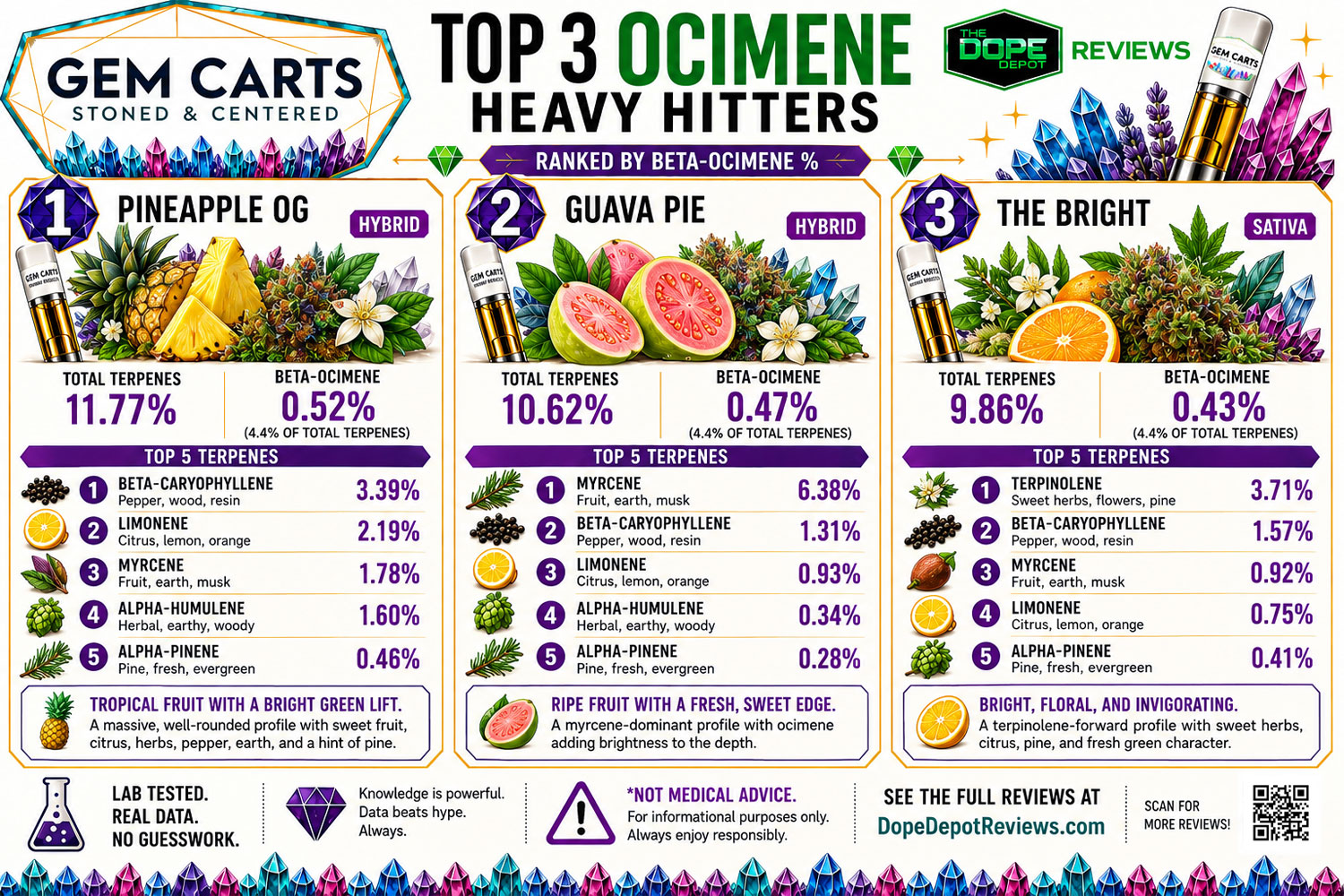
Five Cart Heavy Hitters
1. Pineapple OG
Type: Hybrid
Total Terpenes: 11.77%
Beta-Ocimene: 0.52%
Pineapple OG leads the current cart group with 0.52% beta-ocimene. That represents roughly 4.4% of its enormous total terpene profile.
Beta-caryophyllene leads at 3.39%, followed by limonene at 2.19%, myrcene at 1.78%, and alpha-humulene at 1.60%. Alpha-pinene adds another 0.46%. This is one of the broadest profiles in the database.
The major terpenes create pepper, citrus, ripe fruit, earth, dry herbs, wood, and pine. Beta-ocimene adds sweet green fruit and floral lift around the limonene and myrcene. The pineapple name cannot be explained by beta-ocimene alone. Pineapple aroma depends heavily on esters and other compounds that aren’t represented on this panel.
Still, the combination of ocimene, limonene, myrcene, and the unmeasured volatile fraction gives the profile plenty of chemical room to move toward tropical fruit. At 0.52%, beta-ocimene isn’t steering the whole thing. It has a highly influential seat near the front.
Check out the full review here.
2. Guava Pie
Type: Hybrid
Total Terpenes: 10.62%
Beta-Ocimene: 0.47%
Guava Pie contains 0.47% beta-ocimene, also representing roughly 4.4% of its total terpene content. Myrcene dominates at an extraordinary 6.38%.
Beta-caryophyllene follows at 1.31%, while limonene reaches 0.93%. Every other measured compound remains below half a percent. The chemistry resembles Guava Toss but turned considerably louder.
Myrcene supplies an enormous amount of ripe fruit, earth, herbs, musk, and weight. Beta-ocimene provides sweet green freshness, while limonene adds citrus and caryophyllene supplies peppery structure.
Ocimene becomes particularly useful in a profile this heavy. It cannot make 6.38% myrcene disappear, nor should it. It gives that density a brighter edge. Guava Pie is less a terpene profile than a myrcene weather system with ocimene moving through the upper atmosphere.
Check out the full review here.
3. The Bright
Type: Sativa
Total Terpenes: 9.86%
Beta-Ocimene: 0.43%
The Bright contains 0.43% beta-ocimene, representing roughly 4.4% of its complete profile. Terpinolene dominates at 3.71%. Beta-caryophyllene follows at 1.57%, myrcene reaches 0.92%, and limonene contributes 0.75%.
Alpha-pinene, beta-pinene, alpha-phellandrene, carene, gamma-terpinene, and alpha-terpinene create an unusually diverse collection of lighter aromatic compounds. This is where beta-ocimene’s sweet, green, and floral character should feel most at home.
Terpinolene supplies flowers, sweet herbs, citrus, pine, and fresh vegetation. Ocimene reinforces that brightness, while the pinenes and phellandrene add more herbs and green sharpness. Myrcene provides fruit and body. Caryophyllene and humulene create enough pepper and wood to hold the structure together.
The name “The Bright” becomes almost suspiciously accurate. Normally branding and data maintain a respectful distance from one another.
Check out the full review here.
4. Jack Herer
Type: Sativa
Total Terpenes: 8.20%
Beta-Ocimene: 0.36%
Jack Herer carries 0.36% beta-ocimene in cart form. That represents roughly 4.4% of the measured terpene profile, almost the same proportional role beta-ocimene plays in The Bright, Guava Pie, and Pineapple OG.
Terpinolene leads at 2.01%, followed by beta-caryophyllene at 1.59% and alpha-humulene at 0.77%. Myrcene sits at 0.50%, while limonene contributes 0.43%. The lighter supporting fraction is also important here. Alpha-phellandrene reaches 0.10%, carene sits at 0.08%, alpha-pinene lands at 0.31%, and beta-pinene adds 0.06%.
This is a classic environment for beta-ocimene to matter.
Terpinolene creates the bright sweet-herbal frame. Ocimene reinforces the floral and green fruit side. Pinene, phellandrene, and carene add sharper herbal and forest-like lift. Caryophyllene and humulene give the profile enough pepper, wood, and resin to stay grounded.
Jack Herer doesn’t put ocimene in charge. It gives ocimene a very good band to play in.
Check out the full review here.
5. Blue Dream Berry
Type: Hybrid
Total Terpenes: 9.86%
Beta-Ocimene: 0.24%
Blue Dream Berry rounds out the current cart top five with 0.24% beta-ocimene. That represents roughly 2.4% of its total terpene content. Limonene dominates at 3.02%, followed by beta-caryophyllene at 2.60% and alpha-humulene at 1.17%. Alpha-pinene reaches a substantial 0.83%, while myrcene contributes 0.40%.
This should produce a bright citrus and pine upper end over pepper, wood, herbs, and resin.
Beta-ocimene adds a smaller sweet-green fruit and floral component between the limonene and pinene. The berry portion of the aroma probably depends heavily on compounds beyond the measured panel. Ocimene may contribute to the impression of fruit, but it doesn’t carry a bucket labeled “blueberry.”
Chemistry remains more collaborative and less organized than product naming.
Check out the full review here.
What These Ten Products Show Us
The first major pattern is that beta-ocimene remains a supporting terpene even in the products containing the most. The featured concentrations range from 0.26% to 0.52%. Ocimene represents roughly 2.4% to 4.8% of the total measured terpene content across most of the group.
That may sound small compared with the enormous caryophyllene, myrcene, limonene, or terpinolene results in these products. Aroma isn’t determined by mass alone. Highly aromatic compounds can affect the profile at relatively low concentrations, especially when they reinforce similar notes from other molecules.
The second pattern is that beta-ocimene appears in several very different chemical environments. Pineapple OG is broad and layered, with major caryophyllene, limonene, myrcene, and humulene content.
Guava Toss and Guava Pie are dominated by myrcene. The Bright and Jack Herer are driven by terpinolene and other bright monoterpenes. Blue Dream Berry is led by limonene and beta-caryophyllene. Cherry Paloma x Triple Beam is one of the most balanced profiles in the group. Ocimene contributes freshness to all of them, but the finished aromas should be completely different.
Third, the strongest cart results exceed the strongest Red Eye dab results. Pineapple OG reaches 0.52% beta-ocimene in cart form and 0.40% in the Red Eye dab. Guava Pie lands at 0.47%, and The Bright contains 0.43%. That doesn’t mean decarboxylation creates beta-ocimene.
The dabs and carts are not always identical batches or formats. It does show that meaningful ocimene concentrations can survive properly controlled cart production.
Finally, high beta-ocimene isn’t confined to one traditional cannabis category. The featured group includes sativas, hybrids, and an indica. The molecule contributes chemistry, not a retail classification or guaranteed effect.
The Lab Rat Verdict
Beta-ocimene is one of the most interesting minor terpenes on a cannabis laboratory sheet. It can contribute sweet flowers, fresh herbs, green fruit, citrus peel, living vegetation, and clean aromatic lift. It rarely dominates the profile.
Instead, it modifies larger structures built from myrcene, limonene, terpinolene, pinene, linalool, beta-caryophyllene, and humulene. Its ecological role is considerably clearer than its human pharmacology. Plants use beta-ocimene as part of floral scent, defense signaling, and interactions with insects and neighboring plants.
Human effect claims remain mostly speculative. There’s no strong evidence that beta-ocimene reliably stimulates cannabis users, improves mood, clears congestion, opens airways, or treats infection. Laboratory antifungal results and plant signaling research justify scientific interest. They do not create a medical claim.
Beta-ocimene reminds us why minor compounds matter. The largest number usually builds the profile. The smaller ones make it recognizable.
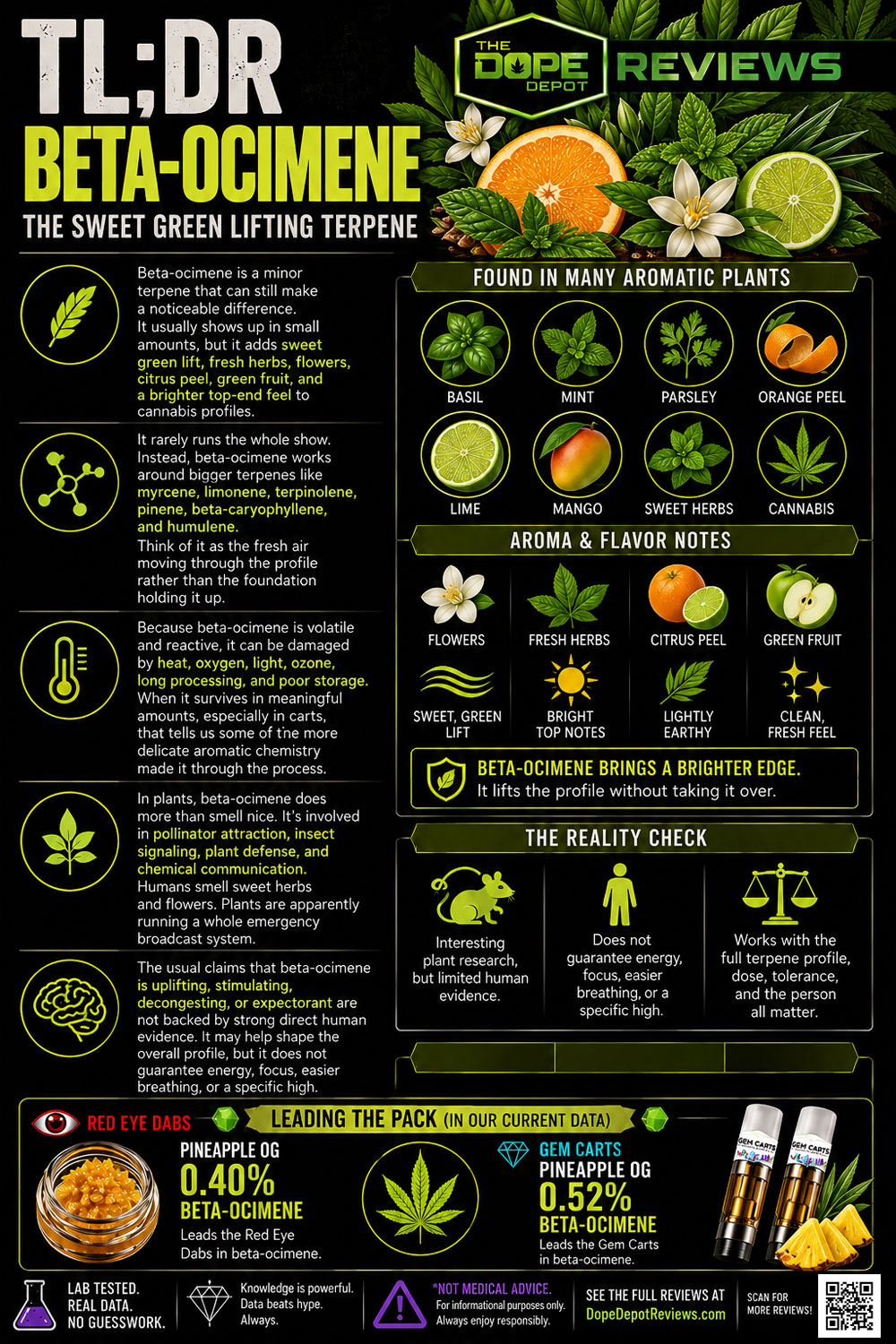
TL;DR: Beta-Ocimene
Beta-ocimene is a minor terpene that can still make a noticeable difference. It usually shows up in small amounts, but it adds sweet green lift, fresh herbs, flowers, citrus peel, green fruit, and a brighter top-end feel to cannabis profiles.
It rarely runs the whole show. Instead, beta-ocimene works around bigger terpenes like myrcene, limonene, terpinolene, pinene, beta-caryophyllene, and humulene. Think of it as the fresh air moving through the profile rather than the foundation holding it up.
Because beta-ocimene is volatile and reactive, it can be damaged by heat, oxygen, light, ozone, long processing, and poor storage. When it survives in meaningful amounts, especially in carts, that tells us some of the more delicate aromatic chemistry made it through the process.
In plants, beta-ocimene does more than smell nice. It’s involved in pollinator attraction, insect signaling, plant defense, and chemical communication. Humans smell sweet herbs and flowers. Plants are apparently running a whole emergency broadcast system.
The usual claims that beta-ocimene is uplifting, stimulating, decongesting, or expectorant are not backed by strong direct human evidence. It may help shape the overall profile, but it does not guarantee energy, focus, easier breathing, or a specific high.
In our current data, Pineapple OG leads both lists, with 0.40% beta-ocimene in Red Eye Dabs and 0.52% in carts. Guava Pie, The Bright, Jack Herer, Blue Dream Berry, and Guava Toss show how ocimene can support very different profiles without dominating them.
The short squirrel version:
Beta-ocimene is small on the lab sheet but useful in the aroma. It adds sweet green freshness and floral lift, but it doesn’t decide the whole flavor or effect by itself.