
Podcast: Play in new window | Download (19.1MB)
The posts in this series are going to be a pretty healthy read, so for those of you who lack the curiosity or the attention span, scroll to the end and find the TL;DR, or CLICK HERE!! Otherwise, put on your thinking caps and lets get shaking!
You can also listen to Finn read the post to you. Download the mp3 here.
- Click here to skip to the top 5 Red Eye dab beta-caryophyllene heavy hitters.
- Click here to skip to the top 5 Gem Cart / Pocket Puffer beta-caryophyllene heavy hitters.
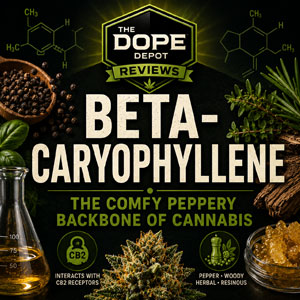
The Comfy Peppery Backbone of Cannabis
Some terpenes make a dramatic entrance. Limonene jumps out with citrus. Terpinolene can announce itself with a chaotic mixture of fruit, herbs, flowers, and pine. Myrcene often brings a heavy wave of earth, musk, hops, or ripe fruit.
Beta-caryophyllene usually takes a different approach.
Rather than floating across the top of a cannabis profile, it builds the foundation underneath it. Pepper, dry wood, herbs, resin, earth, and warm spice are all common descriptions. It can make a profile feel denser, darker, and more structured, even when sweeter or fruitier compounds are doing most of the obvious talking.
It’s also one of the most common dominant terpenes in our SC Labs PhytoFacts powered database. In many of The Dope Depot Red Eye dabs, Gem Carts, and Pocket Puffers, beta-caryophyllene isn’t merely participating in the profile. It’s running the meeting.
What Is Beta-Caryophyllene?
Beta-caryophyllene is a naturally occurring sesquiterpene found in cannabis and many other plants. It’s chemical formula is C15H24. It appears prominently in black pepper, cloves, hops, basil, rosemary, oregano, cinnamon, and copaiba.
If you’ve ever cracked fresh black pepper over food and noticed that warm, woody sharpness rising from the grinder, you already have a reasonable reference point for beta-caryophyllene.
What Does Beta-Caryophyllene Smell and Taste Like?
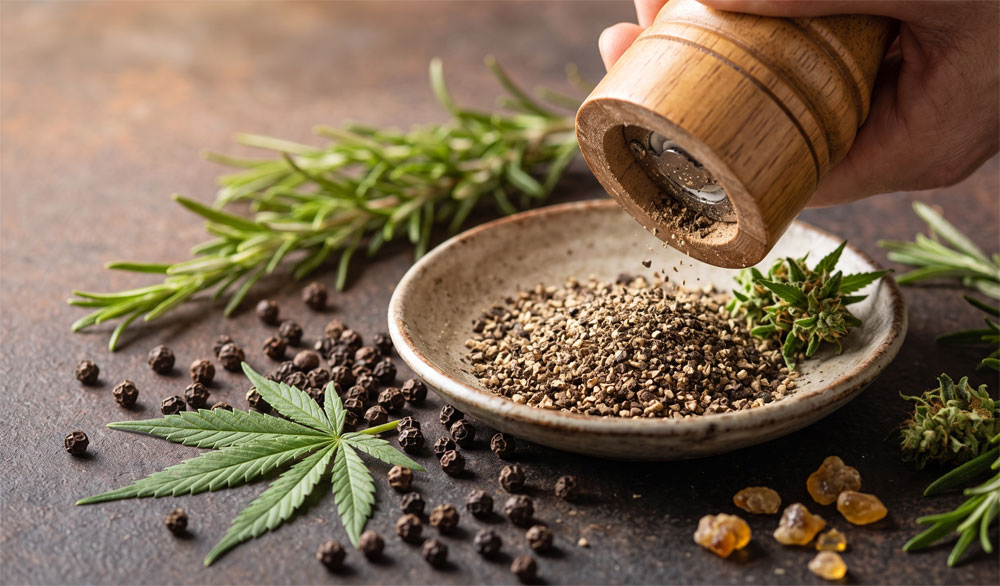
Beta-caryophyllene is most closely associated with black pepper and warm spice, but that description only covers part of its personality. Depending on the rest of the profile, it can contribute cracked pepper, dry wood, earth, herbs, cloves, resin, bitterness, warm spice, and light funk.
At lower concentrations, it may provide structure without being immediately recognizable. At higher concentrations, the profile can become noticeably peppery, woody, dry, or resinous. That doesn’t mean every caryophyllene-dominant extract will taste like someone emptied a pepper grinder into the jar.
As we learned in the Meet the Terpenes overview post, terpenes don’t work alone. Limonene can pull beta-caryophyllene toward brighter citrus and spice. Myrcene can deepen it with musk, fruit, or earth. Alpha-humulene often reinforces its dry, woody, herbal side. Linalool may soften the profile with floral sweetness.
Beta-caryophyllene is less like a solo instrument and more like the rhythm section. You may not always focus on it, but remove it and the entire arrangement changes.
A Heavier, More Stable Terpene
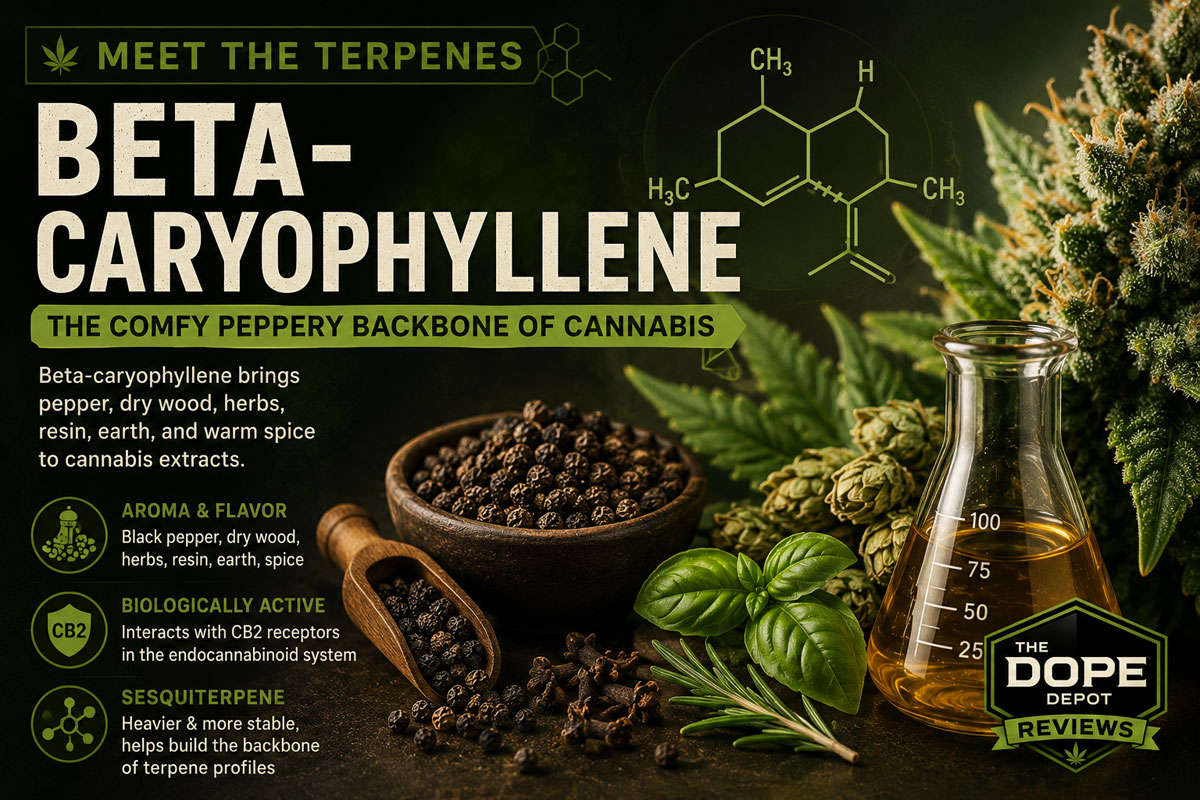
Beta-caryophyllene is classified as a sesquiterpene. Sesquiterpenes contain more carbon atoms than monoterpenes such as limonene, pinene, myrcene, and terpinolene. That larger molecular structure generally makes them heavier, less volatile, and more resistant to evaporation than many of the brighter top-note compounds.
This matters during extraction and post-processing.
Lighter monoterpenes are often the first compounds lost through excessive heat, aggressive vacuum, oxygen exposure, and extended processing. Beta-caryophyllene is comparatively persistent, which helps explain why it frequently remains one of the dominant compounds in cured resin and decarboxylated oil for carts.
That doesn’t make it indestructible by any stretch of the imagination. Heat, oxygen, light, and time can still alter it. One important transformation is oxidation. When beta-caryophyllene reacts with oxygen, it can form caryophyllene oxide, another compound commonly measured on cannabis terpene panels.
A small amount of caryophyllene oxide is normal. Increasing oxidation during storage, however, can signal that the original volatile profile is gradually changing. The molecule is tougher than some of its lighter friends, although it is not immortal.
The Terpene That Behaves Like a Cannabinoid
Beta-caryophyllene is especially interesting because it doesn’t fit neatly into the usual division between terpenes and cannabinoids. Although it’s structurally classified as a terpene, beta-caryophyllene can interact with the body’s cannabinoid type 2 receptor, or CB2 receptor.
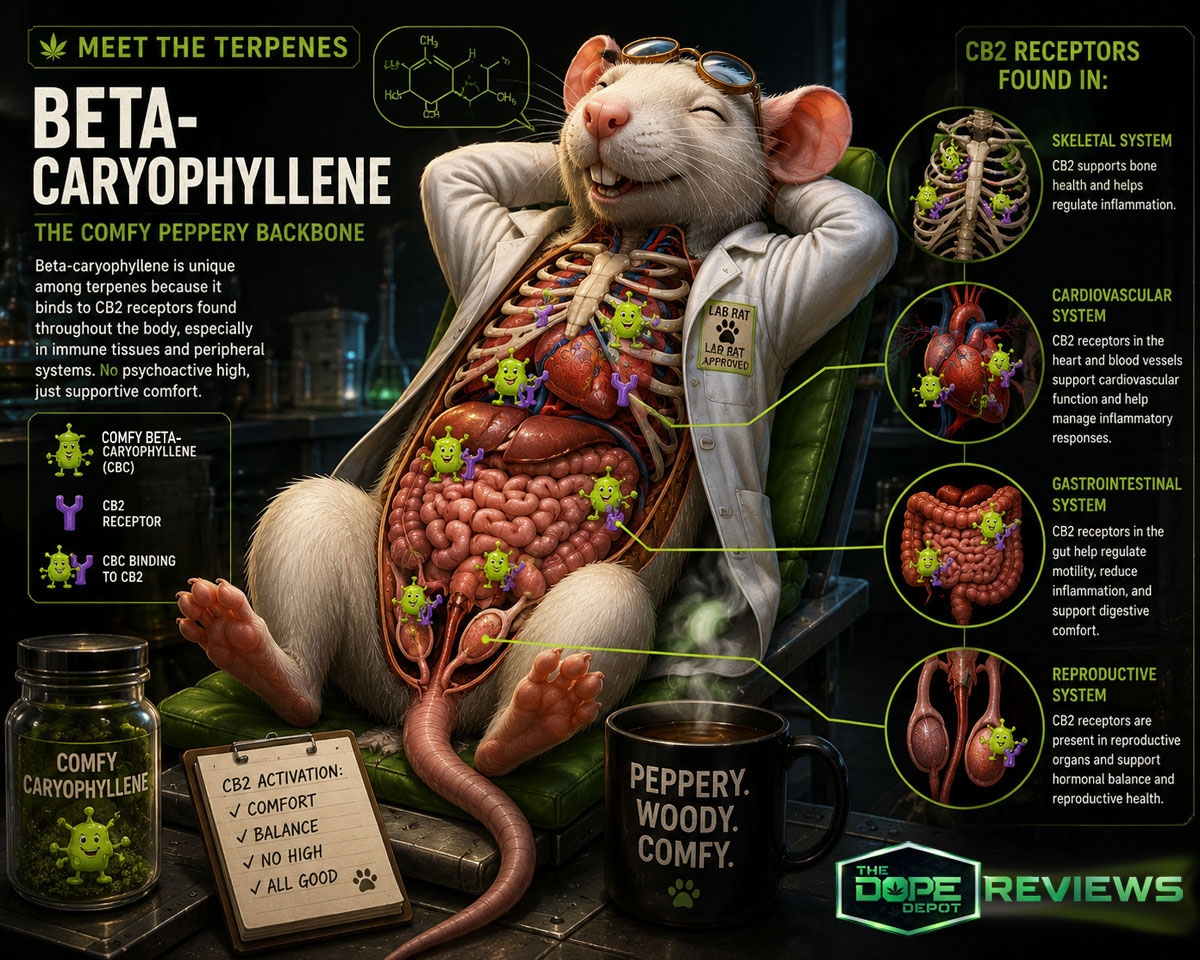
CB2 receptors are found largely throughout immune tissues and peripheral systems, including parts of the skeletal, gastrointestinal, cardiovascular, and reproductive systems. They’re distinct from CB1 receptors, which are heavily involved in the intoxicating effects produced by THC.
Beta-caryophyllene doesn’t produce a THC-like high. Its interaction with CB2 has instead made it the subject of research involving inflammation, pain signaling, oxidative stress, metabolism, mood, and neurological conditions.
The important limitation is that much of the available beta-caryophyllene research comes from cell studies, animal models, isolated compounds, essential oils, or doses that don’t directly match ordinary cannabis consumption.
This research tells us that beta-caryophyllene is biologically active. It does not prove that a concentrate containing a few percent of the terpene will predictably treat inflammation, anxiety, pain, cancer, or any other medical condition in humans.
Remember folks, interesting chemistry is NOT the same as an approved medical claim, and correlation doesn’t always equal causation.
Does Beta-Caryophyllene Determine the Effects?
Cannabis products rich in beta-caryophyllene are often described as calming, comfortable, physically relaxing, or grounding. Those descriptions may sometimes match the experience, but beta-caryophyllene concentration alone can’t reliably predict how a product will feel.
The final experience depends on THC and total active cannabinoid content, minor cannabinoids, the complete terpene profile, dose, consumption method, tolerance, metabolism, individual endocannabinoid chemistry, and mood, also known as the set and setting.
A caryophyllene-heavy sativa can still feel active and mentally stimulating. A caryophyllene-heavy indica may feel physically relaxing. The terpene contributes to the chemistry, but it doesn’t issue commands to the nervous system like some tiny pepper-scented supervisor.
Reading Beta-Caryophyllene on a Lab Sheet
When beta-caryophyllene is the dominant terpene, it usually forms the central structure of the aroma and flavor. The concentration still needs context.
A product containing 1.5% beta-caryophyllene within a 4% total terpene profile is strongly caryophyllene-dominant. A product containing the same 1.5% within a 12% profile may have several other compounds competing for attention.
It helps to examine three numbers:
- The beta-caryophyllene percentage
- The total terpene percentage
- The amount of beta-caryophyllene relative to the other major terpenes
For this piece, we went back about a year in our data and pulled the five strongest beta-caryophyllene results from the Red Eye dab sheet and the five strongest from the Gem Cart / Pocket Puffer sheet. You can find these sheets on The Sheets page if you would like to check out the data for yourself.
This keeps the list focused on SKUs we’re actually working with now, rather than digging through the entire historical database for a batch that disappeared from shelves sometime during the previous geological age.
Some items may not be on Oregon shop shelves yet if they are super new, but they will be soon.
Five Red Eye Dab Beta-Caryophyllene Heavy Hitters
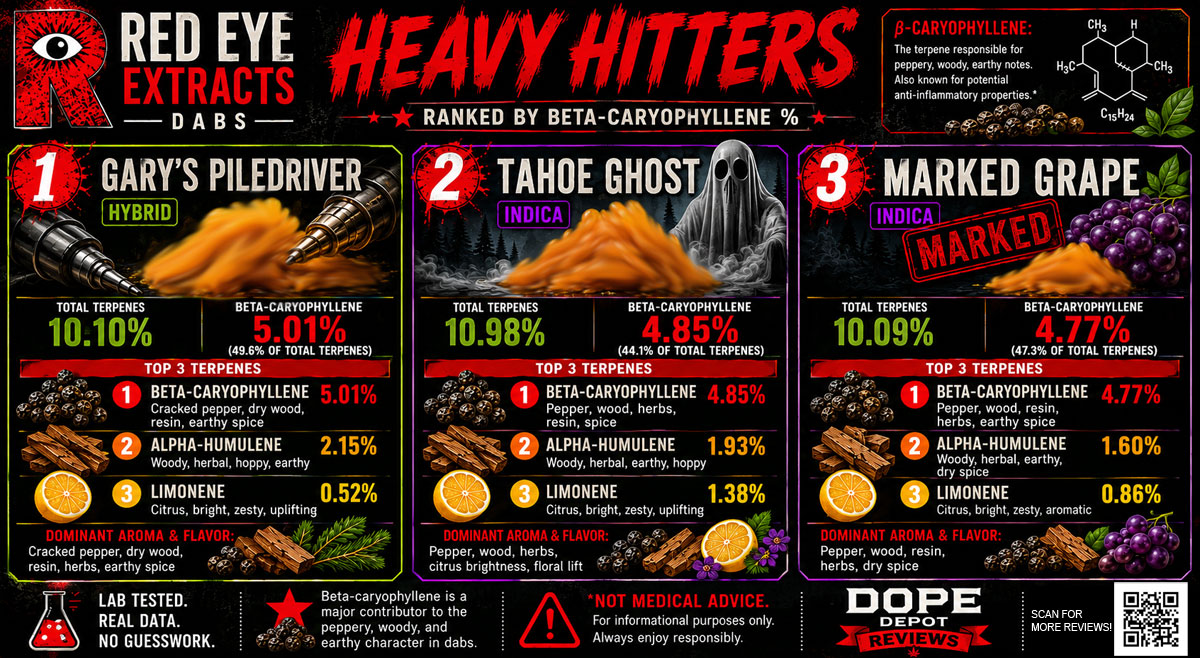
1. Gary’s Piledriver
Type: Hybrid
Total Terpenes: 10.10%
Beta-Caryophyllene: 5.01%
Gary’s Piledriver leads the current Red Eye dab group with a massive 5.01% beta-caryophyllene. That single terpene accounts for just under 50% of the measured profile. This is not a supporting role. Beta-caryophyllene has seized control of the room, changed the locks, and started charging the other terpenes rent.
Alpha-humulene follows at 2.15%, which strongly reinforces the dry, woody, herbal, and hoppy side of the profile. Limonene sits at 0.52%, while linalool, myrcene, and the pinenes fill in smaller background roles.
This should be an intensely caryophyllene-forward extract built around cracked pepper, dry wood, resin, herbs, and earthy spice.
Gary’s Piledriver is a good reminder that beta-caryophyllene doesn’t need help being loud. It only needs enough supporting chemistry to keep the profile from turning into a single-note pepper warehouse.
Check out the full review here.
2. Tahoe Ghost
Type: Indica
Total Terpenes: 10.98%
Beta-Caryophyllene: 4.85%
Tahoe Ghost comes in just behind Gary’s Piledriver with 4.85% beta-caryophyllene. That represents a little over 44% of the total measured terpene profile.
Alpha-humulene is also extremely high at 1.93%, giving Tahoe Ghost a strong dry, woody, herbal foundation. Limonene reaches 1.38%, which adds considerably more brightness than we see in Gary’s Piledriver. Linalool at 0.36% and the combined pinenes at 0.44% add floral softness and sharper aromatic lift.
This is a caryophyllene-heavy indica, but not a dull one. The beta-caryophyllene and humulene provide pepper, wood, herbs, and resin. The limonene gives the profile citrus brightness, while the smaller floral and pine notes help round it out.
Tahoe Ghost has plenty of structure, but it leaves the lights on.
Check out the full review here.
3. Marked Grape
Type: Indica
Total Terpenes: 10.09%
Beta-Caryophyllene: 4.77%
Marked Grape carries 4.77% beta-caryophyllene, accounting for more than 47% of the measured profile. This makes it one of the most proportionally caryophyllene-dominant Red Eye dabs on the current sheet.
Alpha-humulene follows at 1.60%, again reinforcing the dry, woody, earthy, and herbal side. Limonene at 0.86% adds some brightness, while myrcene, linalool, and the pinenes fill in the background with earthier, floral, and aromatic notes.
The result is an extremely caryophyllene-forward profile built around pepper, wood, resin, herbs, and dry spice.
The name may suggest fruit, but the chemistry brings a serious amount of peppery structure underneath it. Apparently the grape was marked for disciplinary review.
Check out the full review here.
4. Citrus Nights
Type: Hybrid
Total Terpenes: 10.74%
Beta-Caryophyllene: 4.56%
Citrus Nights contains 4.56% beta-caryophyllene within a 10.74% total terpene profile. That puts beta-caryophyllene at roughly 42.5% of the measured total.
Alpha-humulene reaches 1.62%, while myrcene lands at 0.97% and limonene sits at 0.78%. The combined pinenes add another 0.77%, which gives the profile a noticeable fresh, aromatic edge.
This is a more layered caryophyllene-heavy profile.
Beta-caryophyllene and humulene provide the pepper, dry wood, herbs, and resin. Myrcene adds fruit, earth, and weight. Limonene brings citrus brightness, while the pinenes contribute a sharper evergreen quality.
Despite the name, Citrus Nights isn’t just citrus. It’s citrus walking through a dark forest while someone grinds black pepper in the distance, because apparently subtlety called in sick.
Check out the full review here.
5. Papaya Cake
Type: Indica
Total Terpenes: 11.63%
Beta-Caryophyllene: 4.53%
Papaya Cake rounds out the current Red Eye top five with 4.53% beta-caryophyllene. That is the lowest beta-caryophyllene number in this group, which says more about how ridiculous the group is than anything negative about Papaya Cake.
Papaya Cake also has the highest total terpene content of the five Red Eye Dabs at 11.63%.
Beta-caryophyllene represents about 39% of the total profile. It’s still dominant, but it has more competition here than it does in Gary’s Piledriver or Marked Grape.
Alpha-humulene reaches 1.69%, while limonene comes in at 1.34%. Myrcene, linalool, and both major pinenes add further complexity. That balance should create a substantial peppery and woody foundation with more citrus, fruit, floral sweetness, and aromatic lift working above it.
Check out the full review here.
Now let’s take a look at the carts. These extracts are all decarbed, then loaded into our Gem Cart or Pocket Puffer line.
Five Beta-Caryophyllene Heavy Carts
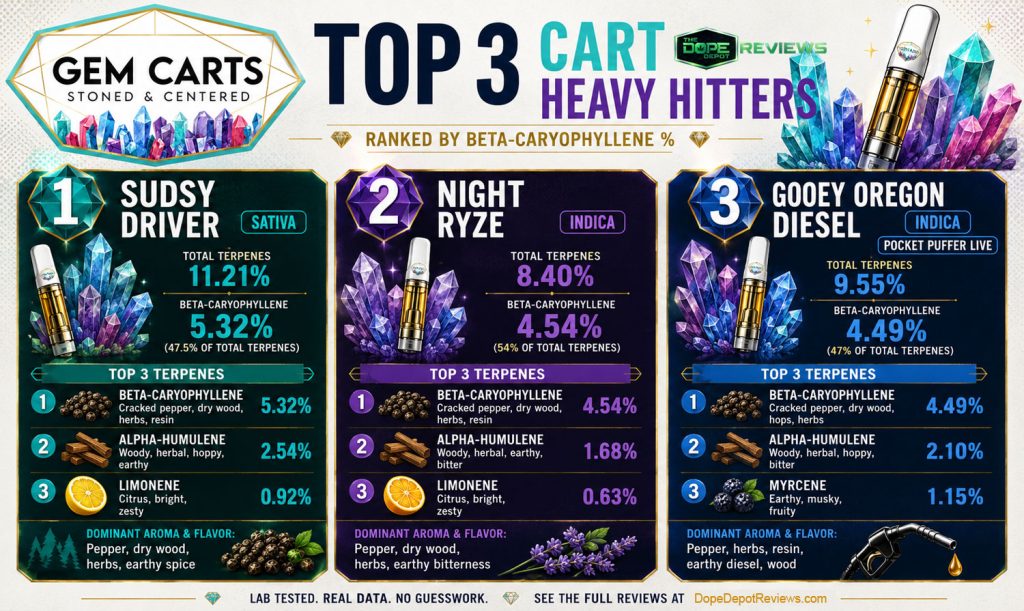
1. Sudsy Driver
Type: Sativa
Total Terpenes: 11.21%
Beta-Caryophyllene: 5.32%
Sudsy Driver leads the current cart group with a huge 5.32% beta-caryophyllene. That is the strongest beta-caryophyllene result in either current category. Beta-caryophyllene accounts for roughly 47.5% of the total measured terpene profile, which makes it both high in raw concentration and strongly dominant within the profile.
Alpha-humulene follows at 2.54%, the highest humulene number in the featured group. Together, beta-caryophyllene and alpha-humulene account for more than 70% of the measured terpene profile. That pairing should create an extremely dry, woody, peppery, herbal, resinous structure.
Limonene at 0.92% adds some brightness, while myrcene at 0.52% provides a little earth and body. The pinenes are present, but they’re not steering the ship.
Sudsy Driver may be labeled sativa, but chemically this is a serious caryophyllene-humulene machine. The molecule did not check with the marketing department before becoming this woody and peppery.
Check out the full review here.
2. Night Ryze
Type: Indica
Total Terpenes: 8.40%
Beta-Caryophyllene: 4.54%
Night Ryze comes in second among the current carts with 4.54% beta-caryophyllene. That represents roughly 54% of the total measured terpene profile, making Night Ryze the most proportionally caryophyllene-dominant product in this entire section.
Alpha-humulene follows at 1.68%, while limonene contributes 0.63%. Linalool lands at 0.27%, with myrcene sitting much lower at 0.10%. This is a very focused profile.
Beta-caryophyllene and humulene provide most of the structure: cracked pepper, dry wood, herbs, resin, and earthy bitterness. Limonene adds a smaller amount of brightness, while linalool softens the edges slightly.
Night Ryze doesn’t need a massive total terpene number to make its point. More than half the measured profile is beta-caryophyllene. That is less of a terpene profile and more of a peppery declaration.
Check out the full review here.
3. Gooey Oregon Diesel Pocket Puffer Live
Type: Indica
Total Terpenes: 9.55%
Beta-Caryophyllene: 4.49%
Gooey Oregon Diesel in our Pocket Puffer Live line carries 4.49% beta-caryophyllene within a 9.55% total terpene profile. That puts beta-caryophyllene at roughly 47% of the measured total.
Alpha-humulene reaches 2.10%, giving this cart one of the strongest caryophyllene-humulene pairings in the current list. Myrcene lands at 1.15%, while limonene is much lower at 0.25%. This should be a dense, heavy, resinous profile.
Beta-caryophyllene and humulene provide the pepper, dry wood, hops, herbs, and bitterness. Myrcene adds earth, musk, fruit, and weight. With limonene playing a smaller role, the profile should lean darker and less bright than something like Permanent Marker V2 or Marked Grape.
The diesel side likely involves volatile compounds beyond the standard terpene panel, but the measured chemistry still shows a strong foundation of pepper, herbs, wood, and earthy weight.
Check out the full review here.
4. Marked Grape
Type: Indica
Total Terpenes: 8.68%
Beta-Caryophyllene: 4.36%
Marked Grape also appears in the current cart top five with 4.36% beta-caryophyllene. That represents just over 50% of the measured terpene profile giving us another clearly caryophyllene-dominant cart.
Alpha-humulene follows at 1.51%, while limonene contributes 0.64%. Myrcene reaches 0.32%, linalool lands at 0.36%, and the combined pinenes contribute another 0.36%.
The dab version contains 4.77% beta-caryophyllene and 10.09% total terpenes. The cart version comes in lower overall, but it preserves the same basic structure: a huge beta-caryophyllene base supported by substantial humulene and smaller amounts of limonene, linalool, myrcene, and pinene.
That makes Marked Grape one of the better examples of how a terpene identity can carry across formats. Different hardware, same peppery skeleton.
Full review coming soon.
5. Sup Dogg
Type: Indica
Total Terpenes: 8.03%
Beta-Caryophyllene: 4.16%
Sup Dogg rounds out the current cart top five with 4.16% beta-caryophyllene. That represents almost 52% of the measured terpene profile, making this one of the most proportionally caryophyllene-dominant carts in the group.
Alpha-humulene follows at 1.47%, which gives Sup Dogg the familiar dry, woody, herbal, and hoppy foundation we keep seeing across these high-caryophyllene products. Limonene contributes 0.70%, while myrcene lands at 0.58%. Linalool sits lower at 0.17%, and the combined pinenes add 0.19%.
This should be a focused, peppery, woody, resinous profile with enough limonene and myrcene to keep it from becoming completely dry.
The beta-caryophyllene and humulene build the backbone. Myrcene adds earth, fruit, and weight. Limonene gives the profile a little brightness, but not enough to drag the whole thing into citrus territory.
Sup Dogg may not have the highest total terpene number in the cart group, but more than half of what is measured points straight back to beta-caryophyllene.
Check out the full review here.
What These Ten Dope Depot Products Show Us
The master data sheet makes the beta-caryophyllene story even clearer. Every product in this section contains at least 4.16% beta-caryophyllene. That’s a serious concentration in any cannabis extract, and in several cases beta-caryophyllene accounts for nearly half, or more than half, of the entire measured terpene profile.
The strongest beta-caryophyllene content in the current Red Eye offering is Gary’s Piledriver at 5.01%. The strongest cart is Sudsy Driver coming in at 5.32%. Those are some seriously structural numbers.
The second major pattern is the relationship between beta-caryophyllene and alpha-humulene. Every featured product contains at least 1.47% alpha-humulene. Sudsy Driver reaches 2.54%, Gary’s Piledriver reaches 2.15%, and Gooey Oregon Diesel reaches 2.10%.

That pairing creates the dominant sensory foundation across the entire list:
- Pepper
- Dry wood
- Herbs
- Hops
- Resin
- Earth
- Mild bitterness
- Warm spice
Beta-caryophyllene brings the pepper and resin. Alpha-humulene reinforces the wood, herbs, hops, and dryness. Together, they form the backbone of these profiles. The differences come from the terpenes layered over that backbone.
Tahoe Ghost, Papaya Cake, Citrus Nights, and Sup Dogg contain more limonene than some of the darker entries, giving them more brightness. Gooey Oregon Diesel, Citrus Nights, and Sup Dogg bring more myrcene, adding earth, fruit, musk, and body. Papaya Cake and Marked Grape carry more linalool, which softens the middle with floral sweetness.
Marked Grape appears in both the Red Eye dab and Gem Cart lists, which gives us a useful format comparison. The dab tests at 4.77% beta-caryophyllene. The cart tests at 4.36%. The total terpene content drops from 10.09% to 8.68%, but the basic caryophyllene-heavy structure remains intact.
We like to think that sort of continuity is important. Decarboxylation changes the cannabinoid profile, but careful processing can preserve much of the original terpene architecture. When that happens, you get an extract that tastes just like the flower that went into it.
Finally, high beta-caryophyllene content still refuses to belong to one category. This list includes indicas, hybrids, and a sativa. Sudsy Driver is labeled sativa and contains the highest beta-caryophyllene result of the entire group.
Once again, the traditional indica-sativa-hybrid labels provide far less chemical information than the actual laboratory results.
TL;DR: Beta-Caryophyllene
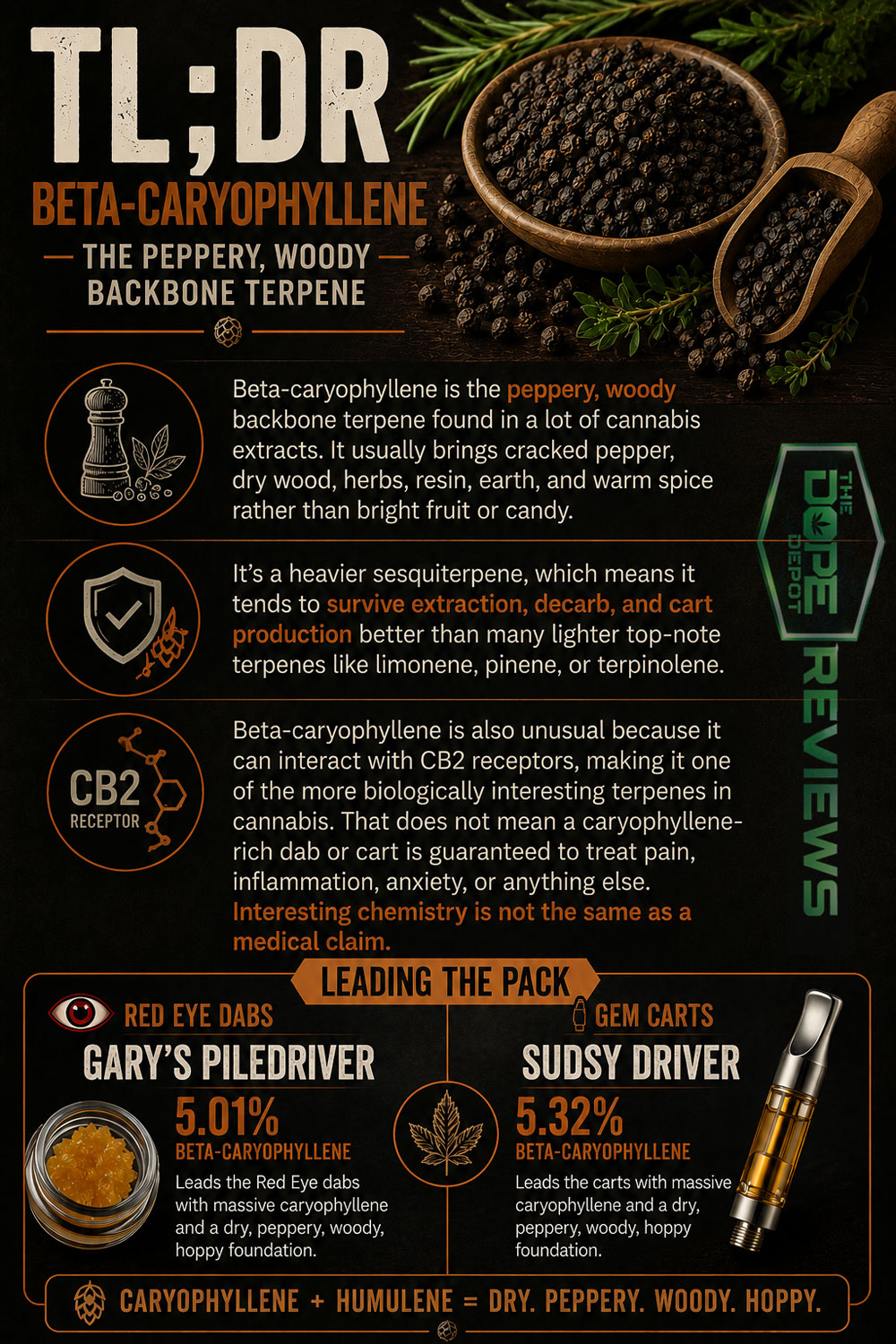
Beta-caryophyllene is the peppery, woody backbone terpene found in a lot of cannabis extracts. It usually brings cracked pepper, dry wood, herbs, resin, earth, and warm spice rather than bright fruit or candy.
It’s a heavier sesquiterpene, which means it tends to survive extraction, decarb, and cart production better than many lighter top-note terpenes like limonene, pinene, or terpinolene.
Beta-caryophyllene is also unusual because it can interact with CB2 receptors, making it one of the more biologically interesting terpenes in cannabis. That does not mean a caryophyllene-rich dab or cart is guaranteed to treat pain, inflammation, anxiety, or anything else. Interesting chemistry is not the same as a medical claim.
In our current data, beta-caryophyllene shows up hard. Gary’s Piledriver leads the Red Eye dabs at 5.01%, while Sudsy Driver leads the carts at 5.32%. Across the biggest hitters, it usually appears alongside alpha-humulene, creating a dry, peppery, woody, hoppy foundation.
The short squirrel version:
Beta-caryophyllene gives cannabis structure. It doesn’t decide the whole flavor or effect by itself, but when it’s high, it usually becomes the backbone everything else gets built around.