
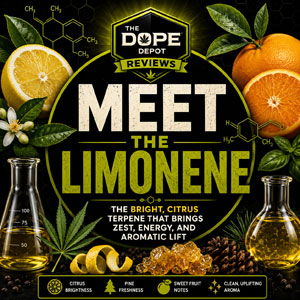
The posts in this series are a pretty healthy read, so for those of you who lack the curiosity or the attention span, scroll to the end and find the TL;DR, or CLICK HERE!! Otherwise, put on your thinking caps and lets get moving!
If you don’t feel like reading, you can listen to Finn read the post to you. Download the mp3 here.
- Click here to skip to the top 5 Red Eye dab limonene heavy hitters.
- Click here to skip to the top 5 Gem Cart / Pocket Puffer limonene heavy hitters.
The Bright Citrus Terpene in Cannabis
Limonene is one of the easiest terpenes to describe poorly. It smells like lemons. It makes cannabis energetic. It’s found in anything with “Lemon” or “Orange” in the name. Case closed. Everyone can go home.
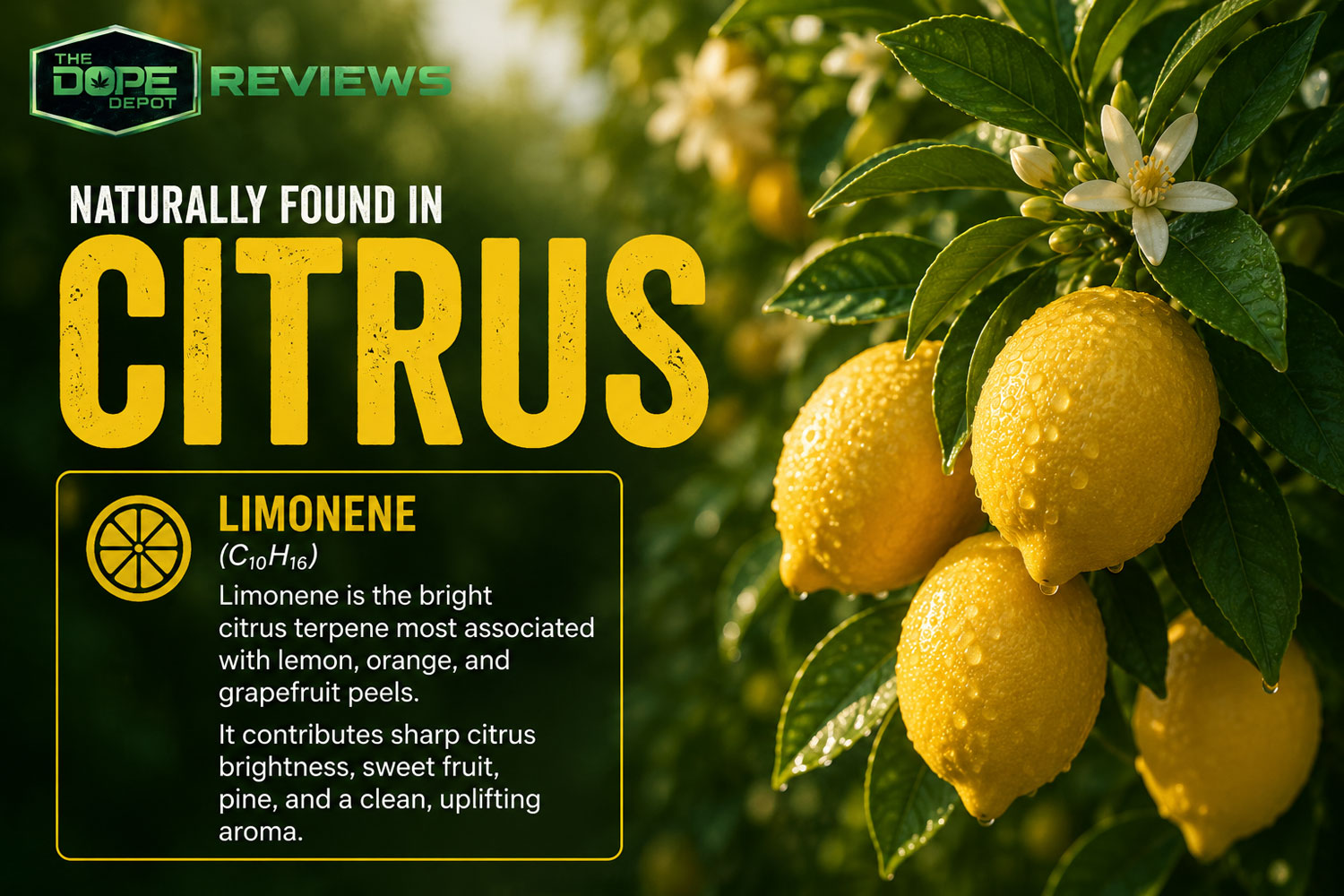
Unfortunately, chemistry has once again declined to cooperate with the convenient explanation. Limonene is strongly associated with citrus, but it can also present as sweet fruit, sharp herbs, fresh peel, pine, resin, or something closer to household cleaner when the surrounding profile becomes especially aggressive. A strain name may suggest limonene, but the laboratory results get the final vote.
It’s also one of the most important top-note terpenes found in cannabis extracts. When preserved well, limonene can give a profile brightness, sharpness, and aromatic lift. When it’s lost through excessive heat, oxygen exposure, or careless storage, the extract can become noticeably flatter.
Let’s introduce the molecule properly before the cannabis industry reduces it to a lemon emoji.
What Is Limonene?
Limonene is a naturally occurring cyclic monoterpene with the molecular formula C10H16. It’s widely produced throughout the plant kingdom and appears prominently in the peels of oranges, lemons, limes, grapefruits, mandarins, and other citrus fruits. It can also be found in cannabis, juniper, rosemary, mint, pine, and several other aromatic plants.
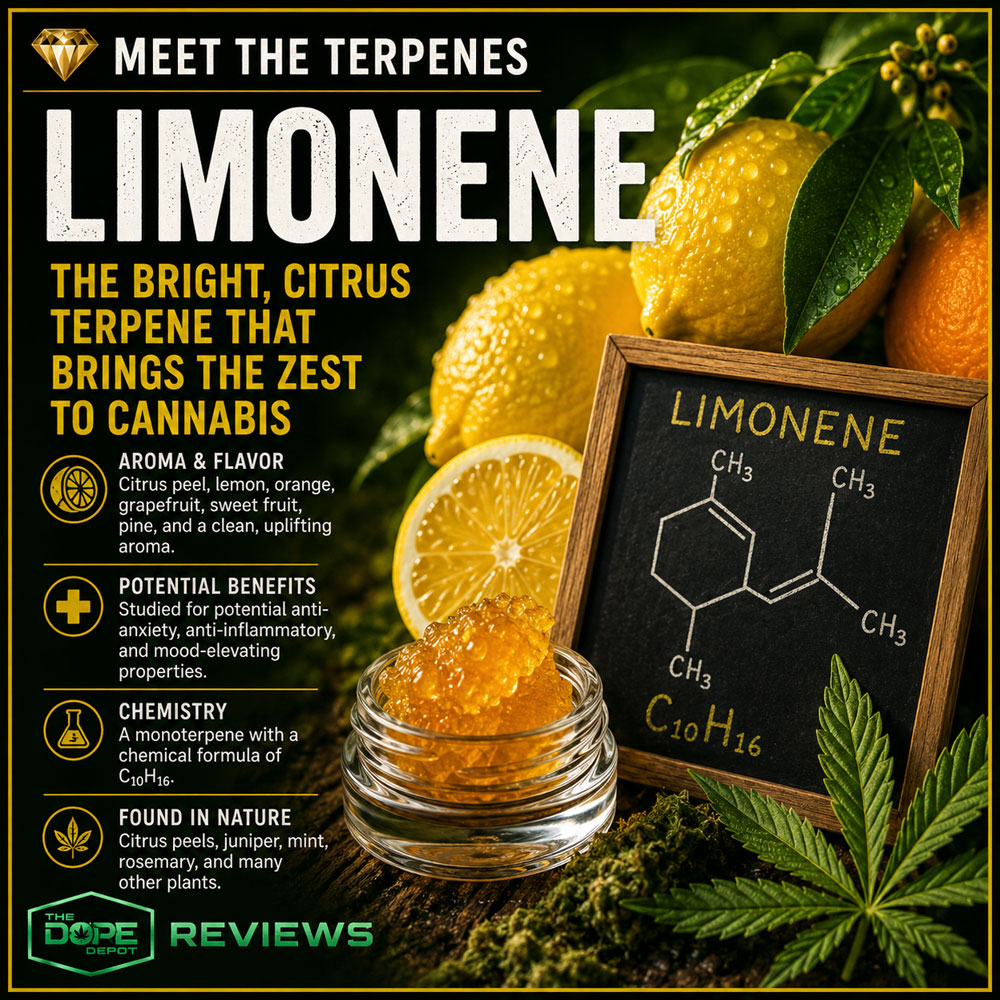
The oils found in citrus peel can contain extremely high concentrations of limonene. This is why bending or twisting a fresh orange peel releases such an immediate burst of bright aroma.
Cannabis generally contains far less limonene than citrus peel oil, but the concentrations can still be high enough to strongly influence the smell and flavor of flower, dabs, and carts.
Limonene Has Two Faces
We’re going to get a little nerdy here for a minute, so bear with me. One of our lab rats fancies himself a proper scientist, and blessed us with this explanation.
Ready?
Limonene exists in two mirror-image molecular forms known as enantiomers. A quick search for that crazy word brings us a fairly easy to understand definition. “Enantiomers are pairs of molecules that are exact mirror images of each other but cannot be superimposed, just like your left and right hands. They share identical physical and chemical properties, except for how they interact with polarized light and, crucially, with biological receptors”
What does that have to do with weed smells? Different enantiomers, different aromas.
The form most strongly associated with citrus fruit is D-limonene, also called R-(+)-limonene. It generally carries the familiar sweet orange, lemon-peel, and fresh citrus character most people expect.
Its mirror image, L-limonene or S-(-)-limonene, can present as sharper, more piney, turpentine-like, or herbal. These two forms have the same molecular formula but interact differently with biological systems, including the receptors responsible for smell.
Most standard cannabis terpene panels, including the PhytoFact sheets we use from SC Labs, provide a single limonene number rather than separating the two forms. That means the percentage tells us how much limonene was detected, but not necessarily which molecular orientation was responsible for the aroma.
Even the apparently simple citrus terpene requires stereochemistry. Nobody warned the dispensary menu writers. Someone should probably send them an email.
What Does Limonene Smell and Taste Like?
Limonene is commonly associated with:
- Lemon peel
- Sweet orange
- Grapefruit rind
- Lime
- Fresh citrus oil
- Sweet fruit
- Sharp herbs
- Pine
- Resin
- Light bitterness
At high concentrations, it can create an immediate bright top note that reaches the nose before heavier terpenes become noticeable. That doesn’t mean limonene alone recreates the aroma of a lemon, orange, or grapefruit.
Real citrus aroma is produced by a much broader mixture that can include aldehydes, esters, alcohols, ketones, and other terpenes. Some of these compounds exist in tiny amounts but have extremely low odor thresholds, allowing them to make an outsized contribution to the final aroma.
Limonene supplies much of the broad citrus structure. The smaller compounds provide the details that tell your brain whether it’s smelling lemon, mandarin, orange candy, grapefruit peel, or industrial floor cleaner.
The same problem appears in cannabis. Two extracts can contain similar amounts of limonene and still smell completely different because the rest of their volatile chemistry is different.
A Bright but Volatile Monoterpene
Limonene is classified as a monoterpene. Monoterpenes are smaller and generally more volatile than heavier sesquiterpenes such as beta-caryophyllene and alpha-humulene.

This volatility helps limonene reach the nose quickly, but it also makes the compound more vulnerable during extraction and post-processing.
Limonene can be lost or altered through:
- Excessive heat
- Aggressive vacuum
- Extended processing
- Oxygen exposure
- Repeated warming and cooling
- Poor storage
- Excessive headspace
- Time
This makes limonene a useful indicator of preservation. A strong limonene result suggests that a meaningful portion of the plant’s lighter aromatic fraction survived extraction, purging, storage, and testing.
That doesn’t prove the entire process was perfect, but it does show that the profile retained some of its more volatile chemistry. Preservation isn’t magic. It’s just chemistry not being abused.
What Happens When Limonene Oxidizes?
Limonene reacts with oxygen during prolonged air exposure. That reaction can produce compounds including limonene oxides, hydroperoxides, carveol, and carvone. These oxygenated compounds have different chemical and sensory properties from the original terpene.
Oxidation doesn’t happen all at once. It gradually changes the profile as the product is exposed to air, heat, light, and time. In practical terms, an old or poorly stored extract may lose some of its fresh citrus brightness and develop duller, sharper, or altered notes.
This is another reason airtight containers and stable storage temperatures matter. Every time a jar is opened and left sitting around, oxygen gets another opportunity to edit the profile without permission.
Does Limonene Make Cannabis Energizing?
Limonene-rich cannabis is often described as uplifting, energetic, focusing, motivating, or mood-enhancing. Those descriptions are common in consumer reports and may match many individual experiences.
They aren’t quite reliable enough to treat as universal pharmacological rules.
A limonene-heavy product can be labeled indica, sativa, or hybrid. It can feel mentally stimulating, physically relaxing, intensely psychoactive, comfortable, anxious, or somewhere between several of those descriptions. The outcome depends on far more than one terpene.
Relevant variables include:
- THC and total cannabinoid concentration
- Minor cannabinoids
- The complete terpene profile
- Dose
- Consumption method
- Individual tolerance
- Metabolism
- Endocannabinoid biology
- Set and setting
Limonene contributes to the profile. It does not turn every product into a tiny citrus-flavored stimulant.
What Does the Research Say?
Limonene has been studied in connection with inflammation, oxidative stress, gastrointestinal conditions, metabolism, neurological processes, mood, and several other areas. Most of that evidence comes from isolated compounds, animal models, cell studies, essential oils, oral administration, or doses that don’t correspond directly to ordinary cannabis use.
One controlled human study published in 2024 is especially relevant to cannabis. Researchers administered vaporized THC with different amounts of isolated D-limonene to healthy adults who used cannabis intermittently.
At the study’s highest tested combination, D-limonene reduced participant ratings of feeling anxious, nervous, and paranoid compared with THC alone. It did not broadly eliminate the other acute effects of THC.
That makes the study interesting because it directly examined inhaled limonene and THC in humans rather than extrapolating from a rodent or a dish of cells. It still doesn’t prove that every limonene-rich extract prevents cannabis anxiety.
The study used controlled doses of isolated THC and D-limonene. Retail cannabis contains numerous cannabinoids, terpenes, and other volatile compounds. The amount of limonene inhaled during an ordinary dab or cartridge pull may also differ substantially from the study dose.
The evidence suggests that limonene can interact meaningfully with the THC experience under certain conditions. It does not justify printing “anti-anxiety” on a product label and calling the scientific process complete.
Reading Limonene on a Lab Sheet
The raw limonene percentage matters, but it needs context. A product containing 1.5% limonene within a 5% total terpene profile is strongly centered on limonene. That same 1.5% inside a 12% profile has far more competition.
Three questions help interpret the number:
- How much limonene is present?
- What percentage of the total terpene profile does it represent?
- Which terpenes surround it?
Beta-caryophyllene can turn a limonene profile toward pepper, spice, and dry wood. Myrcene can add earth, musk, fruit, and weight. Linalool may provide floral softness. Pinene can make the profile feel sharper, greener, or more aromatic. Terpinolene can push it toward sweet herbs, flowers, and fresh pine.
The same limonene percentage can produce very different sensory results depending on the supporting cast.
For this article, we selected the five strongest limonene results from the last year or so in our Red Eye dab sheet and the five strongest from our cart sheet.
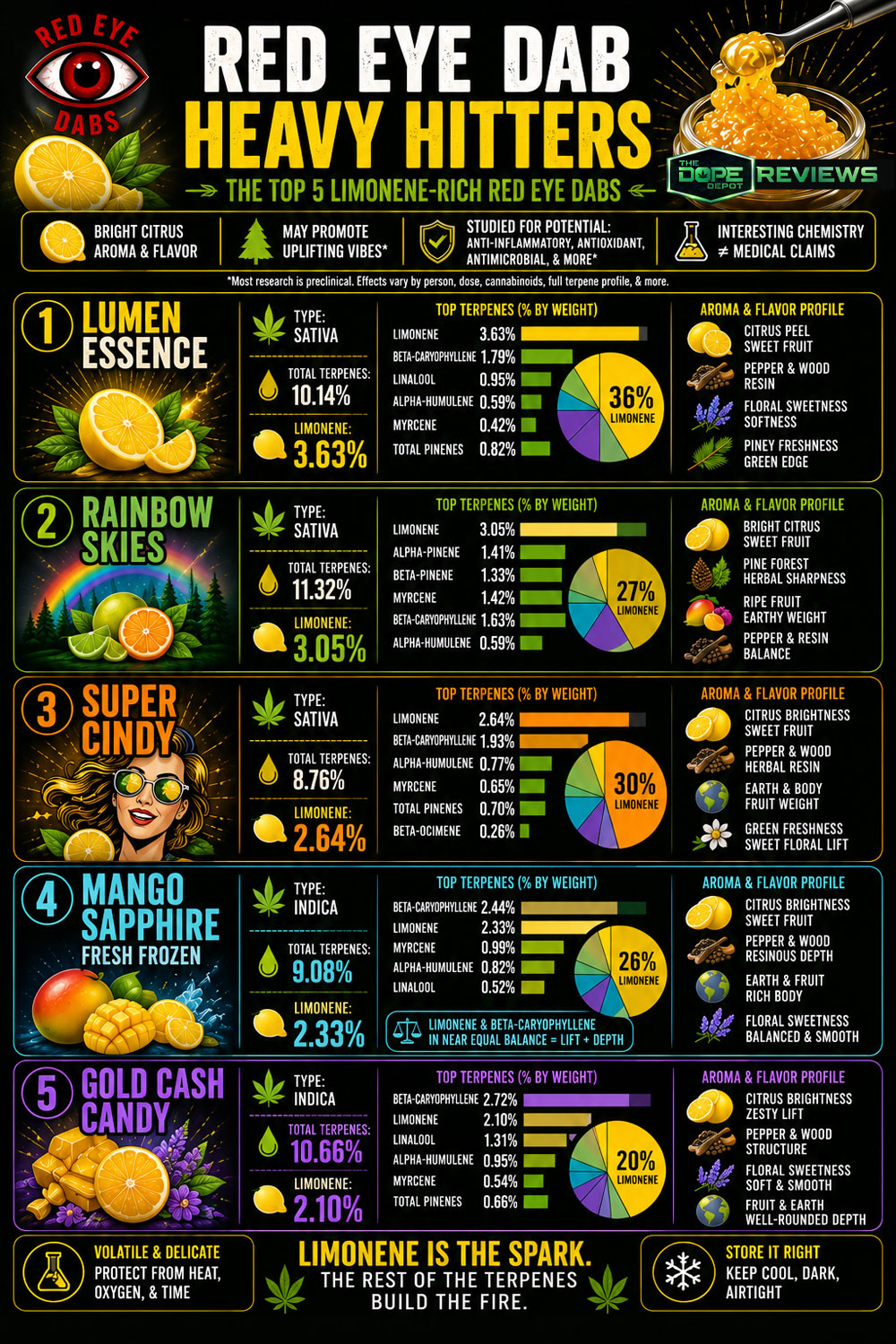
Five Red Eye Dab Heavy Hitters
1. Lumen Essence
Type: Sativa
Total Terpenes: 10.14%
Limonene: 3.63%
Lumen Essence leads the current Red Eye Dab group with a massive 3.63% limonene. That represents nearly 36% of the complete measured terpene profile, making this both high in raw concentration and genuinely limonene-dominant.
Beta-caryophyllene follows at 1.79%, while linalool reaches an unusually strong 0.95%. Alpha-humulene contributes 0.59%, myrcene sits at 0.42%, and the combined pinenes add another 0.82%.
This should be a bright, aromatic, citrus-forward profile with plenty of supporting structure. Limonene brings the citrus peel, sweet fruit, and sharp upper-end brightness. Beta-caryophyllene and humulene add pepper, dry wood, and resin. Linalool softens the middle with floral sweetness, while pinene gives the profile a fresher green edge.
Lumen Essence is not limonene quietly helping the profile. It’s limonene standing under a spotlight, somehow wearing safety glasses.
Check out the full review here.
2. Rainbow Skies
Type: Sativa
Total Terpenes: 11.32%
Limonene: 3.05%
Rainbow Skies comes in second with 3.05% limonene. That accounts for roughly 27% of its total measured terpene content.
This one is especially interesting because the pinene content is enormous. Alpha-pinene reaches 1.41%, while beta-pinene lands at 1.33%. Together, the pinenes contribute 2.74% of the profile.
Myrcene is also high at 1.42%, with beta-caryophyllene at 1.63% and alpha-humulene at 0.59%. That creates a very broad aromatic structure.
Limonene provides bright citrus and fruit. The pinenes bring fresh forest, herbs, and green sharpness. Myrcene adds ripe fruit, earth, and weight. Beta-caryophyllene gives the profile pepper and resin.
Rainbow Skies should not read as simple citrus. It’s citrus flying through a pine forest while carrying a basket of fruit and a small pepper grinder, because apparently restraint was not invited.
Check out the full review here.
3. Super Cindy
Type: Sativa
Total Terpenes: 8.76%
Limonene: 2.64%
Super Cindy contains 2.64% limonene, representing just over 30% of its total terpene profile.
Beta-caryophyllene follows at 1.93%, with alpha-humulene at 0.77% and myrcene at 0.65%. The combined pinenes contribute another 0.70%, while beta-ocimene lands at 0.26%.
This is a bright but well-structured sativa profile. Limonene should lead with citrus peel, sweet fruit, and aromatic lift. Beta-caryophyllene and humulene add pepper, herbs, dry wood, and resin. Myrcene supplies earth and body, while pinene and ocimene bring green freshness and a little sweet floral lift.
Super Cindy is high in limonene without being flimsy. The citrus has backup, and the backup brought lumber.
Check out the full review here.
4. Mango Sapphire Fresh Frozen
Type: Indica
Total Terpenes: 9.08%
Limonene: 2.33%
Our fresh frozen Mango Sapphire lands fourth with 2.33% limonene. That represents nearly 26% of the complete measured terpene profile.
Beta-caryophyllene is slightly higher at 2.44%, meaning these two terpenes share control rather than leaving limonene alone at the top. Myrcene reaches 0.99%, alpha-humulene contributes 0.82%, and linalool sits at 0.52%.
The result is a broad, balanced profile with citrus brightness laid over pepper, dry wood, earth, fruit, and floral softness. This is not likely to present as simple lemon candy.
The nearly equal balance between limonene and beta-caryophyllene should create tension between brightness and depth, while myrcene gives the lower end additional weight. It’s an excellent example of limonene providing lift without completely defining the extract.
Check out the full review here.
5. Gold Cash Candy
Type: Indica
Total Terpenes: 10.66%
Limonene: 2.10%
Gold Cash Candy rounds out the current Red Eye Dab top five with 2.10% limonene. That accounts for nearly 20% of its total terpene content.
Beta-caryophyllene leads at 2.72%, while linalool is unusually prominent at 1.31%. Alpha-humulene contributes 0.95%, myrcene sits at 0.54%, and the combined pinenes add 0.66%.
This is one of the softer and more floral profiles in the limonene group. Limonene brings citrus brightness, but beta-caryophyllene and humulene give it a peppery, woody frame. The high linalool content should add floral sweetness and a smoother middle, while myrcene provides a little fruit and earth underneath.
Gold Cash Candy sounds like it should be pure sweetness. The lab sheet says the candy has citrus, flowers, pepper, wood, and enough structure to avoid becoming syrup. A small mercy in a world determined to make everything taste like melted neon.
Check out the full review here.
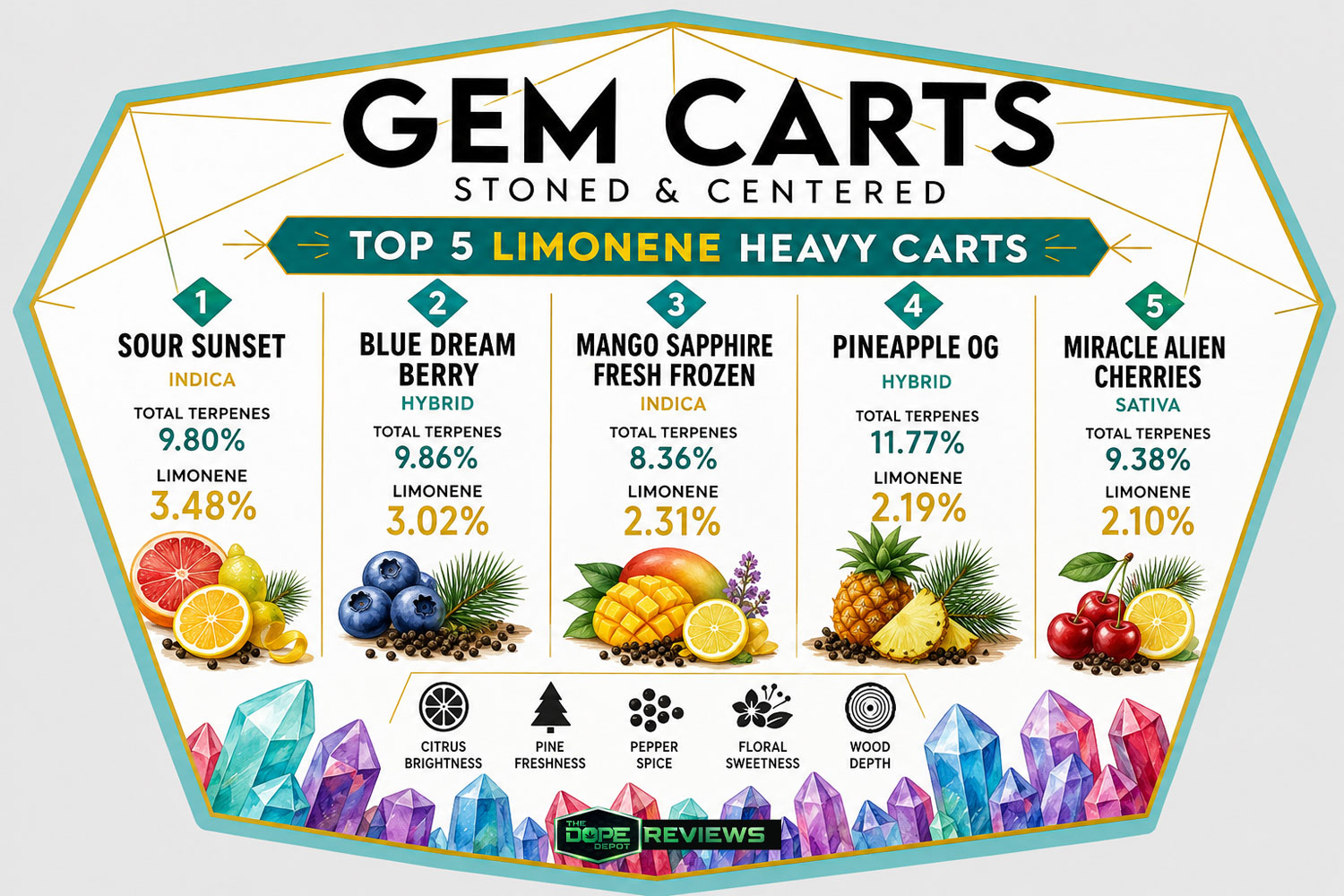
Five Cart Heavy Hitters
1. Sour Sunset
Type: Indica
Total Terpenes: 9.80%
Limonene: 3.48%
Sour Sunset leads the current cart group with a remarkable 3.48% limonene. That single compound represents more than 35% of the total terpene profile, making Sour Sunset both high in limonene and genuinely limonene-dominant.
Beta-caryophyllene follows at 1.69%. Linalool and myrcene are nearly equal at 0.76% and 0.75%, while alpha-pinene contributes a notable 0.52%.
This should produce a bright, sharp citrus structure with pepper, pine, floral sweetness, earth, and fruit beneath it. The combination of limonene and alpha-pinene may give the profile an especially fresh and aromatic upper end, while caryophyllene and myrcene keep it grounded.
At 3.48%, limonene isn’t adding a little citrus garnish. It has taken the entire fruit bowl and barricaded itself inside the kitchen.
Check out the full review here.
2. Blue Dream Berry
Type: Hybrid
Total Terpenes: 9.86%
Limonene: 3.02%
Blue Dream Berry contains 3.02% limonene, accounting for just over 30% of its complete measured terpene content.
Beta-caryophyllene follows closely at 2.60%, and alpha-humulene reaches 1.17%. Alpha-pinene is also unusually strong at 0.83%.
This creates a more evenly balanced profile than Sour Sunset. Limonene supplies the bright citrus and fruit structure, beta-caryophyllene and humulene bring pepper, wood, and herbs, and alpha-pinene contributes a fresh piney sharpness.
The profile should be bright without feeling thin, with enough heavy sesquiterpene content to provide substantial depth underneath the citrus. Blue Dream Berry is what happens when the top notes and the bass section agree to share the stage rather than filing complaints with management.
Check out the full review here.
3. Mango Sapphire Fresh Frozen
Type: Indica
Total Terpenes: 8.36%
Limonene: 2.31%
The Mango Sapphire Fresh Frozen cart carries 2.31% limonene, almost perfectly matching the 2.33% found in the dabbable version. That’s a difference of only 0.02 percentage points.
The cart also preserves a similar supporting structure, with 2.15% beta-caryophyllene, 0.92% myrcene, 0.75% alpha-humulene, and 0.49% linalool. This is an unusually useful side-by-side comparison.
Decarboxylation dramatically changes the cannabinoid profile, converting THCA into THC, but the broad terpene arrangement remains recognizable. Limonene and beta-caryophyllene still lead, followed by myrcene, humulene, and linalool.
The result should retain the same broad balance of citrus, pepper, earth, wood, fruit, and flowers. Turning an extract into a cart without erasing its original personality shouldn’t feel revolutionary, but standards are where we find them.
Check out the full review here.
4. Pineapple OG
Type: Hybrid
Total Terpenes: 11.77%
Limonene: 2.19%
Pineapple OG combines 2.19% limonene with the highest total terpene content among the featured carts at 11.77%.
Beta-caryophyllene leads at 3.39%, myrcene reaches 1.78%, and alpha-humulene contributes 1.60%. Beta-ocimene adds another 0.52%. Limonene represents just under 19% of the complete profile, so this is another case where the raw concentration is high without being proportionally dominant.
The substantial myrcene content should give the profile more fruit, earth, and heaviness. Caryophyllene and humulene provide pepper, resin, wood, and dry herbs. Limonene cuts through the middle with sharper citrus brightness, while ocimene adds sweet green lift.
Pineapple OG should present as broad and layered rather than narrowly citrus-driven. There’s plenty of limonene in the room. It simply arrived at a meeting already occupied by three larger personalities.
Check out the full review here.
5. Miracle Alien Cherries
Type: Sativa
Total Terpenes: 9.38%
Limonene: 2.10%
Miracle Alien Cherries rounds out the current cart top five with 2.10% limonene. That matches Gold Cash Candy on the Red Eye side and accounts for roughly 22% of the total measured terpene profile.
Beta-caryophyllene is even higher at 3.40%, with alpha-humulene at 1.30%. Alpha-pinene reaches 0.79%, while linalool and myrcene are much lower at 0.22% and 0.14%.
This creates a bright but highly structured profile. Limonene contributes citrus, fruit, and aromatic lift. Beta-caryophyllene and humulene bring pepper, wood, herbs, and resin. Alpha-pinene adds a fresh evergreen edge.
The cherry side likely depends on volatile compounds beyond the standard terpene panel, because cherries are complicated and apparently fruit refuses to fit into a spreadsheet either. Still, the measured chemistry shows a clear contrast between citrus brightness, pine freshness, and a heavy peppery backbone.
Check out the full review here.
What These Ten Products Show Us
The data gives us two slightly different limonene stories. The Red Eye dab list is led by three sativas: Lumen Essence, Rainbow Skies, and Super Cindy. All three contain more than 2.6% limonene, and all three show enough supporting chemistry to keep them from becoming simple citrus profiles.
Lumen Essence is the cleanest limonene showcase, with 3.63% limonene and strong linalool support.
Rainbow Skies is the most pine-heavy of the group, with an enormous 2.74% combined alpha- and beta-pinene.
Super Cindy sits somewhere in the middle, combining strong limonene with meaningful beta-caryophyllene, humulene, myrcene, pinene, and ocimene.
The cart list is still led by Sour Sunset and Blue Dream Berry, both of which are genuinely limonene-dominant. Mango Sapphire Fresh Frozen remains one of the best format comparisons, with 2.33% limonene in the dab and 2.31% in the cart.
That near-match is usefully interesting. It shows that careful decarboxylation and cart production can preserve the main terpene architecture instead of turning the finished product into anonymous hot citrus vapor juice.
The third pattern is that high limonene doesn’t always mean limonene-dominant. Pineapple OG and Miracle Alien Cherries both contain more than 2% limonene, but beta-caryophyllene is higher in both profiles. Gold Cash Candy also contains 2.10% limonene, yet beta-caryophyllene and linalool are major players. Raw concentration matters, as do the ratios we find these molecules in.
Finally, limonene-rich products still refuse to stay inside one traditional cannabis category. The top Red Eye Dabs include sativas and indicas. The top carts include indicas, hybrids, and a sativa.
The limonene number tells us about brightness, citrus structure, and volatile preservation. It does not issue an effect guarantee, because the human nervous system continues to be a poorly documented operating system.
The Lab Rat Verdict
Limonene is one of the main sources of brightness in cannabis aroma. It can contribute citrus peel, sweet fruit, sharp herbs, pine, resin, and fresh aromatic lift. As a volatile monoterpene, it’s also among the compounds most vulnerable to heat, oxygen, time, and careless processing.
A high limonene result tells us that a meaningful amount of this lighter chemistry survived into the finished extract. What it doesn’t do is guarantee that the product will taste like lemons, feel energetic, improve someone’s mood, or prevent anxiety.
For that, we need the rest of the profile and a human nervous system, two variables that remain annoyingly resistant to simple labels.
Beta-caryophyllene can make limonene spicier and more grounded. Myrcene can push it toward fruit, earth, and musk. Linalool can soften it with floral sweetness. Pinene can sharpen it. Humulene can make it drier and more herbal. Ocimene can give it sweet green lift.
The limonene number tells you how much brightness is available. The rest of the chemistry decides where the light lands.
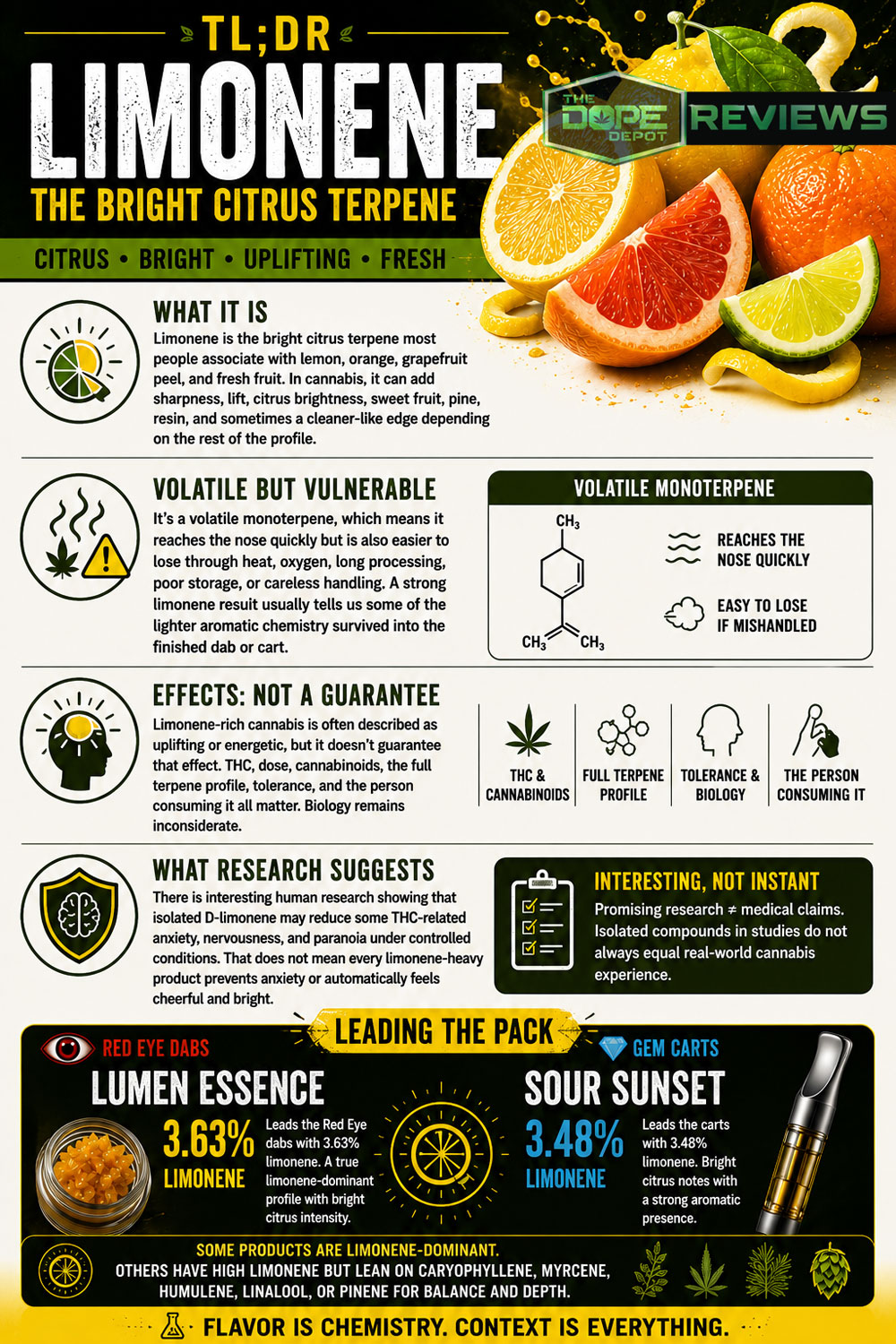
TL;DR: Limonene
Limonene is the bright citrus terpene most people associate with lemon, orange, grapefruit peel, and fresh fruit. In cannabis, it can add sharpness, lift, citrus brightness, sweet fruit, pine, resin, and sometimes a cleaner-like edge depending on the rest of the profile.
It’s a volatile monoterpene, which means it reaches the nose quickly but is also easier to lose through heat, oxygen, long processing, poor storage, or careless handling. A strong limonene result usually tells us some of the lighter aromatic chemistry survived into the finished dab or cart.
Limonene-rich cannabis is often described as uplifting or energetic, but it doesn’t guarantee that effect. THC, dose, cannabinoids, the full terpene profile, tolerance, and the person consuming it all matter. Biology remains inconsiderate.
There is interesting human research showing that isolated D-limonene may reduce some THC-related anxiety, nervousness, and paranoia under controlled conditions. That does not mean every limonene-heavy product prevents anxiety or automatically feels cheerful and bright.
In our current data, Lumen Essence leads the Red Eye Dabs at 3.63% limonene, while Sour Sunset leads the carts at 3.48%. Some products are truly limonene-dominant, while others contain high limonene but still lean heavily on beta-caryophyllene, myrcene, humulene, linalool, or pinene.
The short squirrel version:
Limonene brings brightness, citrus structure, and aromatic lift. It can make a profile feel fresher and sharper, but the rest of the chemistry decides whether that brightness turns into lemon peel, fruit, pine, flowers, spice, or something closer to industrial floor cleaner with ambition.

Podcast: Play in new window | Download