

Podcast: Play in new window | Download (Duration: 36:20 — 26.2MB)
The posts in this series are a pretty healthy read, so for those of you who lack the curiosity or the attention span, scroll to the end and find the TL;DR, or CLICK HERE!! Otherwise, put on your thinking caps and lets get going!
If you don’t feel like reading, you can listen to Finn read the post to you. Download the mp3 here or tap the play button!
- Click here to skip to the top 5 Red Eye dab Pinene heavy hitters.
- Click here to skip to the top 5 Gem Cart Pinene heavy hitters.
Alpha-Pinene and Beta-Pinene: The Fresh Forest Terpenes in Cannabis
Pinene has one of the most straightforward names in terpene chemistry. To put it plainly, it smells like pine. For once, whoever named the molecule resisted the temptation to bury useful information beneath six syllables of academic fog.
Unfortunately, the simplicity mostly ends there.
Pinene isn’t one compound. The two major forms found on cannabis terpene panels are alpha-pinene and beta-pinene. They share the same molecular formula and both contribute fresh, woody, green, and evergreen aromas, but they’re separate molecules with different structures and somewhat different sensory personalities.
They’ve also collected an impressive assortment of cannabis claims. Pinene supposedly improves focus, protects memory from THC, increases alertness, opens the lungs, reduces inflammation, and gives certain strains their clear-headed sativa effects.
Some of those ideas have a reasonable scientific origin. Others have been repeated so many times that the cannabis industry forgot to check whether humans had actually been studied. Most recently, researchers did test one of the biggest claims directly. The result was not what the terpene charts promised.
What Are Alpha-Pinene and Beta-Pinene?
Alpha-pinene and beta-pinene are bicyclic monoterpenes with the molecular formula C10H16. “Bicyclic” means their carbon structures contain two connected rings. “Monoterpene” means they’re built from two isoprene units and contain ten carbon atoms.
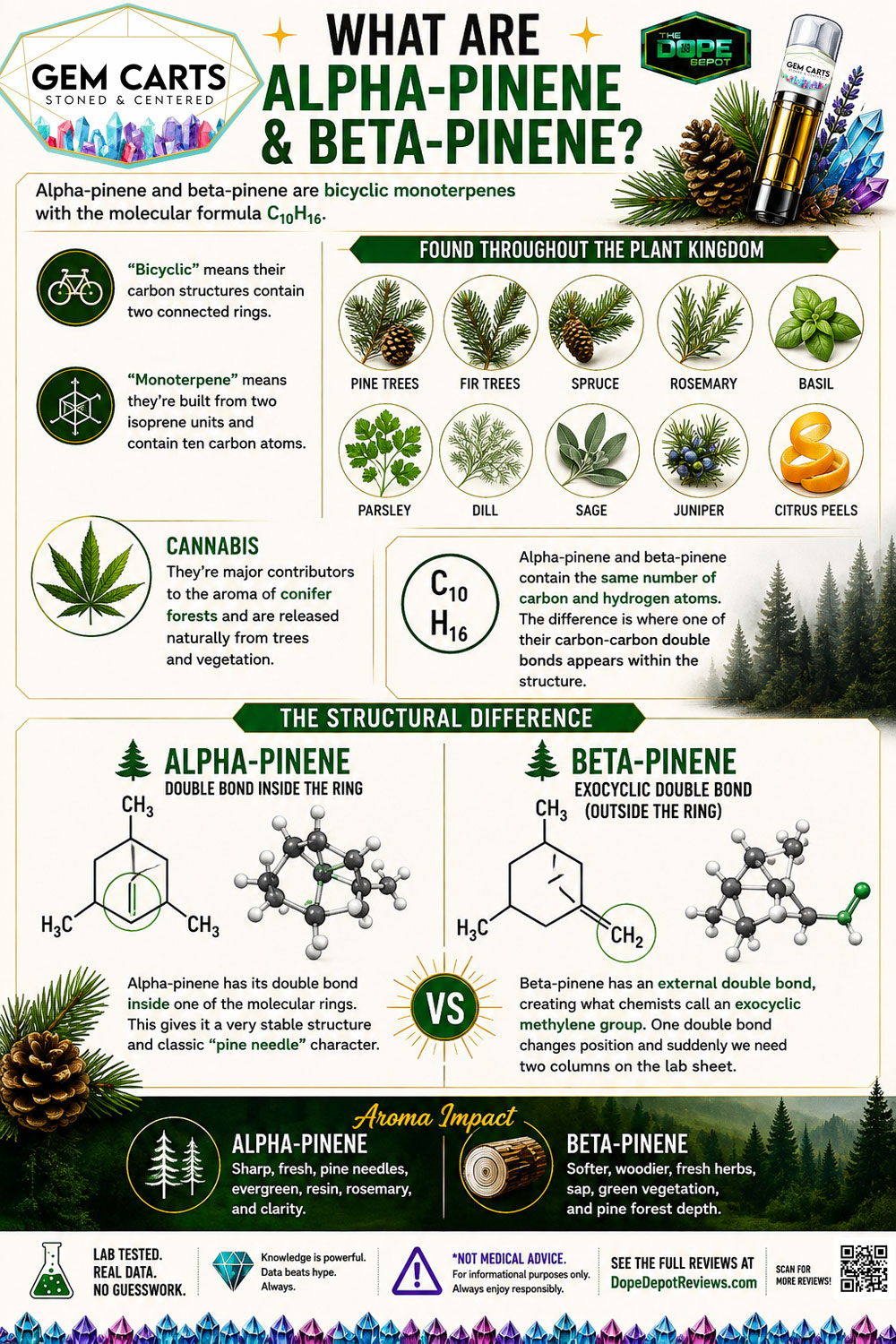
Both compounds are found throughout the plant kingdom, including in:
- Pine trees
- Fir trees
- Spruce
- Rosemary
- Basil
- Parsley
- Dill
- Sage
- Juniper
- Citrus peels
- Cannabis
They’re major contributors to the aroma of conifer forests and are released naturally from trees and vegetation. Alpha-pinene and beta-pinene contain the same number of carbon and hydrogen atoms. The difference is where one of their carbon-carbon double bonds appears within the structure.
Alpha-pinene has its double bond inside one of the molecular rings. Beta-pinene has an external double bond, creating what chemists call an exocyclic methylene group. One double bond changes position and suddenly we need two columns on the lab sheet.
Molecules are very efficient at generating paperwork.
What Does Alpha-Pinene Smell Like?
Alpha-pinene is usually the sharper and more immediately recognizable of the two. It can contribute:
- Fresh pine needles
- Evergreen forest
- Rosemary
- Resin
- Turpentine
- Crisp herbs
- Eucalyptus-like freshness
- Woody spice
- Sap
- Light citrus peel
Alpha-pinene often creates the sensation of aromatic sharpness rather than sweetness or weight. It can make a profile feel brighter, greener, and more open, especially when paired with limonene, terpinolene, or ocimene.
When substantial beta-caryophyllene and humulene are present, alpha-pinene can sharpen a heavier foundation of pepper, dry wood, herbs, and resin. With myrcene, it can create something closer to damp forest vegetation: pine needles, earth, ripe fruit, herbs, and musk sharing the same space.
It’s like a tiny forest in a jar.
What Does Beta-Pinene Smell Like?
Beta-pinene overlaps with alpha-pinene, but its aroma is generally described as softer, woodier, greener, and more herbal. It can contribute:
- Pine
- Fresh wood
- Basil
- Dill
- Parsley
- Green herbs
- Resin
- Sap
- Light spice
- Hops
- Dry vegetation
Beta-pinene may feel less sharply evergreen than alpha-pinene and more like crushed herbs, fresh lumber, or green plant material. That distinction isn’t absolute. Aroma depends on concentration, molecular orientation, the surrounding chemistry, and the person doing the smelling.
In a laboratory profile, alpha-pinene and beta-pinene usually work together. Alpha-pinene provides much of the crisp evergreen top note. Beta-pinene helps widen that note into wood, herbs, and green vegetation.
One is the pine needle. The other is the branch it rode in on.
Each Pinene Has Mirror Images
Alpha-pinene and beta-pinene each exist in multiple mirror-image forms called enantiomers. The most important examples are:
- Positive and negative alpha-pinene
- Positive and negative beta-pinene
These forms contain the same atoms and basic connections, but their three-dimensional structures are mirror images. Human odor receptors can distinguish between molecular orientation, meaning different pinene enantiomers can produce somewhat different aroma impressions and biological responses.
Standard cannabis terpene panels generally report total alpha-pinene and total beta-pinene without separating their enantiomers. The PhytoFact sheet can tell us how much alpha- and beta-pinene were detected. It cannot fully explain the specific three-dimensional mixture responsible for the exact aroma.
The deeper we look into smell, the less cooperative the word “piney” becomes.
Pine Aroma Is More Than Pinene
Pine trees contain pinene, but pinene alone doesn’t recreate the complete smell of a forest. Conifer aroma can also involve:
- Camphene
- Limonene
- Bornyl acetate
- Borneol
- Carene
- Terpinolene
- Myrcene
- Sabinene
- Numerous oxygenated compounds
The same is true in cannabis. An extract can contain substantial pinene without smelling exactly like pine needles. Limonene may pull it toward citrus. Myrcene can make it earthier and fruitier. Terpinolene can add flowers and sweet herbs. Caryophyllene and humulene may make it feel woodier, drier, and more resinous.
Conversely, an extract with moderate pinene may smell strongly piney because several related compounds reinforce the same general sensory direction. One terpene column is evidence. It is not a complete explanation.
The forest, inconveniently, contains more than one tree.
Pinenes Are Volatile Monoterpenes
Alpha-pinene and beta-pinene are relatively light and volatile. That volatility allows them to reach the nose quickly, creating the fresh top notes associated with pine, herbs, and green vegetation.
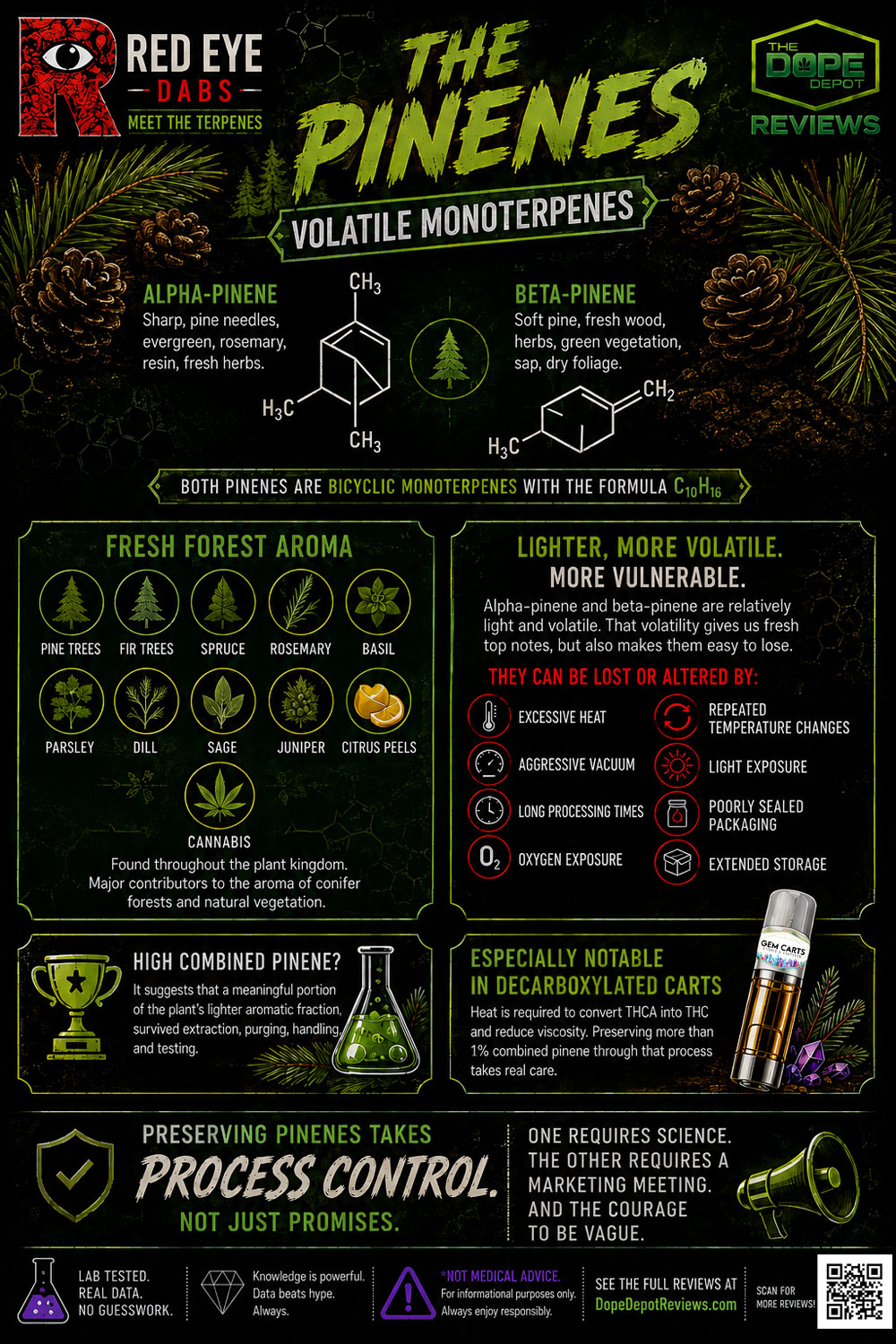
It also makes them vulnerable. Pinenes can be lost or altered through:
- Excessive heat
- Aggressive vacuum
- Long processing times
- Oxygen exposure
- Repeated temperature changes
- Light exposure
- Poorly sealed packaging
- Extended storage
A high combined pinene result suggests that a meaningful portion of the plant’s lighter aromatic fraction survived extraction, purging, handling, and testing. This is especially notable in decarboxylated carts, where heat and time is required to convert THCA into THC and reduce the extract’s viscosity.
Preserving more than 1% combined pinene through that process requires considerably more care than writing “fresh forest flavor” on the package. One requires process control. The other requires a marketing meeting and the courage to be vague.
What Happens When Pinene Oxidizes?
Alpha-pinene and beta-pinene react with oxygen and environmental oxidants. Those reactions can form compounds such as pinene oxides, pinonaldehyde, verbenol, verbenone, and numerous other oxygenated products.
These molecules don’t smell or behave exactly like the original pinenes. As oxidation progresses, the fresh evergreen character may become duller, sharper, more resinous, or otherwise altered.
This is part of the reason an old jar can lose the crisp aroma it had when first packaged, even when the total amount of material hasn’t visibly changed. The chemistry is still there. It has simply rearranged itself into something nobody ordered.
Cool, airtight, light-protected storage slows that process. Oxygen will eventually win.
Does Pinene Protect Your Memory From THC?
This is probably the most famous pinene claim in cannabis. The basic story goes like this:
THC can impair short-term memory. Alpha-pinene may inhibit acetylcholinesterase, an enzyme that breaks down the neurotransmitter acetylcholine. Therefore, alpha-pinene-rich cannabis may reduce or prevent THC-related memory impairment.
That explanation is chemically plausible enough to sound convincing. Until recently, it had not been properly demonstrated in humans. Researchers conducted a controlled human study specifically designed to test the claim.
Nineteen healthy adults completed six double-blind sessions involving placebo, alpha-pinene alone, THC alone, and THC combined with three different alpha-pinene doses. The highest alpha-pinene dose was 15 milligrams, which the researchers described as being at or above amounts naturally encountered in cannabis flower.
THC impaired cognitive performance and working memory as expected. Adding alpha-pinene did not reduce that impairment. Alpha-pinene also did not meaningfully alter THC’s other major subjective, cognitive, physiological, or psychomotor effects.
That doesn’t prove alpha-pinene can never interact with THC under any possible chemical or dosing condition. The study tested isolated alpha-pinene and THC rather than the complete chemistry of a cannabis extract.
It does mean the direct human evidence currently fails to support the industry’s standard claim that alpha-pinene protects memory from THC.
Does Pinene Improve Focus or Alertness?
Pinene-rich products are frequently described as clear-headed, focused, alert, or mentally active. Those descriptions may sometimes match the consumer experience, especially when the products also contain substantial limonene, terpinolene, ocimene, or THC.
The pinene number alone cannot confirm the cause. Small human aroma studies have examined alpha-pinene outside cannabis.
In one experiment, young adult women inhaled a weak alpha-pinene odor for a brief period. The researchers observed increased parasympathetic nervous activity, a small reduction in heart rate, and higher ratings of comfort compared with clean air.
That result points more toward short-term physiological relaxation than stimulation. It was also a very small study involving brief odor exposure, not a cannabis product, THC intoxication, or sustained cognitive performance. Alpha-pinene may influence the nervous system.
Current evidence doesn’t support reducing that influence to “focus terpene” or “energy terpene.” Once again, our physiology has refused to fit on the front of a vape box.
Is Pinene a Bronchodilator?
Alpha-pinene is regularly described as a bronchodilator, meaning a compound that relaxes airway muscles and makes breathing easier. The claim appears throughout cannabis education materials and terpene charts.
The direct evidence is considerably weaker than those summaries suggest.
Human alpha-pinene inhalation research has demonstrated that the compound is absorbed through the lungs and enters the bloodstream. That work primarily examined uptake, distribution, metabolism, and elimination.
It wasn’t a clinical trial showing that inhaled alpha-pinene treats asthma, bronchospasm, or another airway disorder. Some essential oils and plant extracts containing pinene have shown respiratory effects in preclinical or clinical research. Those mixtures contain numerous compounds and cannot establish that pinene alone caused the result.
Calling pinene an established human bronchodilator goes beyond the evidence. Inhaling cannabis smoke or vapor should also not be treated as respiratory therapy. A pleasant sensation of pine freshness is not the same thing as a measured improvement in lung function.
The lungs, annoyingly, care more about physiology than branding.
What Does the Research Say?
Alpha-pinene and beta-pinene have been studied for potential:
- Anti-inflammatory activity
- Antimicrobial activity
- Antioxidant effects
- Neuroprotective activity
- Anxiety-related effects
- Pain-related effects
- Anticonvulsant activity
- Gastrointestinal effects
- Anticancer activity
Most of this evidence comes from animal studies, cell cultures, isolated tissues, essential oils, or doses that don’t correspond directly to ordinary cannabis use. Alpha-pinene has received more research attention than beta-pinene, particularly in neurological and inflammatory models.
Beta-pinene has also produced interesting preclinical results, including antimicrobial and mood-related findings, but direct human research remains sparse. These compounds are biologically active.
That statement is considerably more defensible than claiming a pinene-rich dab improves memory, opens the lungs, treats anxiety, reduces inflammation, or protects the brain. Promising research is a reason to conduct better studies. It’s not permission to skip them.
Do the Pinenes Determine the High?
The Pinenes may contribute to the character of a cannabis experience, but they cannot independently predict it. Our current pinene-heavy products include sativas, hybrids, and indicas.
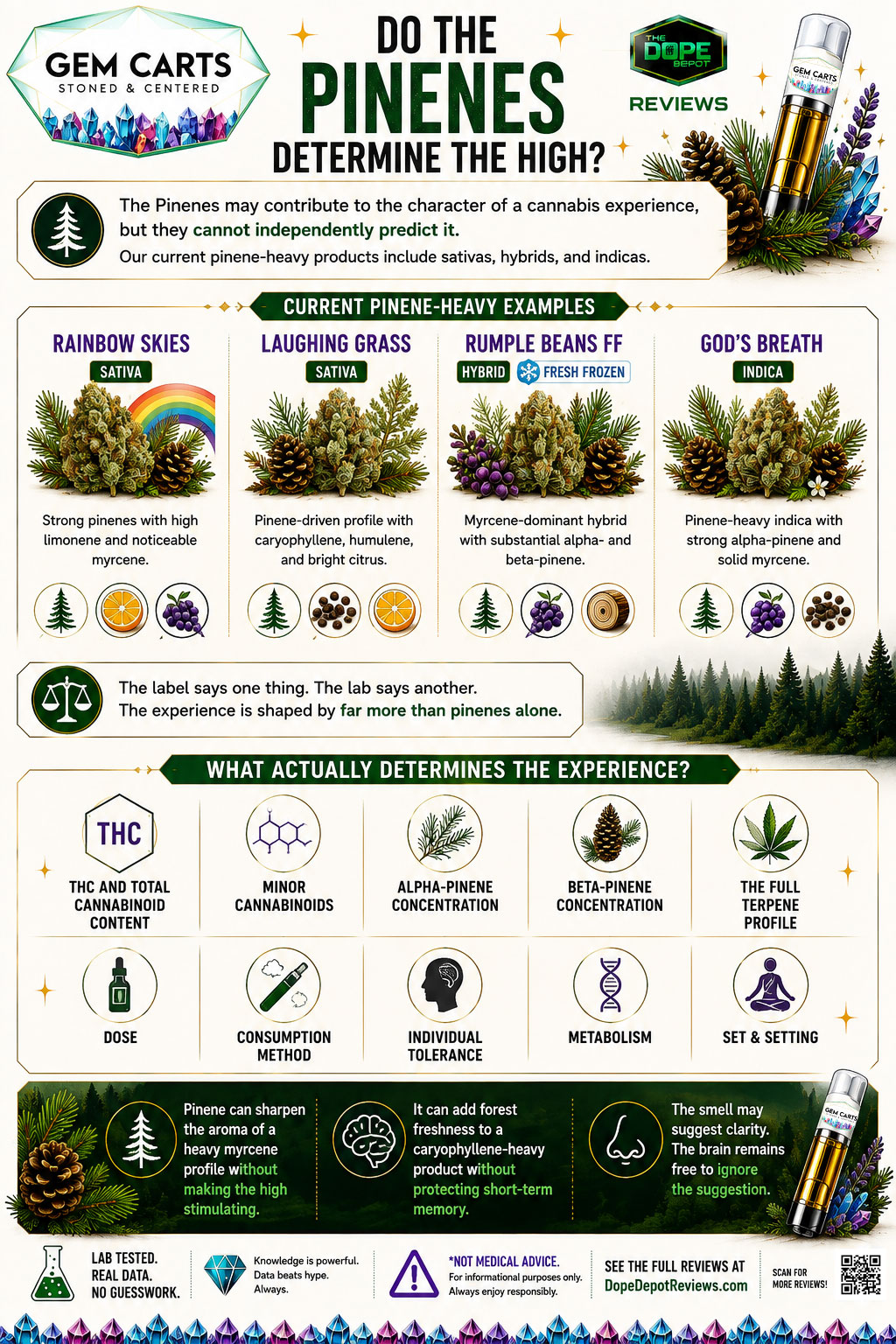
Rainbow Skies and Laughing Grass are sativas. Rumple Beans FF is a myrcene-dominant fresh frozen hybrid with substantial amounts of both pinenes. God’s Breath is labeled indica and appears in both current pinene-heavy lists.
The experience depends on:
- THC and total cannabinoid content
- Minor cannabinoids
- Alpha-pinene concentration
- Beta-pinene concentration
- The full terpene profile
- Dose
- Consumption method
- Individual tolerance
- Metabolism
- Set and setting
Pinene can sharpen the aroma of a heavy myrcene profile without making the high stimulating. It can add forest freshness to a caryophyllene-heavy product without protecting short-term memory. The smell may suggest clarity. The brain remains free to ignore the suggestion.
Reading Alpha-Pinene and Beta-Pinene on a Lab Sheet
Because the two pinenes overlap sensorially, it’s useful to examine them individually and together. For this article, we ranked current products by combined pinene content:
Combined pinenes = alpha-pinene + beta-pinene
That method identifies the products with the largest overall measured pine-related fraction while preserving the distinction between the two molecules. When reading the panel, ask:
- What is the alpha-pinene concentration?
- What is the beta-pinene concentration?
- What is their combined concentration?
- How much of the total terpene profile do they represent?
- Which other compounds surround them?
Alpha-pinene is higher than beta-pinene in all ten products featured below. That pattern is common in our current data, but the ratio varies considerably.
Rainbow Skies carries 1.41% alpha-pinene and 1.33% beta-pinene, a nearly balanced pair.
God’s Breath cart contains 1.61% alpha-pinene and only 0.13% beta-pinene, making the combined result heavily weighted toward alpha-pinene.
The combined total tells us the overall pinene concentration. The ratio tells us which version is doing most of the work.
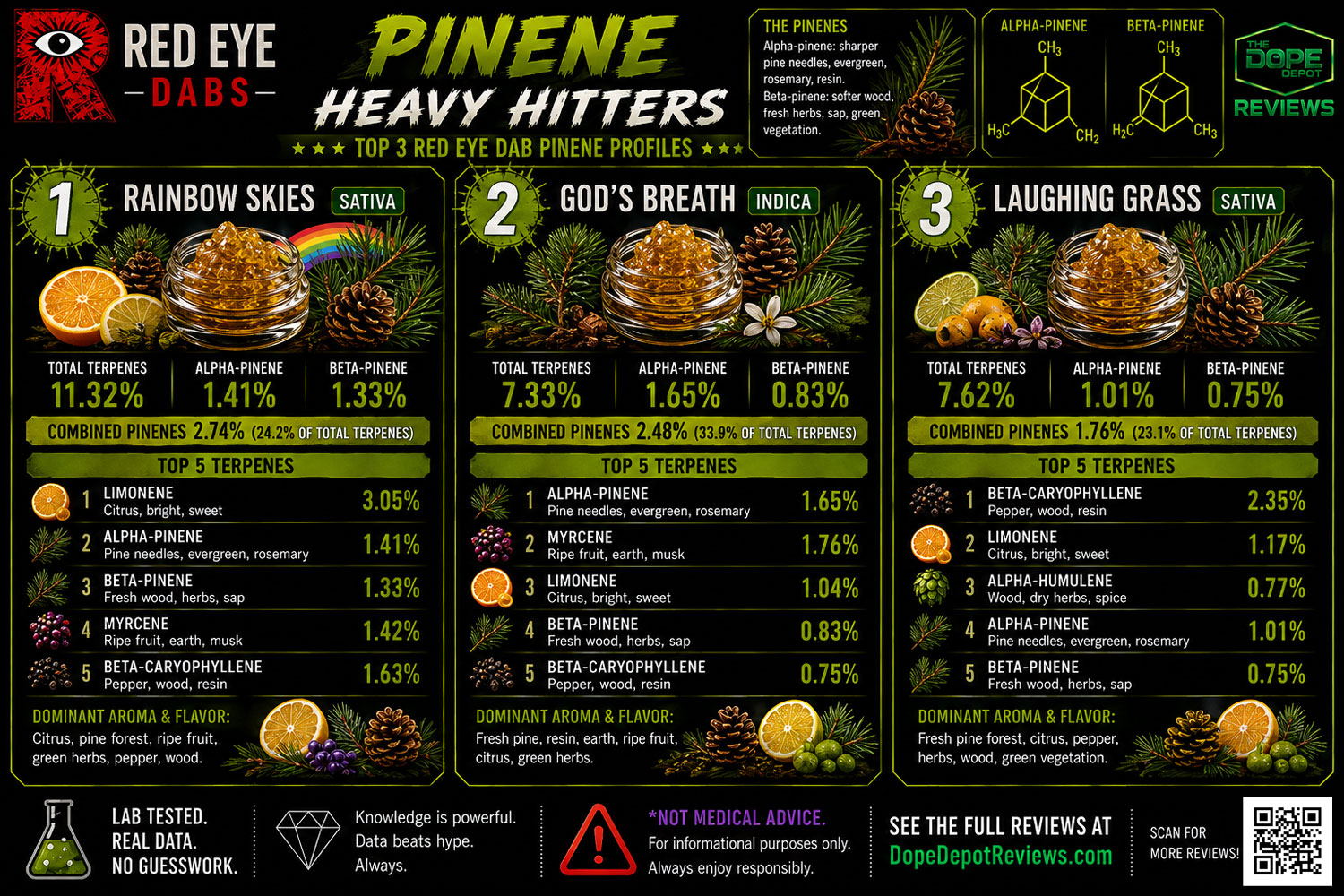
Five Red Eye Dab Heavy Hitters
1. Rainbow Skies
Type: Sativa
Total Terpenes: 11.32%
Alpha-Pinene: 1.41%
Beta-Pinene: 1.33%
Combined Pinenes: 2.74%
Rainbow Skies leads the current Red Eye Dab list with a huge 2.74% combined pinenes. That represents roughly 24% of the complete measured terpene profile.
Even more interesting, the alpha-pinene and beta-pinene results are almost evenly matched. Alpha-pinene sits at 1.41%, while beta-pinene lands at 1.33%. This should create a very broad pine expression.
Alpha-pinene brings the sharper evergreen, rosemary, resin, and pine-needle side. Beta-pinene widens that into fresh wood, green herbs, sap, and dry vegetation. Limonene is even higher at 3.05%, while myrcene contributes 1.42% and beta-caryophyllene reaches 1.63%.
That means Rainbow Skies is not just a pine profile. It’s citrus, pine, ripe fruit, green herbs, pepper, and wood all sharing a very crowded room. The pinenes give the profile a massive fresh forest structure, but limonene is bright enough to pull that forest toward citrus and sweet fruit.
Rainbow Skies apparently wanted to smell like someone peeled citrus fruit in a pine grove after a rainstorm.
Check out the full review here.
2. God’s Breath
Type: Indica
Total Terpenes: 7.33%
Alpha-Pinene: 1.65%
Beta-Pinene: 0.83%
Combined Pinenes: 2.48%
God’s Breath comes in second with 2.48% combined pinenes. That accounts for nearly 34% of the measured terpene profile, making this the most proportionally pinene-heavy Red Eye dab in the current top five.
Alpha-pinene is the single largest terpene in the profile at 1.65%. Beta-pinene follows at 0.83%. Myrcene is also substantial at 1.76%, while limonene reaches 1.04%. Beta-caryophyllene sits much lower at 0.75%, and alpha-humulene contributes 0.25%.
This is a very different structure from most of the pinene list. Instead of pinene sharpening a caryophyllene-heavy foundation, God’s Breath puts alpha-pinene and myrcene near the center of the profile.
Expect fresh pine, resin, green herbs, ripe fruit, earth, musk, and citrus. The indica label may suggest something heavy, but the terpene panel contains a surprising amount of bright forest chemistry. Apparently the breath in question came from a pine forest with questionable boundaries.
Check out the full review here.
3. Laughing Grass
Type: Sativa
Total Terpenes: 7.62%
Alpha-Pinene: 1.01%
Beta-Pinene: 0.75%
Combined Pinenes: 1.76%
Laughing Grass carries 1.76% combined pinenes. That represents roughly 23% of its complete measured terpene profile, making pine chemistry one of the product’s main structural features.
Beta-caryophyllene leads at 2.35%, while limonene reaches 1.17% and alpha-humulene contributes 0.77%. Myrcene sits at 0.50%, with smaller amounts of linalool and ocimene. This should create a profile with a particularly crisp and aromatic upper end.
Alpha- and beta-pinene provide pine needles, herbs, fresh wood, and green vegetation. Limonene adds citrus brightness. Caryophyllene and humulene build a heavier foundation of pepper, resin, and dry wood. The result should feel fresh without being light.
Laughing Grass didn’t merely bring a pine tree into the terpene profile. It apparently dragged in several surrounding acres.
Check out the full review here.
4. Blue Dream Team
Type: Sativa
Total Terpenes: 7.52%
Alpha-Pinene: 0.86%
Beta-Pinene: 0.52%
Combined Pinenes: 1.38%
Blue Dream Team carries 1.38% combined pinenes, accounting for more than 18% of its total terpene content. Beta-caryophyllene leads at 2.31%, followed by alpha-pinene at 0.86%, alpha-humulene at 0.84%, and myrcene at 0.78%.
Beta-pinene contributes another 0.52%, while limonene sits at 0.40%. This is a distinctly woody and forest-oriented profile. Caryophyllene and humulene provide pepper, dry herbs, wood, and resin. The pinenes sharpen that structure with evergreen freshness, while myrcene adds earth, fruit, and musk.
Limonene plays a smaller role than it does in Rainbow Skies or Laughing Grass, so the brightness should lean more toward pine and fresh wood than citrus. Blue Dream Team has the chemical architecture of a damp forest with a pepper grinder left somewhere near the trail.
Check out the full review here.
5. Rumple Beans Fresh Frozen
Type: Hybrid
Total Terpenes: 9.15%
Alpha-Pinene: 0.66%
Beta-Pinene: 0.53%
Combined Pinenes: 1.19%
Rumple Beans FF is a custom blend of Pistil Pioneers fresh frozen Rumple Berry and our Pink Beans blend. Pink Beans was a blend of Vanilla Bean and Pink Rosay. It contains 1.19% combined pinenes, representing roughly 13% of the complete measured profile.
Myrcene dominates at 4.02%, followed by beta-caryophyllene at 1.58%. Limonene reaches 0.88%, while alpha-humulene contributes 0.45%. This is primarily a myrcene-driven extract.
Expect ripe fruit, herbs, earth, musk, and balsamic depth to lead. The pinenes contribute a substantial fresh evergreen and herbal layer through the upper portion of the profile. Limonene adds further brightness, while caryophyllene and humulene supply pepper, wood, and resin.
The pinenes don’t make Rumple Beans FF a light profile. They keep an extremely heavy myrcene base from closing every window in the building.
Check out the full review here.
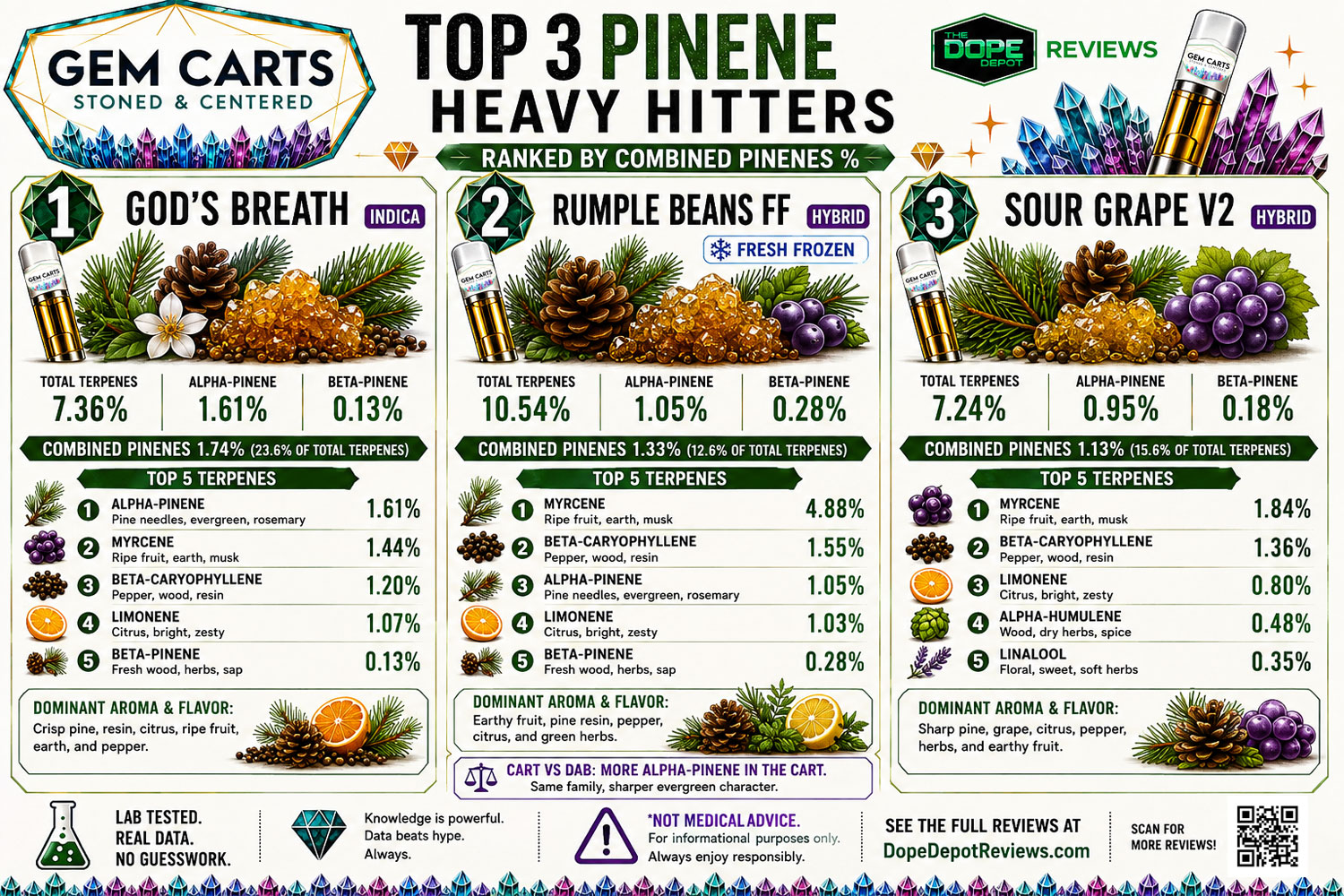
Five Cart Heavy Hitters
1. God’s Breath
Type: Indica
Total Terpenes: 7.36%
Alpha-Pinene: 1.61%
Beta-Pinene: 0.13%
Combined Pinenes: 1.74%
God’s Breath leads the current cart group with 1.74% combined pinenes. That represents nearly 24% of the complete measured terpene profile.
Unlike the Red Eye dab version, the cart is overwhelmingly weighted toward alpha-pinene. Alpha-pinene reaches 1.61%, while beta-pinene contributes only 0.13%. Myrcene follows at 1.44%, beta-caryophyllene reaches 1.20%, and limonene lands at 1.07%.
This is a broad but sharply alpha-pinene-forward profile. Expect crisp pine needles, resin, rosemary, fresh herbs, citrus, ripe fruit, earth, and pepper. The high alpha-pinene concentration should give the cart a strong evergreen top note, while myrcene and caryophyllene add body underneath.
God’s Breath is one of the clearest examples in the current data of a pinene-heavy indica. Which is inconvenient for anyone still pretending pine equals sativa clarity.
Check out the full review here.
2. Rumple Beans Fresh Frozen
Type: Hybrid
Total Terpenes: 10.54%
Alpha-Pinene: 1.05%
Beta-Pinene: 0.28%
Combined Pinenes: 1.33%
The Rumple Beans FF cart contains 1.33% combined pinenes. Alpha-pinene rises to 1.05%, while beta-pinene lands at 0.28%. The dab version contains a more balanced 0.66% alpha-pinene and 0.53% beta-pinene.
Myrcene also rises from 4.02% in the dab to 4.88% in the cart. Beta-caryophyllene remains nearly unchanged at 1.55%, and limonene reaches 1.03%. The broad profile remains recognizable between formats: dominant myrcene, substantial caryophyllene, meaningful limonene, and a large pine fraction.
The internal pinene ratio changes, however. The cart is much more strongly weighted toward alpha-pinene, suggesting a sharper evergreen and resinous character rather than the more evenly mixed pine-and-herb structure found in the dab.
The family resemblance survived decarboxylation. One sibling simply came back from the process wearing a considerably larger pine hat.
Check out the full review here.
3. Sour Grape V2
Type: Hybrid
Total Terpenes: 7.24%
Alpha-Pinene: 0.95%
Beta-Pinene: 0.18%
Combined Pinenes: 1.13%
Sour Grape V2 contains 1.13% combined pinenes, accounting for nearly 16% of its complete terpene profile. Myrcene leads at 1.84%, followed by beta-caryophyllene at 1.36%. Limonene reaches 0.80%, while alpha-humulene and linalool contribute 0.48% and 0.35%.
Alpha-pinene does most of the pinene work here. At 0.95%, it should create a clear layer of sharp pine, rosemary, resin, and fresh herbs. Myrcene supplies ripe fruit, earth, and weight, while limonene gives the grape-oriented profile additional brightness. Caryophyllene and humulene add pepper, wood, and dryness.
Sour Grape V2 should feel greener and more resinous than its name alone suggests. The grape brought pine needles. Nobody checked the guest list.
Check out the full review here.
4. Out of the Blue
Type: Sativa
Total Terpenes: 7.32%
Alpha-Pinene: 0.90%
Beta-Pinene: 0.22%
Combined Pinenes: 1.12%
Out of the Blue follows only 0.01 percentage points behind Sour Grape V2. Combined pinenes represent a little over 15% of its total terpene content.
Beta-caryophyllene dominates at 2.42%, followed by alpha-humulene at 0.92%. Limonene reaches 0.71%, myrcene sits at 0.63%, and linalool contributes 0.39%. This creates a dry and structured foundation.
Caryophyllene and humulene provide pepper, wood, herbs, and resin. Alpha-pinene adds sharp evergreen freshness, while limonene and myrcene contribute citrus, fruit, and earth. Linalool softens the profile with a floral middle.
Out of the Blue contains nearly equal concentrations of alpha-pinene and humulene, creating an interesting contrast between fresh pine and dry hops. It sounds like a candle marketed toward people who own axes but work in accounting.
Check out the full review here.
5. Laughing Blue Grass
Type: Sativa
Total Terpenes: 8.28%
Alpha-Pinene: 0.84%
Beta-Pinene: 0.24%
Combined Pinenes: 1.08%
Laughing Blue Grass rounds out the current cart top five with 1.08% combined pinenes. Beta-caryophyllene leads at 2.75%, followed by limonene at 1.14% and alpha-humulene at 0.95%.
Linalool reaches 0.51%, while myrcene sits at 0.42%. The profile should have a particularly fresh upper end, with pine and citrus appearing over pepper, dry wood, herbs, and flowers.
Compared with Out of the Blue, Laughing Blue Grass contains more limonene, caryophyllene, humulene, and linalool. That should make it broader and somewhat louder, with more citrus brightness and floral softness around the pine structure.
Laughing Blue Grass has nearly enough forest chemistry to qualify for a recreational land-use permit.
Check out the full review here.
What These Ten Products Show Us
The first pattern is that alpha-pinene consistently exceeds beta-pinene. That’s true in all ten featured products.
The difference ranges from very small in Rainbow Skies, where alpha-pinene reaches 1.41% and beta-pinene hits 1.33%, to very large in God’s Breath cart, where alpha-pinene reaches 1.61% and beta-pinene contributes only 0.13%. This means “high pinene” can describe very different internal ratios.
The second pattern is that strong pinene profiles rarely stand alone. Every featured product also contains meaningful amounts of other major terpenes. Rainbow Skies contains 3.05% limonene and 1.42% myrcene. God’s Breath pairs high pinene with substantial myrcene. Laughing Grass, Blue Dream Team, Out of the Blue, and Laughing Blue Grass all carry major beta-caryophyllene and alpha-humulene support.
The pinenes contribute freshness, green herbs, resin, and wood. The surrounding compounds determine whether that freshness feels citrusy, earthy, fruity, floral, peppery, or dry.
Third, pinene-rich products aren’t limited to one category. The featured products include sativas, hybrids, and indicas. The data provides no basis for treating pinene as an automatic sativa marker or a guaranteed predictor of alertness. God’s Breath appears in both lists as an indica with very high combined pinene content. The molecule has once again declined to obey retail taxonomy.
Fourth, the Rumple Beans FF comparison shows how the total pinene fraction and the internal alpha-to-beta ratio can shift during processing. The dab contains 1.19% combined pinenes, divided fairly evenly between alpha and beta. The cart reaches 1.33%, but most of that total comes from alpha-pinene.
The broad profile remains recognizable while the details change. That is exactly why individual terpene results matter more than a total percentage and a strain name.
Finally, Rainbow Skies shows what happens when alpha- and beta-pinene both show up in major amounts. The result is not merely “piney.” Its pine, citrus, fruit, herbs, resin, and wood spread across a very large 11.32% terpene profile.
The Lab Rat Verdict
Alpha-pinene and beta-pinene provide some of the freshest aromatic chemistry found in cannabis. They can contribute pine needles, resin, herbs, fresh wood, sap, green vegetation, rosemary, dill, and citrus-adjacent sharpness.
Alpha-pinene usually supplies the crisper evergreen character. Beta-pinene tends to broaden that character into softer wood and green herbs. Both are volatile monoterpenes that require careful handling and storage.
Their research potential is real. Laboratory and animal studies justify continued investigation into inflammation, neurological activity, microorganisms, pain, and other biological systems. The human evidence is far less dramatic than the marketing.
A controlled trial found that alpha-pinene did not protect working memory from THC. Small odor studies suggest alpha-pinene may influence autonomic activity, but they don’t prove predictable cannabis effects. The popular bronchodilator claim also remains much less established than cannabis terpene charts imply.
Pinene can make a product smell clear, fresh, and open. That does not guarantee the person consuming it will become any of those things. Chemistry provides the forest. The human still has to find a path through it.
Be sure to check out the Sheets page if you want to check out the full spreadsheet of our test results!
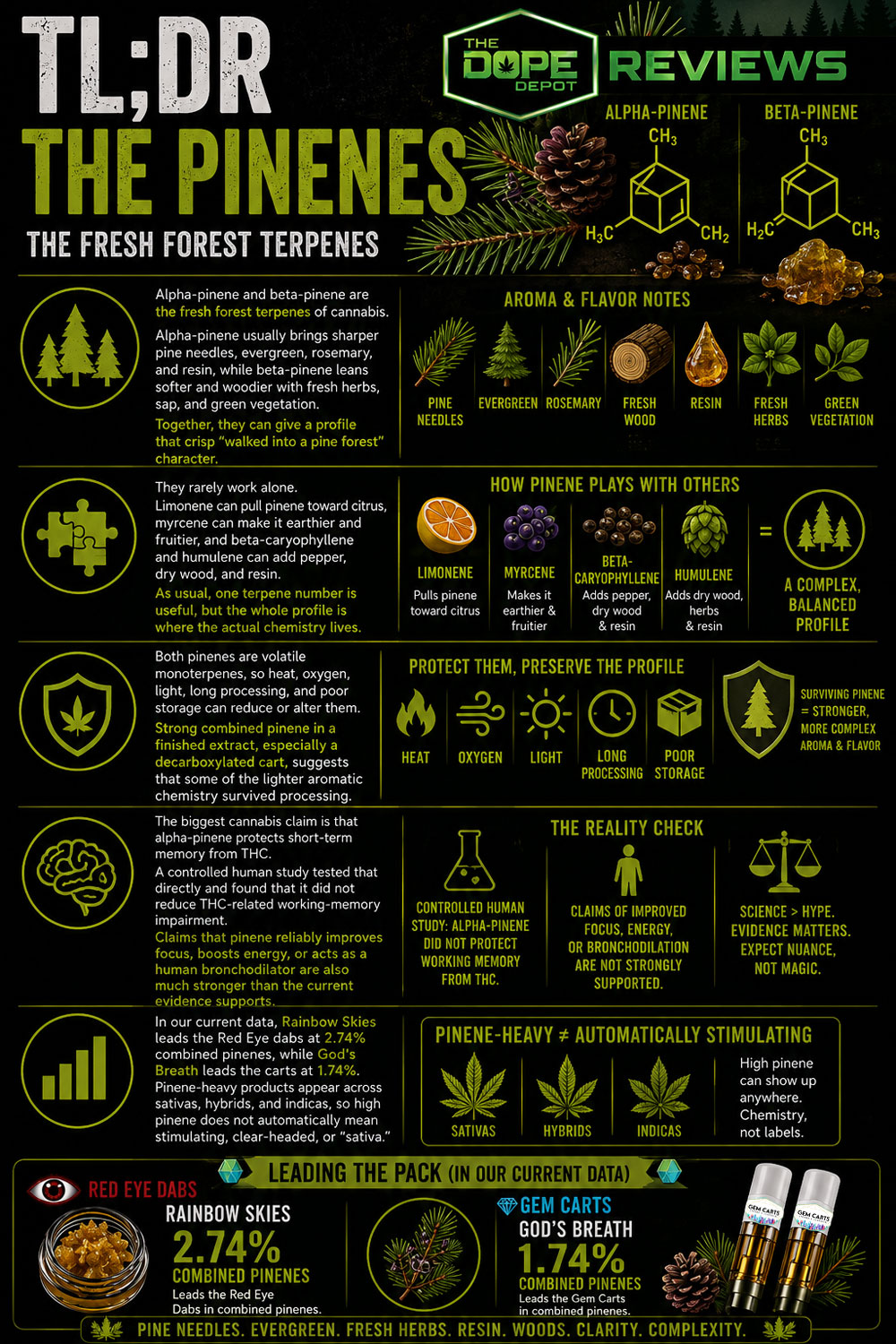
TL;DR: The Pinenes
Alpha-pinene and beta-pinene are the fresh forest terpenes of cannabis. Alpha-pinene usually brings sharper pine needles, evergreen, rosemary, and resin, while beta-pinene leans softer and woodier with fresh herbs, sap, and green vegetation. Together, they can give a profile that crisp “walked into a pine forest” character.
They rarely work alone. Limonene can pull pinene toward citrus, myrcene can make it earthier and fruitier, and beta-caryophyllene and humulene can add pepper, dry wood, and resin. As usual, one terpene number is useful, but the whole profile is where the actual chemistry lives.
Both pinenes are volatile monoterpenes, so heat, oxygen, light, long processing, and poor storage can reduce or alter them. Strong combined pinene in a finished extract, especially a decarboxylated cart, suggests that some of the lighter aromatic chemistry survived processing.
The biggest cannabis claim is that alpha-pinene protects short-term memory from THC. A controlled human study tested that directly and found that it did not reduce THC-related working-memory impairment. Claims that pinene reliably improves focus, boosts energy, or acts as a human bronchodilator are also much stronger than the current evidence supports.
In our current data, Rainbow Skies leads the Red Eye dabs at 2.74% combined pinenes, while God’s Breath leads the carts at 1.74%. Pinene-heavy products appear across sativas, hybrids, and indicas, so high pinene does not automatically mean stimulating, clear-headed, or “sativa.”
The short squirrel version:
Alpha-pinene brings the pine needles, beta-pinene brings more of the branch and green herbs, and together they add fresh forest character. They help shape the aroma, but they do not decide the whole flavor or effect by themselves.