

Podcast: Play in new window | Download (20.5MB)
The posts in this series are a pretty healthy read, so for those of you who lack the curiosity or the attention span, scroll to the end and find the TL;DR, or CLICK HERE!! Otherwise, put on your thinking caps and lets get moving!

If you don’t feel like reading, you can listen to Finn read the post to you. Download the mp3 here.
- Click here to skip to the top 5 Red Eye dab Myrcene heavy hitters.
- Click here to skip to the top 5 Gem Cart / Pocket Puffer Myrcene heavy hitters.
Myrcene: The Earthy, Fruity Heavyweight of Cannabis
Myrcene has accumulated more cannabis folklore than most molecules could reasonably carry.
It supposedly separates indicas from sativas. It causes couch lock. It makes THC hit harder. Eating a mango forty-five minutes before smoking will apparently launch you into another dimension because the fruit contains myrcene.
Somewhere, a ripe mango is exhausted from the responsibility.
Myrcene is genuinely important. It’s a common and sometimes dominant cannabis terpene that can contribute earth, musk, ripe fruit, herbs, hops, cloves, and balsamic depth. It’s also biologically active and has produced interesting results in preclinical research.
What it hasn’t done is validate every claim attached to it by dispensary menus, blogs, and the person at the party who recently learned the word “entourage.”
Let’s separate chemistry from folklore.
What Is Myrcene?
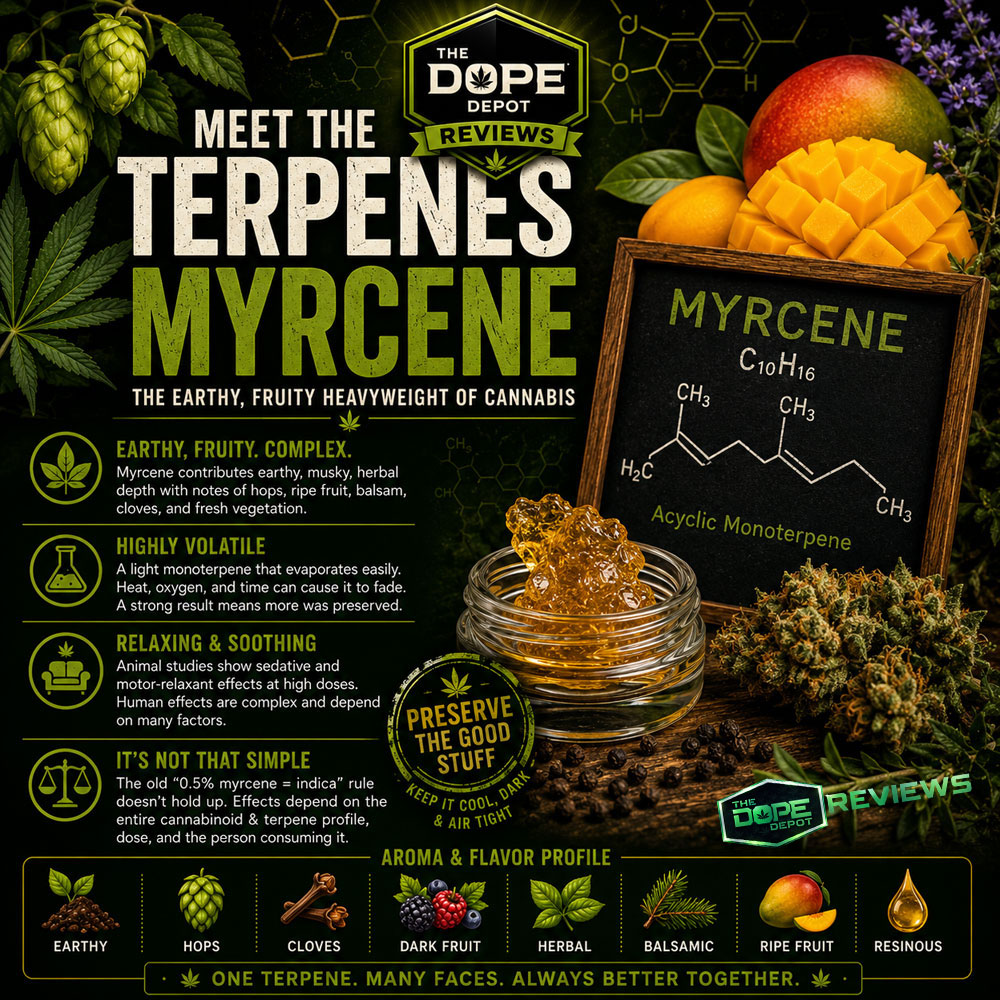
Myrcene, usually referring to beta-myrcene, is an acyclic monoterpene with the molecular formula C10H16.
“Acyclic” means its carbon structure forms an open chain rather than a ring. Limonene, by comparison, is a cyclic monoterpene. They contain the same numbers of carbon and hydrogen atoms, but those atoms are arranged differently.
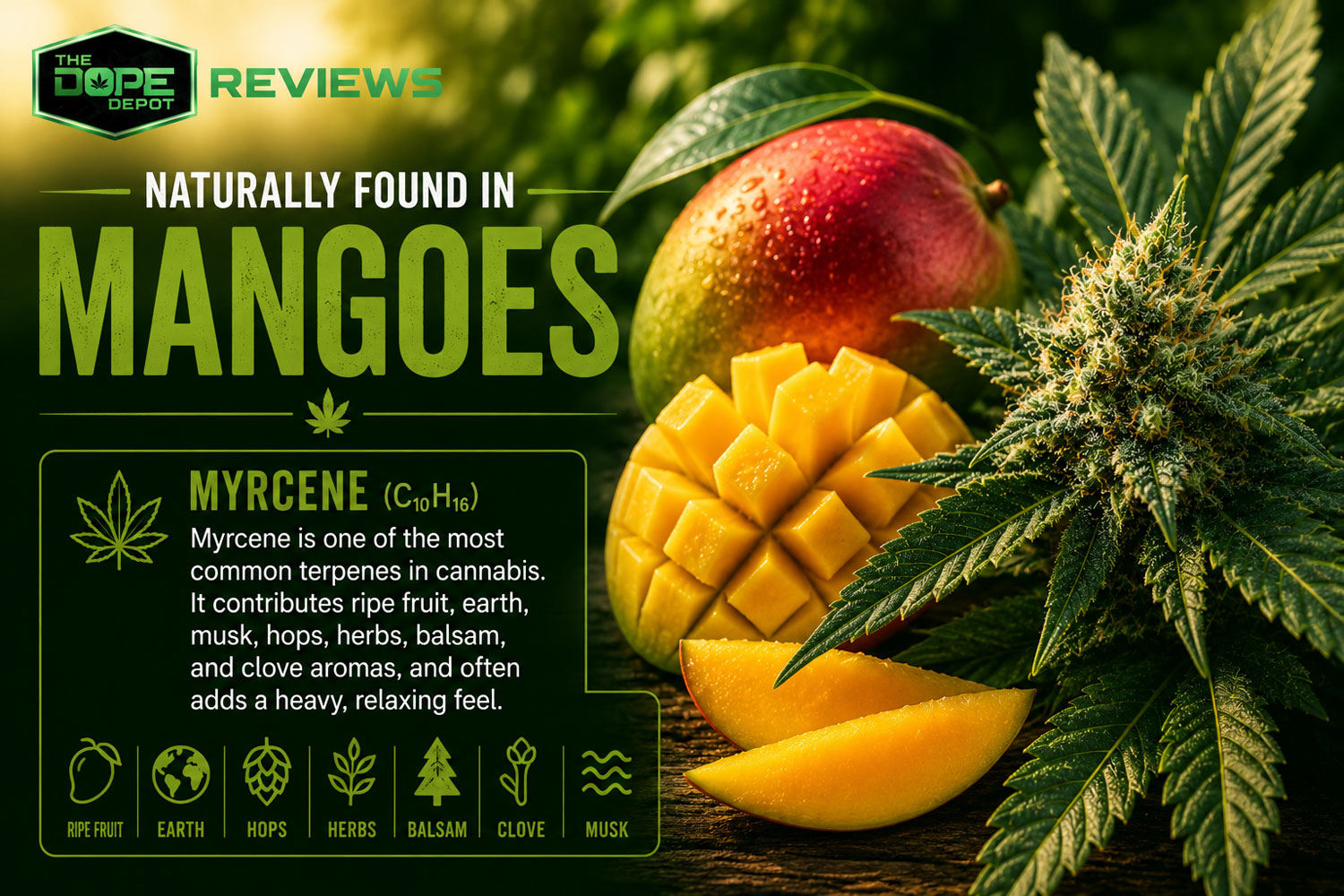
That structural difference changes how the molecules smell, react, and behave. Myrcene occurs naturally in:
- Cannabis
- Hops
- Lemongrass
- Mangoes
- Bay leaves
- Thyme
- Basil
- Cardamom
- Juniper
Its association with hops helps explain why certain beers carry musky, green, spicy, or resinous aromas that feel oddly familiar to cannabis consumers.
Myrcene also acts as an important starting material in the fragrance industry, where it can be converted into other aromatic compounds. Even outside cannabis, the molecule has found itself surrounded by people trying to make everything smell more interesting.
What Does Myrcene Smell and Taste Like?
Myrcene is frequently described as earthy or musky, but its sensory range is much broader. Depending on its concentration and surrounding chemistry, it can contribute:
- Damp earth
- Musk
- Hops
- Balsam
- Fresh herbs
- Cloves
- Ripe tropical fruit
- Dark berries
- Green vegetation
- Light pepper
- Fermented fruit
- Resin
At high concentrations, myrcene can make a profile feel heavy, dense, soft, or deeply fruity. In other combinations, it can lean herbal, green, hoppy, or almost savory. This is why myrcene-rich products don’t all smell alike.
Myrcene combined with limonene may present as brighter tropical fruit. With beta-caryophyllene and humulene, it can become earthier, woodier, and more resinous. Terpinolene may pull it toward sweet herbs and fresh fruit. Linalool can soften the profile with floral sweetness. Pinene can sharpen the edges with fresh herbs and forest air.
The word “earthy” is useful, but it has also become the terpene equivalent of describing every wine as “grapey.” Technically true. Spiritually useless.
A Volatile Monoterpene
Myrcene is a relatively light and volatile molecule. That volatility allows it to reach the nose easily, but it also makes myrcene vulnerable during harvesting, drying, extraction, purging, decarboxylation, storage, and ordinary handling.
Myrcene can be lost or altered through:
- Excessive heat
- Oxygen exposure
- Aggressive vacuum
- Extended processing
- Repeated warming
- Light exposure
- Poorly sealed packaging
- Time
It’s also chemically reactive and relatively unstable in air compared with heavier sesquiterpenes such as beta-caryophyllene.
A strong myrcene result therefore tells us something about preservation. It suggests that a meaningful portion of the lighter volatile fraction survived processing and made it into the final product. That doesn’t automatically make the extract better. It means the chemistry retained more myrcene.
Whether you enjoy what that myrcene does to the profile remains inconveniently subjective, because, you know, personal taste.
Does Myrcene Cause Couch Lock?
Myrcene-rich products are commonly associated with relaxation, sedation, body heaviness, and the mythical condition known as couch lock. There is some scientific basis for taking the idea seriously, but not enough to turn it into a reliable consumer rule.

Animal studies have found sedative and motor-relaxant effects after administering myrcene at relatively high doses. Other animal research has examined its potential effects on sleep, anxiety-like behavior, and nervous-system signaling.
Those studies are useful for identifying biological activity. They don’t establish that the amount of myrcene inhaled from an ordinary cannabis product will sedate a human. Controlled human studies isolating myrcene’s contribution to cannabis intoxication remain extremely limited.
A product containing 4% myrcene may feel heavy and relaxing. It may also contain substantial THC, beta-caryophyllene, linalool, CBN, or other compounds that contribute to the experience.
Myrcene is one variable in a crowded chemical argument. The couch may be involved, although the couch is not peer-reviewed… Yet.
The 0.5% Indica Rule
One particularly persistent claim says that cannabis containing more than 0.5% myrcene produces indica-like effects, while products below 0.5% behave more like sativas.
There is no credible universal threshold supporting that division. Our own current SKU data makes the issue obvious.
Guava Toss, Rumple Beans FF, and Pistil Punch FF are all labeled hybrids despite carrying between 2.92% and 4.18% myrcene. Grapefruit Moonshine Fresh Frozen is labeled sativa and contains 2.35%.
Traditional indica, sativa, and hybrid labels don’t map cleanly onto terpene chemistry. They can still help describe growth patterns, genetic history, marketing categories, or broad consumer expectations, but they shouldn’t be treated as laboratory conclusions.
The terpene panel contains more useful information. Which is rude of it, frankly, because the three-category system was so much easier to print on little stickers.
Does Eating Mango Make Cannabis Stronger?
Mangoes may contain myrcene. That part is true. The amount varies considerably by mango variety, ripeness, growing conditions, storage, and which part of the fruit is analyzed. Mango aroma also depends on dozens of other volatile compounds, not myrcene alone.
The popular claim goes much further. It says eating a ripe mango shortly before consuming cannabis will intensify the high, speed its onset, or make it last longer. There is no controlled human evidence demonstrating that this reliably happens.
The story is sometimes explained by claiming that myrcene helps THC cross the blood-brain barrier. That mechanism has not been established in humans at the doses someone would receive from eating a mango.
There’s nothing wrong with eating fruit before getting high. It’s probably a better snack choice than attempting to empty an entire family-size bag of Sour Patch Kids while insisting you’re going to save some for later.
Just don’t confuse a pleasant ritual with proven pharmacology. A mango can be delicious without becoming a pharmacokinetic strategy.
What Does the Research Say?
Myrcene has been studied for possible analgesic, anti-inflammatory, antioxidant, anxiolytic, sedative, gastrointestinal, and neuroprotective activity. Most supporting evidence comes from:
- Cell studies
- Mouse or rat models
- Isolated myrcene
- Essential oils
- Topical administration
- Oral or injected doses
- Concentrations far above normal cannabis exposure
Animal studies have reported reduced pain behaviors and inflammatory responses under certain conditions. Other research suggests myrcene can interact with TRPV1 channels, which participate in temperature and pain signaling.
Recent mouse research has also explored inhaled myrcene rather than relying entirely on oral or injected administration. The results suggest that exposure conditions and biological sex may influence the response.
That complication is worth remembering. Terpene research rarely produces one clean answer that applies equally to every dose, route of administration, species, and nervous system.
The honest conclusion is that myrcene is pharmacologically interesting, but its effects in ordinary human cannabis use remain under-characterized. “Promising research” and “this dab treats pain” are not interchangeable sentences.
Reading Myrcene on a Lab Sheet
The myrcene percentage tells us how much of the compound was detected. It doesn’t tell us whether myrcene dominates the profile. As usual, context matters.
A product containing 2% myrcene within a 5% total terpene profile is strongly myrcene-centered. The same 2% in a 13% profile may contain several other terpenes in equal or greater concentrations.
When reading the sheet, ask:
- How much myrcene is present?
- What percentage of the total profile does it represent?
- Is myrcene the dominant terpene?
- Which compounds surround it?
Limonene can brighten myrcene with citrus and fruit. Beta-caryophyllene and alpha-humulene can make it woodier, drier, and more resinous. Terpinolene can add sweet herbs and fresh aromatic lift. Linalool can soften it with floral sweetness. Pinene can make it greener and more herbal.
For this article, we went back about a year in the data and selected the five strongest myrcene results from the Red Eye dab sheet and the five strongest from the Gem Cart and Pocket Puffer sheet.
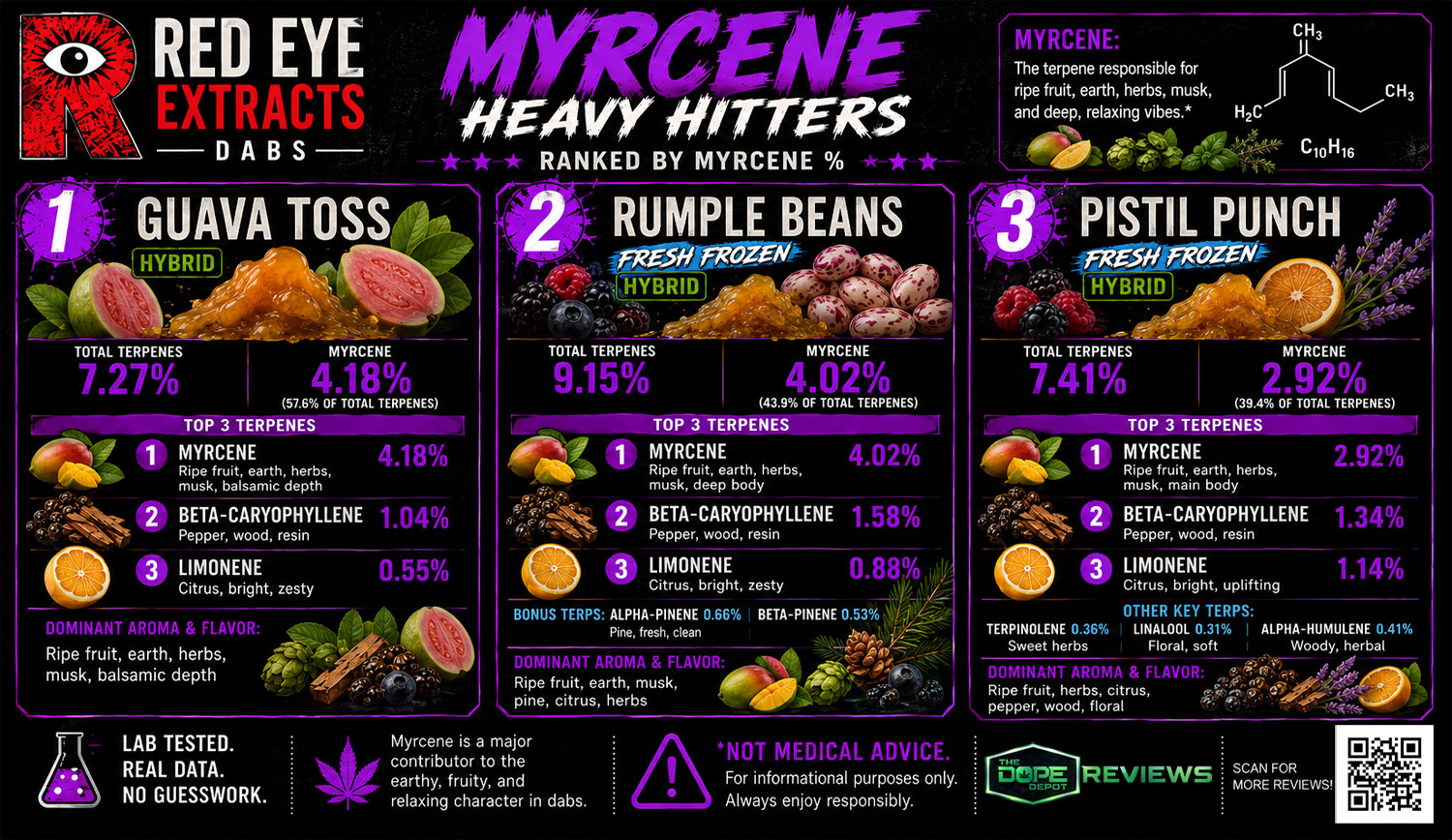
Five Red Eye Dab Myrcene Heavy Hitters
1. Guava Toss
Type: Hybrid
Total Terpenes: 7.27%
Myrcene: 4.18%
Guava Toss leads the current Red Eye group with an enormous 4.18% myrcene. That single terpene represents roughly 58% of the complete measured profile.
There’s plenty of myrcene in this jar, then some supporting terpenes standing around wondering whether they’re still needed. Beta-caryophyllene follows at 1.04%, while limonene reaches 0.55%. Beta-ocimene contributes 0.27%, with smaller amounts of humulene and linalool underneath.
The profile should be intensely centered on ripe fruit, earth, herbs, musk, and balsamic depth. Caryophyllene adds pepper and wood, while limonene and ocimene give the upper end some brighter fruit and sweetness.
This isn’t a profile where myrcene supplies background weight. Myrcene is the profile.
Check out the full review here.
2. Rumple Beans Fresh Frozen
Type: Hybrid
Total Terpenes: 9.15%
Myrcene: 4.02%
Rumple Beans is a custom blend of Pistil Pioneers fresh frozen Rumple Berry and our Pink Beans blend. At 4.02%, myrcene accounts for roughly 44% of its measured terpene content.
Beta-caryophyllene follows at 1.58%, limonene reaches 0.88%, and the profile carries unusually substantial pinene content, with alpha-pinene at 0.66% and beta-pinene at 0.53%.
That combination should produce a deep base of ripe fruit, earth, musk, and herbs, sharpened by pine and citrus. Caryophyllene adds pepper and resinous structure.
The fresh frozen input likely helped preserve the lighter pine and citrus notes that keep the heavy myrcene base from becoming dull. It’s dense chemistry with the windows cracked open.
Check out the full review here.
3. Pistil Punch Fresh Frozen
Type: Hybrid
Total Terpenes: 7.41%
Myrcene: 2.92%
Pistil Punch FF contains 2.92% myrcene, representing roughly 39% of its total measured terpene content.
Beta-caryophyllene follows at 1.34%, with limonene close behind at 1.14%. Terpinolene reaches 0.36%, linalool sits at 0.31%, and alpha-humulene contributes 0.41%. This should create a more balanced profile than Guava Toss.
Myrcene still supplies the main body through fruit, earth, herbs, and musk. Limonene brightens the profile, caryophyllene and humulene add pepper and wood, while terpinolene and linalool contribute sweet herbs and floral softness.
The result should feel broad rather than purely heavy. Myrcene may be steering, but several other molecules are loudly offering directions from the back seat.
Check out the full review here.
4. Grapefruit Moonshine Fresh Frozen
Type: Sativa
Total Terpenes: 11.40%
Myrcene: 2.35%
Our award-winning Grapefruit Moonshine fresh frozen carries 2.35% myrcene. That’s a substantial raw concentration, but it represents only about 21% of the total terpene profile because this extract contains an enormous 4.64% terpinolene.
Beta-caryophyllene follows at 1.35%, with pinene, limonene, ocimene, and several other monoterpenes contributing additional detail. Here, myrcene provides ripe fruit, herbal depth, and weight underneath a much brighter terpinolene-dominant profile.
Terpinolene pushes toward sweet citrus, flowers, fresh herbs, and pine. Myrcene prevents that brightness from feeling thin, giving the profile more fruit and body underneath. This is an important distinction.
Grapefruit Moonshine is high in myrcene, but it isn’t myrcene-dominant. Raw concentration and proportional dominance are two different measurements.
Check out the full review here.
5. Grease Bucket
Type: Indica
Total Terpenes: 7.35%
Myrcene: 2.18%
Grease Bucket rounds out the current Red Eye top five with 2.18% myrcene. That represents nearly 30% of the measured terpene profile.
Limonene sits close behind at 1.92%, while beta-caryophyllene reaches 1.36%. Alpha-humulene contributes 0.50%, and the combined pinenes add another 0.40%. This is much more balanced than Guava Toss or Rumple Beans FF.
Myrcene leads with ripe fruit, earth, herbs, musk, and weight, but limonene is high enough to bring serious citrus brightness. Beta-caryophyllene and humulene add pepper, dry wood, herbs, and resin, while the pinenes sharpen the upper end slightly.
Grease Bucket is high in myrcene, but it shouldn’t feel like a one-note myrcene wall. It has weight, brightness, pepper, and a little green lift. The name says grease. The chemistry brought a surprisingly organized toolbox.
Check out the full review here.
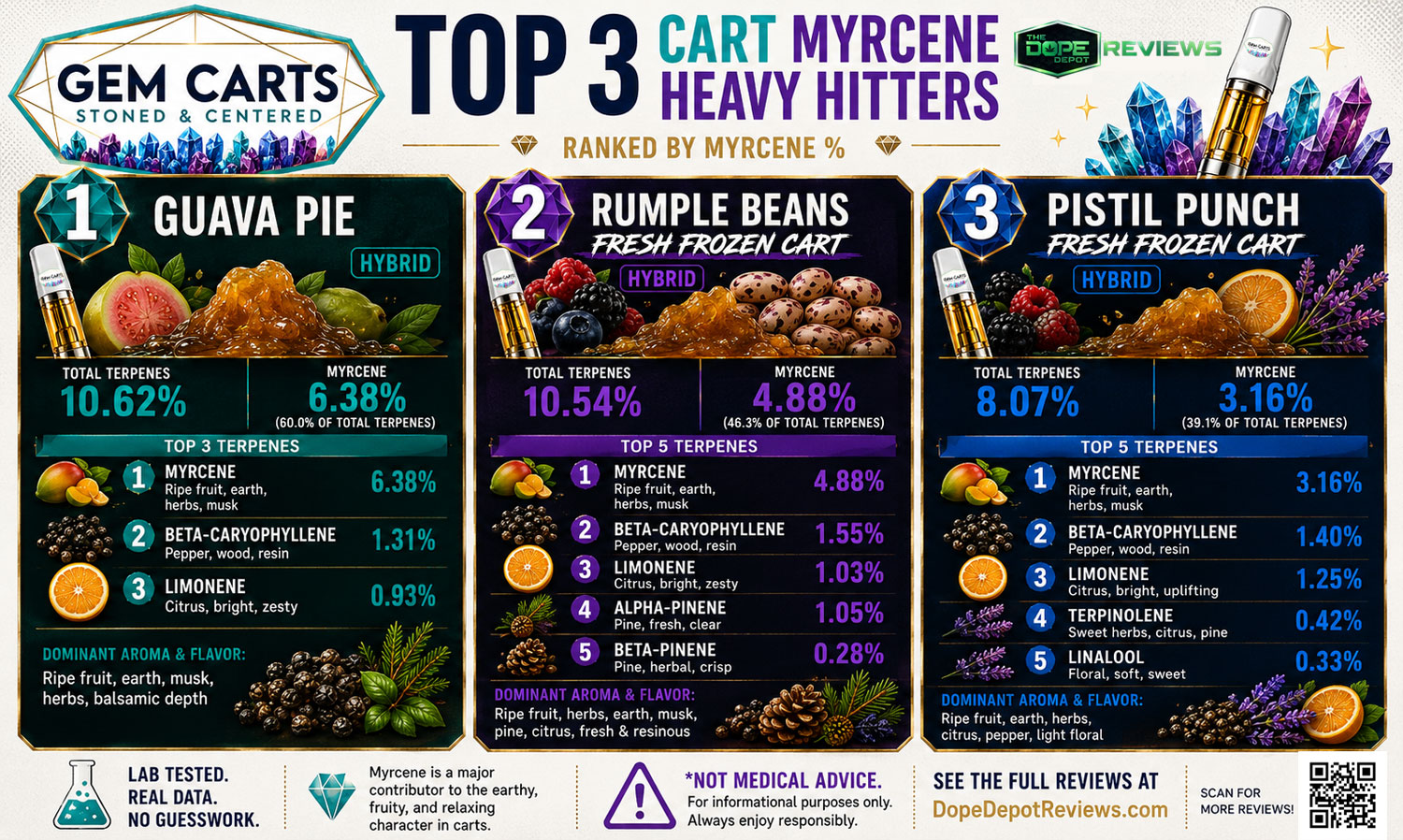
Five Cart Myrcene Heavy Hitters
1. Guava Pie
Type: Hybrid
Total Terpenes: 10.62%
Myrcene: 6.38%
Guava Pie doesn’t merely lead the current carts. At 6.38% myrcene, it launches itself into another category entirely.
Myrcene represents roughly 60% of the entire measured terpene profile. Beta-caryophyllene is a distant second at 1.31%, followed by limonene at 0.93% and beta-ocimene at 0.47%. This is an extraordinarily concentrated myrcene profile built around ripe fruit, earth, musk, herbs, and dense balsamic depth.
Limonene and ocimene should provide some brighter sweet fruit, while caryophyllene and humulene add pepper, resin, and dry wood. Still, there’s no serious debate over who owns the profile. At 6.38%, myrcene has purchased the property outright and is currently raising the rent.
Check out the full review here.
2. Rumple Beans Fresh Frozen Cart
Type: Hybrid
Total Terpenes: 10.54%
Myrcene: 4.88%
The Rumple Beans FF cart contains 4.88% myrcene, accounting for more than 46% of its total measured terpene content. That’s notably higher than the 4.02% found in the dab version.
The cart also carries 1.55% beta-caryophyllene, 1.03% limonene, and an impressive 1.05% alpha-pinene. Beta-pinene reaches 0.28%.
This creates an unusually aromatic myrcene profile. The base should be heavy with ripe fruit, herbs, earth, and musk, but the substantial pinene and limonene concentrations give it a sharper, fresher top end.
The dab and cart preserve the same broad arrangement, but the cart pushes myrcene and alpha-pinene even further forward. Decarboxylation didn’t erase the original profile. It apparently gave a few molecules better seats.
Check out the full review here.
3. Pistil Punch Fresh Frozen Cart
Type: Hybrid
Total Terpenes: 8.07%
Myrcene: 3.16%
Pistil Punch FF contains 3.16% myrcene in cart form, representing roughly 39% of the total measured terpene profile. The remaining structure closely resembles the dab: beta-caryophyllene reaches 1.40%, limonene sits at 1.25%, terpinolene contributes 0.42%, and linalool reaches 0.33%.
The dab contains 2.92% myrcene, meaning the cart tests slightly higher while retaining essentially the same proportional role. This should produce ripe fruit and earthy herbal depth, balanced against citrus, pepper, light flowers, and sweet aromatic freshness.
The similarity between formats is exactly what we want to see. Different cannabinoid chemistry, recognizable terpene architecture. A cartridge should taste like the extract it came from, not like the concept of fruit explained over a bad telephone connection.
Check out the full review here.
4. Banana Puddin’ Fresh Frozen
Type: Indica
Total Terpenes: 9.07%
Myrcene: 3.10%
Our fresh frozen Banana Puddin’ carries 3.10% myrcene, accounting for a little over 34% of its complete terpene profile.
Beta-caryophyllene follows at 2.21%, while limonene reaches 1.32%. Alpha-humulene contributes 0.73%, and linalool adds 0.34%.
This is another profile where myrcene leads without operating alone. Myrcene should provide ripe fruit, earth, herbs, and body. Limonene brings citrus brightness, caryophyllene and humulene add pepper and wood, while linalool supplies floral softness.
That combination should feel fuller and more structured than a simple sweet banana profile. The name says pudding. The chemistry brought fruit, pepper, citrus, flowers, herbs, and lumber. Apparently nobody coordinated the catering.
Check out the full review here.
5. Grapefruit Moonshine Fresh Frozen V1
Type: Sativa
Total Terpenes: 12.89%
Myrcene: 2.59%
The first fresh frozen Grapefruit Moonshine cart batch contains 2.59% myrcene within an enormous 12.89% total terpene profile. Myrcene represents about 20% of the measured total.
Terpinolene dominates at 5.36%, followed by myrcene and beta-caryophyllene at 1.43%. Limonene, pinene, ocimene, and several other lighter terpenes complete the profile.
As with the dab, myrcene isn’t the main aromatic driver. Its role is to add ripe fruit, herbs, earth, and weight underneath the exceptionally bright terpinolene structure.
This is one of the clearest examples of why ranking products by one terpene requires context. At 2.59%, Grapefruit Moonshine FF contains more myrcene than most extracts will ever see. It still isn’t primarily a myrcene profile. The jar contains enough chemistry for multiple departments.
Check out the full review here.
What These Ten Products Show Us
The first obvious pattern is that myrcene can dominate a profile more completely than many other common terpenes. Guava Toss, Guava Pie, and both Rumple Beans FF products contain more than 40% of their measured terpene content as myrcene. Guava Pie passes 60%. At those ratios, myrcene isn’t simply adding depth. It becomes the main aromatic framework.
The second pattern is that high myrcene isn’t limited to indicas. Guava Toss, Rumple Beans FF, and Pistil Punch FF are labeled hybrids. Grapefruit Moonshine FF is labeled sativa. Grease Bucket and Banana Puddin’ FF are indicas. The data refuses to support a simple rule connecting myrcene concentration to traditional cannabis categories.
Third, fresh frozen products appear throughout the list. Rumple Beans FF, Pistil Punch FF, Banana Puddin’ FF, and Grapefruit Moonshine FF all retain substantial myrcene concentrations. That fits what we’d expect from rapid freezing and low-temperature extraction designed to preserve volatile monoterpenes.
Finally, the dab and cart comparisons are remarkably consistent. Rumple Beans FF rises from 4.02% myrcene in the dab to 4.88% in the cart. Pistil Punch moves from 2.92% to 3.16%. Grapefruit Moonshine shifts from 2.35% in the dab to 2.59% in the first cart batch.
These aren’t identical products after decarboxylation, but their broad terpene architecture survives. That’s measurable evidence of preservation rather than a paragraph of branding copy insisting something tastes “premium.”
The data sheets also give us a useful contrast between dominance and balance. Guava Toss and Guava Pie are myrcene showcases. Grease Bucket and Banana Puddin’ FF are myrcene-leading profiles with much stronger supporting chemistry from limonene, caryophyllene, humulene, and linalool.
Same featured terpene. Different architecture. This is why the full panel matters.
The Lab Rat Verdict
Myrcene is one of cannabis chemistry’s major sources of weight. It can contribute ripe fruit, earth, musk, herbs, hops, cloves, and balsamic depth. As a volatile monoterpene, it can also be easily lost or altered through heat, oxygen exposure, time, and careless processing.
Its biological activity makes it scientifically interesting. Animal and laboratory studies justify further research into sedation, pain signaling, inflammation, and other pathways. They don’t establish that myrcene reliably causes couch lock, separates indicas from sativas, or allows a mango to modify cannabis intoxication on command.
The myrcene percentage tells you how much of the molecule survived. The complete terpene profile tells you what it’s doing there. The human or lab rat consuming it remains the least predictable variable in the experiment. Naturally, that variable is also the one most likely to write a confident review after taking a heroic dab and forgetting where they left their phone.
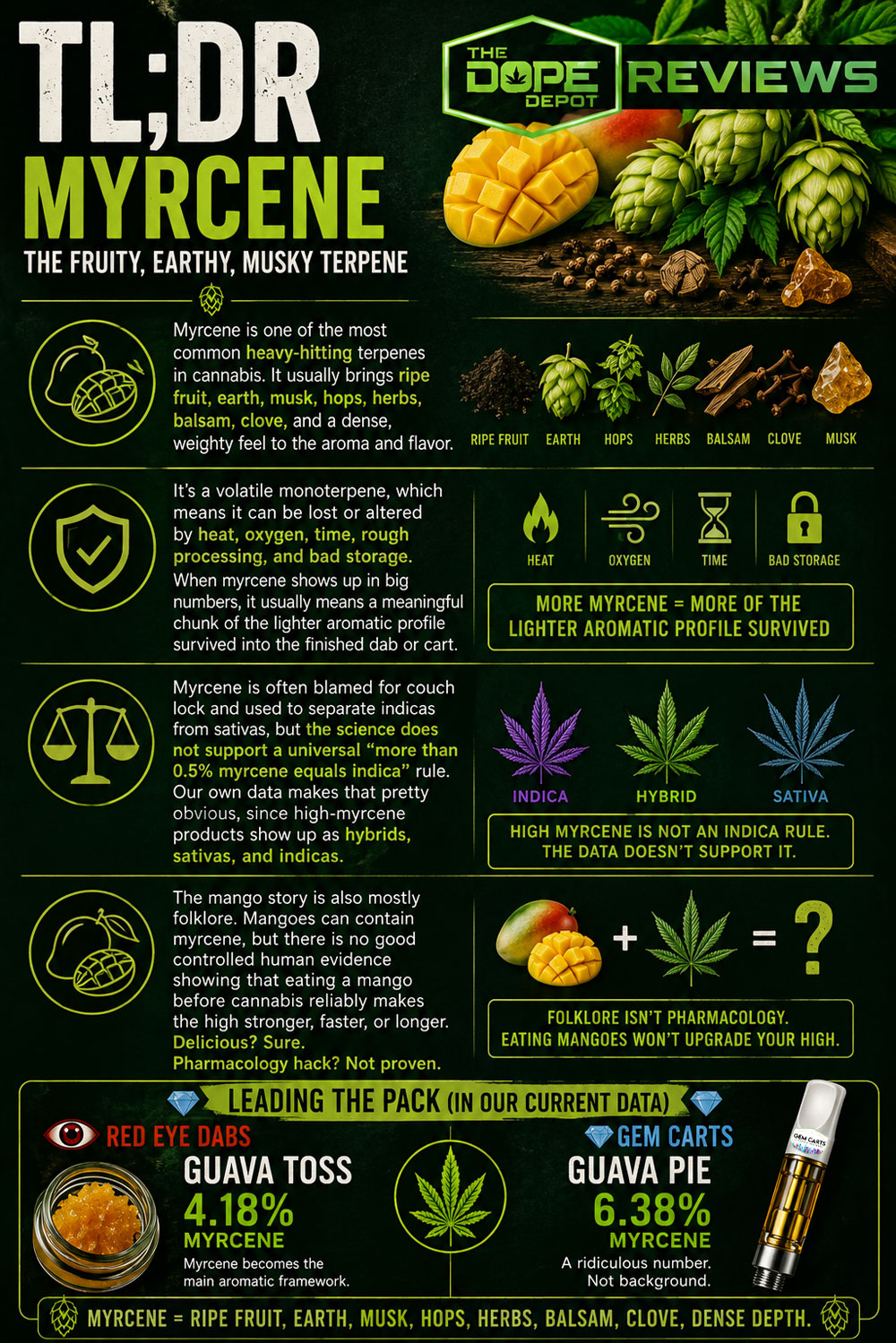
TL;DR: Myrcene
Myrcene is one of the most common heavy-hitting terpenes in cannabis. It usually brings ripe fruit, earth, musk, hops, herbs, balsam, clove, and a dense, weighty feel to the aroma and flavor.
It’s a volatile monoterpene, which means it can be lost or altered by heat, oxygen, time, rough processing, and bad storage. When myrcene shows up in big numbers, it usually means a meaningful chunk of the lighter aromatic profile survived into the finished dab or cart.
Myrcene is often blamed for couch lock and used to separate indicas from sativas, but the science does not support a universal “more than 0.5% myrcene equals indica” rule. Our own data makes that pretty obvious, since high-myrcene products show up as hybrids, sativas, and indicas.
The mango story is also mostly folklore. Mangoes can contain myrcene, but there is no good controlled human evidence showing that eating a mango before cannabis reliably makes the high stronger, faster, or longer. Delicious? Sure. Pharmacology hack? Not proven.
In our current data, Guava Toss leads the Red Eye Dabs at 4.18% myrcene, while Guava Pie leads the carts at a ridiculous 6.38%. Those are not background numbers. In products like that, myrcene becomes the main aromatic framework.
The short squirrel version:
Myrcene gives cannabis fruit, earth, musk, herbs, and weight. It can make a profile feel deeper and heavier, but it does not automatically cause couch lock, define indica effects, or turn mangoes into cannabis rocket fuel.