
Podcast: Play in new window | Download (Duration: 22:09 — 16.5MB)
What Actually Makes Cannabis Smell Like Cannabis?
This post is a fairly healthy read, so for those of you who lack the curiosity or the attention span, scroll to the end and find the TL;DR, or CLICK HERE!! Otherwise, put on your thinking caps and lets get going!
If you don’t feel like reading, you can listen to Finn read the post to you. Download the mp3 here or tap the play button!
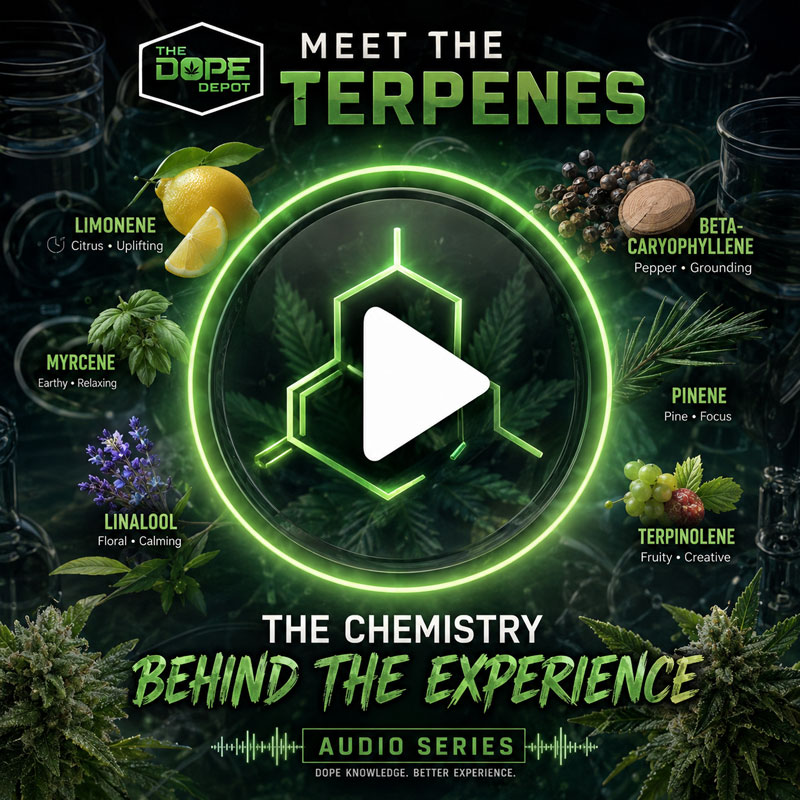
We need to talk about terpenes.
Again.
Except this time we’re going to talk about all the things that aren’t terpenes.
After spending an entire Meet the Terpenes series digging through beta-caryophyllene, limonene, myrcene, humulene, terpinolene, linalool, the pinenes, and beta-ocimene, you might reasonably assume we’ve covered the complete chemistry behind cannabis aroma.
We have not.

Don’t get me wrong, terpenes are certainly one of the more important parts of cannabis smell. They help build the pine, citrus, floral, herbal, woody, peppery, and earthy character we recognize across different cannabis products. They’re also among the most abundant volatile compounds found in cannabis, which is one reason laboratories test for them and cannabis companies love putting them on labels.
But here’s the problem.
Cannabis can smell like ripe mangoes. Grapefruit candy. Gasoline. Garlic. Cheese. Strawberries. Burnt rubber. Tropical fruit. Cream. Onions. Fresh-cut grass. Cat piss. A mechanic’s shop. You’ll even occasionally get something that smells like somebody stored fruit salad inside an old gym shoe.
Trying to explain all of that with myrcene, limonene, caryophyllene, and friends has never worked particularly well, and increasingly, cannabis aroma research is showing us why.
The Terpene Panel Isn’t the Whole Aroma
When we look at an SC Labs PhytoFacts sheet here at Dope Depot Reviews, we’re getting an incredibly useful snapshot of the extract.
We can see the cannabinoids, major terpenes, and how those compounds are distributed. That lets us compare products, recognize patterns, and understand some of the chemical structure behind what we’re smelling and tasting.
But it does not mean we’re looking at every aromatic compound in the extract.
Researchers have identified a much broader collection of volatile compounds in cannabis, including esters, aldehydes, alcohols, ketones, sulfur-containing compounds, heterocyclic compounds, and plenty of other molecules that don’t conveniently fit onto the terpene panel printed on the package.
A 2025 review of cannabis aroma research describes the plant’s sensory profile as the product of numerous volatile and nonvolatile compounds rather than terpenes alone.
That’s an important distinction. A terpene test tells us which terpenes were measured and how much of each was detected. It doesn’t tell us:
“This is everything responsible for how this cannabis extract or bud smells.”
Those are two very different statements.
What Exactly Is a Volatile Compound?
Before we descend farther into chemistry hell, we should probably establish some vocabulary.
A volatile organic compound, usually shortened to VOC, is basically an organic chemical that can readily enter the air under ordinary conditions. That’s important because smelling something requires molecules to reach the receptors in your nose.
When you open a jar of fresh cannabis or crack open a container of live resin and immediately get punched in the face by grapefruit, pine, gas, berries, garlic, or whatever other nonsense the plant has cooked up, you’re detecting volatile molecules escaping from that material and entering the air.
Terpenes are VOCs. But terpenes are only one family of VOCs. Cannabis produces a considerably larger chemical cast of characters. Some members apparently only needed three seconds of screen time to steal the entire show.
Meet the Volatile Sulfur Compounds
This is where things get particularly interesting. For years, the unmistakable skunky character of cannabis was frequently attributed to terpenes. You’ll still find plenty of terpene charts attempting to explain essentially every cannabis smell using the same handful of compounds.
Recent research has complicated that story considerably.
In 2021, researchers used advanced two-dimensional gas chromatography to investigate some of the compounds behind cannabis’s characteristic skunky aroma. They identified a family of prenylated volatile sulfur compounds, or VSCs, associated with that pungent smell. One particularly important compound is 3-methyl-2-butene-1-thiol, sometimes abbreviated 321MBT.
If “thiol” sounds vaguely familiar, there’s a reason. Thiols are sulfur-containing compounds, and members of this chemical family are responsible for some extremely powerful odors throughout nature. Skunk spray isn’t a terpene problem either. Sulfur chemistry is very good at making itself everyone else’s problem.
What makes these compounds especially important isn’t necessarily how much of them exists, it’s how little we may need before we can smell them.
The Biggest Number Doesn’t Always Have the Biggest Nose
This may be the most important concept in this entire post. We’re accustomed to reading cannabis laboratory results from the top down.
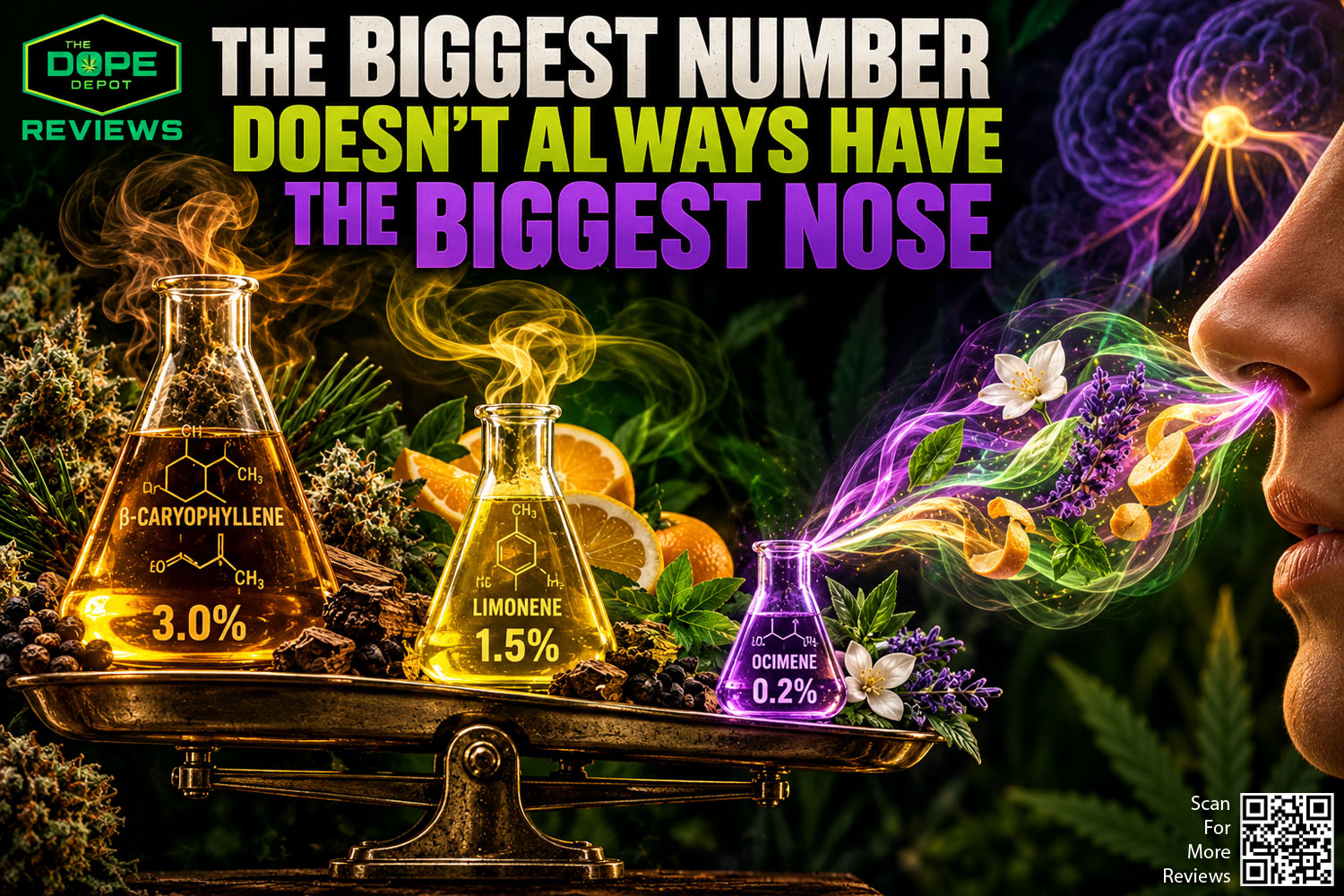
If beta-caryophyllene is 3% and limonene is 1.5%, while another compound is present at a tiny fraction of a percent, our instinct is to assume the 3% compound must be vastly more important to the aroma.
That isn’t quite how smell works.
Every aromatic molecule has something called an odor threshold, which is essentially the concentration at which humans can begin detecting its smell.
Some molecules require relatively large concentrations before our noses care about them. Others can be detected at extremely low concentrations. That means a compound present in tiny quantities can potentially make a disproportionate contribution to the overall aroma.
Researchers studying cannabis odor have demonstrated exactly this problem. Chemical abundance alone doesn’t reliably predict odor impact. Some lower-concentration compounds can have stronger sensory effects than more abundant compounds.
This gives us a useful rule for reading cannabis chemistry: Concentration tells us how much is there. It doesn’t automatically tell us how much our nose cares.
That distinction becomes very important once we start looking beyond terpenes.
Why Does Some Cannabis Smell Like Fruit?
Now lets get into another chemical family that most people encounter every day without realizing it. They’re called esters.
Esters are a broad group of compounds found throughout nature, and many are strongly associated with fruity aromas. Bananas, apples, pineapples, strawberries, pears, and other fruits owe parts of their characteristic aroma to various combinations of esters and other volatile compounds.
Recent cannabis research has identified minor nonterpenoid compounds, including esters, that appear to help distinguish aroma profiles even when the major terpene profiles look surprisingly similar. In studies of cannabis and hemp, certain esters have been associated with fruity and citrus sensory characteristics.
That doesn’t mean we can smell one of our extracts and declare, “Ah yes, ethyl hexanoate. Obviously.”
Please don’t become that person.
Without testing specifically for these compounds, we don’t know which esters are present in a particular Red Eye dab or Gem Cart, much less their exact concentrations.
What we can say is that fruit aroma in cannabis doesn’t have to come exclusively from something like limonene or myrcene. There may be an entire layer of aromatic chemistry underneath the standard terpene panel.
Before we continue, this seems like a good spot to let you all know that SC Labs does test for a lot more terpenes than what you see on the PhytoFact sheets. The PhytoFacts just show the main ones everyone should be familiar with by now.
Would you like to see the complete test results? If you click on any review that’s published on Dope Depot Reviews, then click on the PhytoFact sheet to open it in a new page, make it full size and you’ll see a qr code in the upper right. Simply scan that with your phone, and it’ll take you to the full test panel. There you’ll see the complete test results, which offer a lot more information than what’s displayed on the PhytoFacts.
We dive into some of these on the Grape Grove Gem Cart and Red Eye dab review.
Now back to our regularly scheduled program.
Sulfur Can Smell Fruity Too
If you were getting comfortable with the idea that sulfur equals skunk and esters equal fruit, chemistry would like you to kindly refrain from doing that.
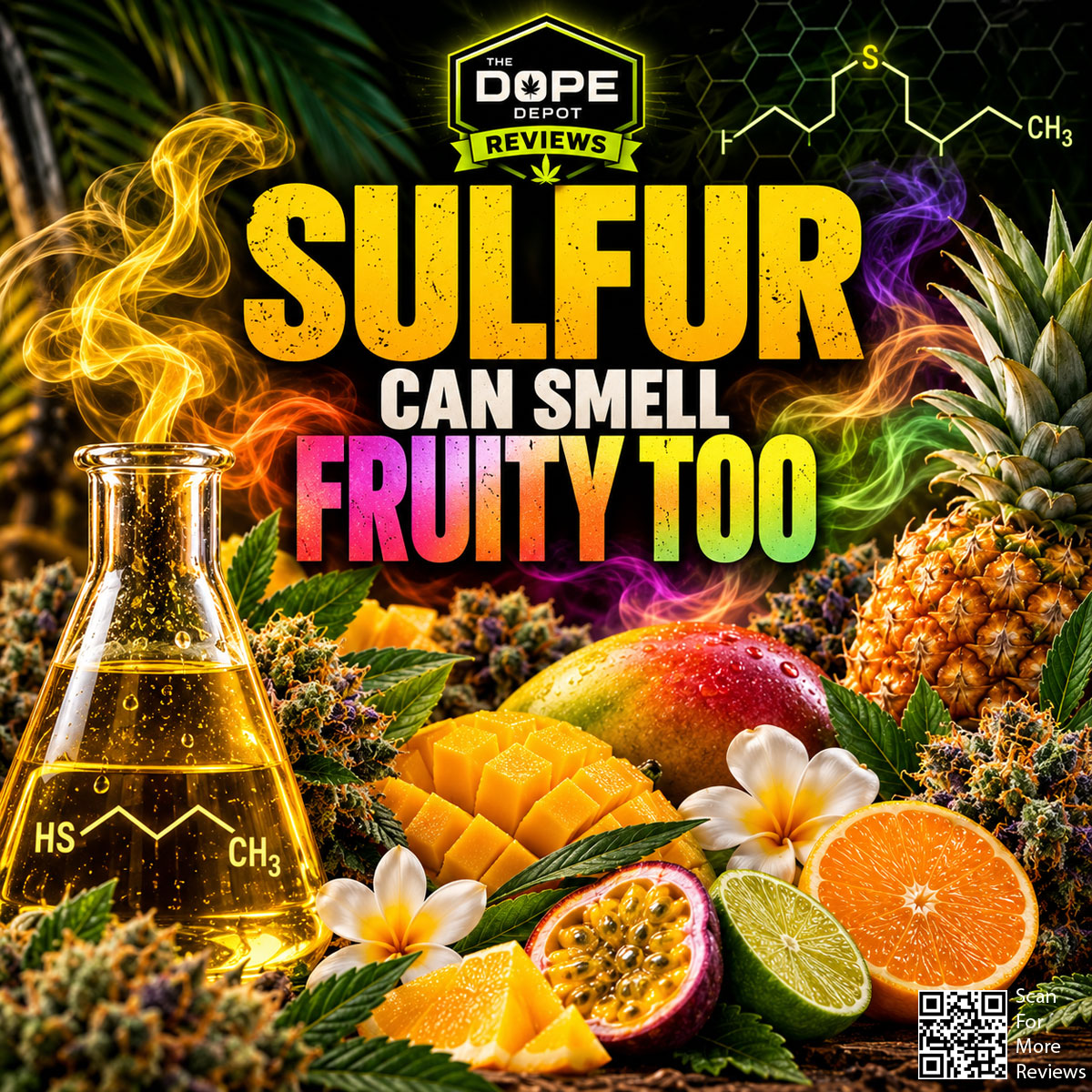
Research published in 2023 examined cannabis varieties with very different aromas despite having relatively similar terpene profiles. Researchers identified a class of sulfur-containing compounds with a 3-mercaptohexyl functional group associated with strong citrus and tropical-fruit characteristics in some samples.
That means sulfur chemistry isn’t limited to skunk, garlic, or rotten eggs. Under the right molecular circumstances, sulfur-containing compounds can help create aromas we interpret as tropical, citrusy, or fruity. Anyone up for a little Tropicanna Sulfur? Yes please!
This is one reason assigning one smell to one chemical can become misleading very quickly. Cannabis aroma isn’t a box of crayons where limonene is yellow, myrcene is purple, and caryophyllene is blue. It’s a mixture. Change the molecules, their concentrations, their ratios, or what they’re interacting with and the sensory result can change.
Aldehydes, Alcohols, and Ketones Join the Party
There are several other families worth introducing without turning this article into Organic Chemistry 201.
Aldehydes occur throughout plant chemistry and can contribute aromas ranging from green and grassy to citrusy, fatty, floral, or sweet depending on the individual compound.
Alcohols are another enormous chemical family. Some volatile alcohols contribute green, floral, fruity, mushroom-like, or herbaceous characteristics in plants and foods.
Ketones can contribute another range of aromas, depending again on the specific molecule and its concentration.
The important part isn’t memorizing the functional groups. We’re not studying for a test. The important part is realizing how many different chemical routes can eventually lead to something your brain interprets as:
“That smells like fruit.”
Or:
“That smells like gas.”
Or:
“Why does this weed smell like parmesan cheese?”
Aroma descriptors are sensory shorthand. They’re how our brains interpret an enormously complicated chemical signal.
And Then There’s Skatole
As if cannabis chemistry wasn’t weird enough already.
That same study we discussed earlier that examined “exotic” cannabis aromas identified skatole, also known as 3-methylindole, as an important contributor to the aroma of some savory or chemically scented varieties.
Skatole has a fascinating reputation in aroma chemistry because its sensory character can change dramatically with concentration and context.
This is another useful reminder that aroma isn’t simply about whether a compound exists. How much of that molecule or compound is present matters. What else is present matters, and how all of those signals reach the nose together matters. The molecule doesn’t come with a label telling your brain what it’s supposed to smell like.
Why Similar Terpene Tests Can Smell Completely Different
This brings us back to something we’ve repeatedly noticed while reviewing extracts. Sometimes the terpene numbers suggest one thing and our nose says something considerably more complicated.
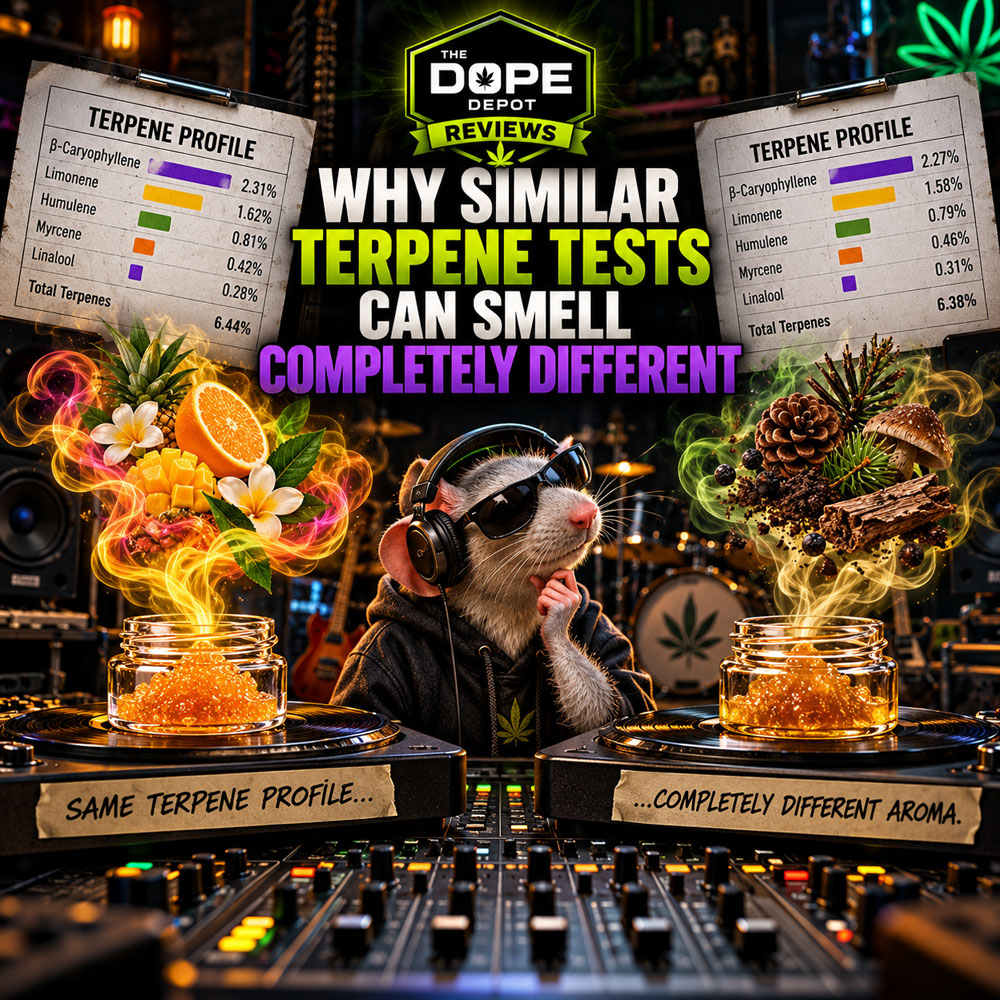
Two products might both be dominated by beta-caryophyllene, limonene, and humulene. On paper, they can look remarkably similar. Open the jars and one might lean sweet and fruity while the other goes earthy, savory, or funky. That doesn’t mean the terpene test is wrong. It means we’re asking the terpene test a question it wasn’t designed to answer.
Recent analytical research has found cannabis samples with broadly similar major-terpene profiles but noticeably different sensory characteristics. When researchers examined minor nonterpenoid compounds, those differences became more apparent.
That’s a pretty significant finding. It suggests that the major terpene profile may describe part of the aromatic architecture without necessarily explaining the details that make one cultivar or extract smell completely different from another.
Think of the terpene panel as the rhythm section. It’s providing structure. But there’s other shit happening in the mix.
This Is Why We Smell and Taste the Extract
This is also why us lab rats here at Dope Depot Reviews have never been particularly interested in replacing sensory evaluation with a spreadsheet. As we like to say, “The nose knows.”
I love the numbers. Give a lab rat a PhytoFacts sheet and we’ll happily stare at it far longer than any well-adjusted adult should. But the numbers and the nose answer different questions. The laboratory report tells us what was measured. Our senses tell us what the complete mixture actually smells and tastes like.
If a product contains a lot of beta-caryophyllene, that’s real information. If it contains a lot of limonene, that’s real information too.
But if we smell that product and get berry jam, garlic, cream, tropical fruit, fuel, cheese, or some strange combination of all six, we shouldn’t force those observations into whatever three terpenes happen to be highest on the test.
Sometimes the chemistry responsible may simply be outside the panel we’re looking at.
Extraction Makes This Even More Interesting
Now we get to the part that’s particularly relevant here in the lab.
We’re dealing with hydrocarbon extracts to create live resin, cured resin, and decarbed resin for carts. Every step between living plant and finished product creates an opportunity for volatile chemistry to change or be lost forever.
Harvesting changes the plant. Drying changes it. Curing changes it. Extraction selectively moves compounds from one material into another. Heat can drive off or transform volatile molecules. Oxygen can promote oxidation.
Storage conditions matter, as well as good old fashioned time. Even compounds present at the beginning aren’t guaranteed to survive processing in exactly the same proportions. Research into cannabis aroma increasingly emphasizes genetics, cultivation, post-harvest handling, processing, and storage as factors capable of influencing the final volatile profile.
That means aroma preservation isn’t simply:
“Did we save the terpenes?”
A better question might eventually be:
“How much of the plant’s original volatile chemistry survived?”
That’s a much harder thing to measure. It’s also much closer to what we’re trying to accomplish when making flavorful extracts for our Red Eye dabs, Gem Carts, and Pocket Puffers.
What Our PhytoFacts Sheets Can and Can’t Tell Us
None of this makes our SC Labs PhytoFacts sheets less valuable. If anything, understanding its limits makes the information more useful. Our reports give us cannabinoid and terpene data we can use to compare products and identify meaningful patterns.

What they don’t give us is a complete aroma reconstruction, even when viewing the complete lab sheet beyond the PhytoFacts by scanning the qr code on each sheet.
The test results we get back from SC Labs we’re using for these reviews don’t report every ester, aldehyde, alcohol, ketone, volatile sulfur compound, heterocycle, or trace odorant potentially contributing to the sensory experience.
So when we compare a lab report with what we’re actually smelling, we need to remember that we’re looking through a particular analytical window. There’s a lot happening outside the frame.
So Are Terpenes Overrated?
No. Most certainly not, and after spending an entire series writing about them, I’d be a sad panda if that were the conclusion.
Terpenes remain major components of cannabis volatile chemistry. Their concentrations vary substantially among products, and they clearly contribute to aroma.
The mistake is going from:
“Terpenes contribute to cannabis aroma.”
to:
“Terpenes explain cannabis aroma.”
Those aren’t the same claim. The emerging research doesn’t make terpenes irrelevant. In my humble lab rat opinion, I think it makes the chemistry a lot more interesting.
Terpenes are part of an aromatic system that can also contain sulfur compounds, esters, aldehydes, alcohols, ketones, heterocycles, and other trace compounds, all appearing in different concentrations and interacting with human sensory perception.
Which, inconveniently, means the real answer is more complicated than the terpene wheel hanging on the wall.
The Lab Rat Takeaway
After spending months meeting the terpenes, this feels like the appropriate next step. We learned what beta-caryophyllene can contribute. We learned about limonene, myrcene, humulene, terpinolene, linalool, pinene, and ocimene.
Those compounds have been, and always will be important. But now we can put them into a larger context. When you smell a cannabis extract, you’re not smelling a terpene chart. You’re smelling a chemical mixture. Some of those molecules may be abundant. Some may exist only in trace amounts. Some are included on the lab report, while others are not.
A molecule doesn’t need to dominate the test results to dominate your nose. That’s probably the biggest lesson here. The terpene panel isn’t wrong.
It’s incomplete.
To me, that’s a hell of a lot more interesting because now when we open a jar that smells like grapefruit, garlic, gasoline, berries, cheese, flowers, or some unholy combination thereof, instead of trying to make three familiar terpenes explain everything, we have a better answer.
There’s more chemistry in that jar than we’re currently measuring. A lot more chemistry that takes us Beyond Terpenes.
As an aside, if you want to learn more about how the human body deals with tastes and smells, a favorite author of mine, Mary Roach, wrote a book about it called Gulp: Adventures on the Alimentary Canal. I highly recommend it if you like to nerd out on this sort of stuff like I do.
TL;DR: Beyond Terpenes
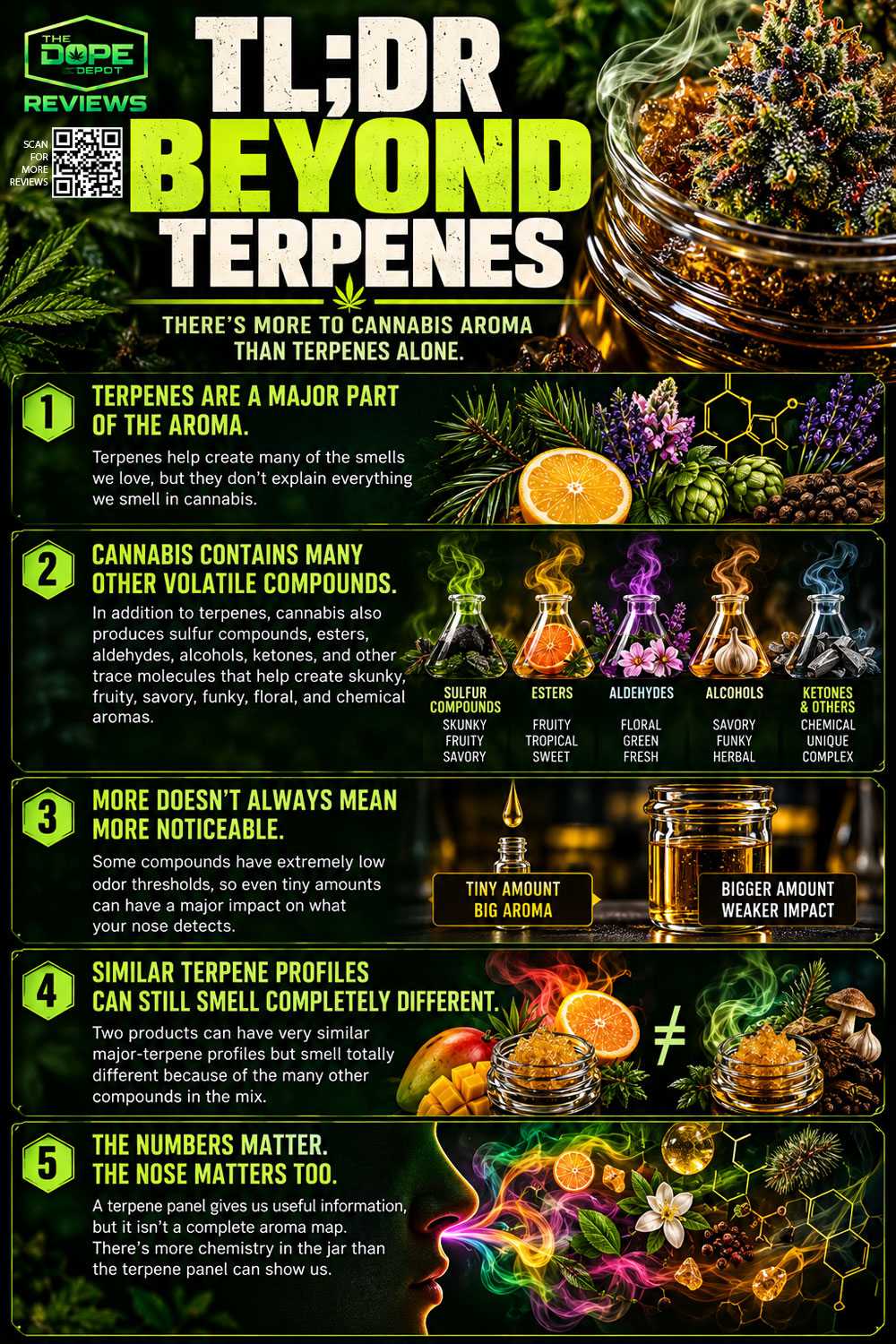
Terpenes are a major part of cannabis aroma, but they don’t explain everything we smell. Cannabis also contains other volatile compounds, including sulfur compounds, esters, aldehydes, alcohols, ketones, and other trace molecules that can help create skunky, fruity, savory, funky, floral, and chemical aromas.
The important part is that more doesn’t always mean more noticeable. Some compounds have extremely low odor thresholds, so even tiny amounts can have a major impact on what your nose detects.
That’s why two products with very similar terpene profiles can still smell completely different. A terpene panel gives us useful information, but it isn’t a complete aroma map.
The numbers matter. The nose matters too. There’s more chemistry in the jar than the terpene panel can show us.